


Thristapar (Þrístapar) is a group of three small hills (freely translated Þrístapar just means three hills) located between fields in northwest Iceland. It is Thristapar that is the site of the last execution in Iceland. On January 12, 1830, an axe severed the heads of Agnes Magnusdottir and Friðrik Sigurðsson, who – along with several other people – had been convicted of the murder of Natan Ketilsson and Petur Jonsson two years earlier.
The people behind Iceland’s last execution
Natan Ketilsson, born in 1792, lost his father young and was raised by his mother. He picked up a knowledge of homeopathy in Copenhagen and treated patients across the districts of Hunavatn and Skagafjörður. He also had a bad reputation: he was held to be dishonest and dangerous, and he came by the farm of Illugastadir by refusing to treat a sick farmer unless the man handed over the land in exchange.
Agnes Magnusdottir, born in 1795, grew up in the countryside as the child of unmarried servants. She was thought clever, could both read and write, and had worked as a maidservant on several farms before Natan hired her at Illugastadir – she was over thirty by then, and the accounts differ on whether she and Natan were lovers. Fridrik Sigurðsson came from Katadalur, a farm on the same peninsula, and was eighteen. Petur Jonsson was only staying at Illugastadir, himself awaiting judgment in a case of killing another man’s sheep.
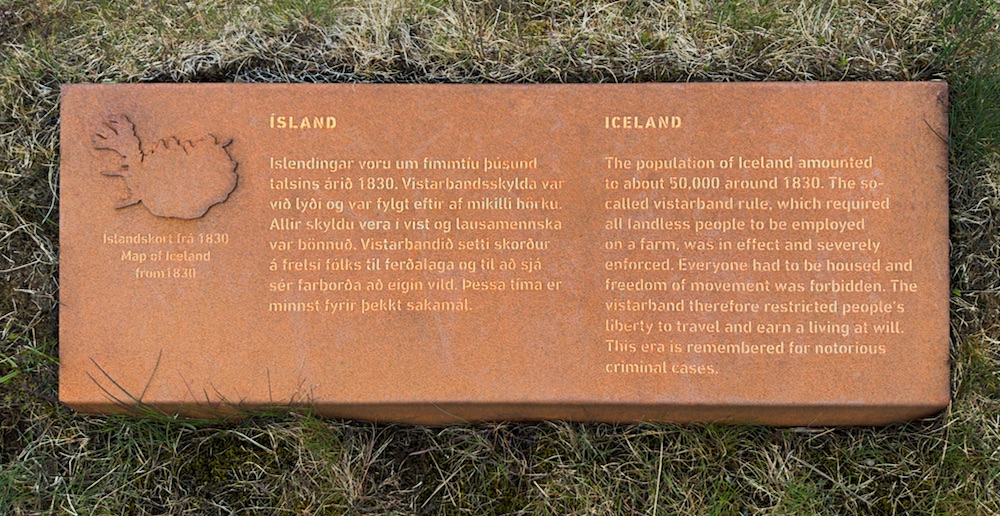
One of the plaques along the path: Iceland as it was in 1830
The execution and what followed
The axe was swung by Gudmundur Ketilsson, the murdered man’s own brother, and farmers from across the district were ordered to attend and forbidden to look away. The bodies were buried where they fell and the heads set on stakes as a warning. More people were convicted than the two who died here: sixteen-year-old Sigridur Gudmundsdottir, who also lived at Illugastadir, was sentenced to death but pardoned by the king because of her age and sent to hard labor instead, and Fridrik’s mother, Thorbjorg Halldorsdottir, got five years in a Copenhagen prison for plotting the killings with her son and urging him on.
The graves stayed on the hillside for over a century. In 1934 the remains of Agnes and Fridrik were dug up, and on June 17 of the same year they were reburied in the churchyard of Tjarnarkirkja on the Vatnsnes peninsula. A memorial stone marks the execution site, and at the far end of the path an axe of rust-brown steel stands with its blade sunk into a long stone block. It is an art installation, not a relic – the axe and the block that were really used here are kept at the National Museum of Iceland in Reykjavik.
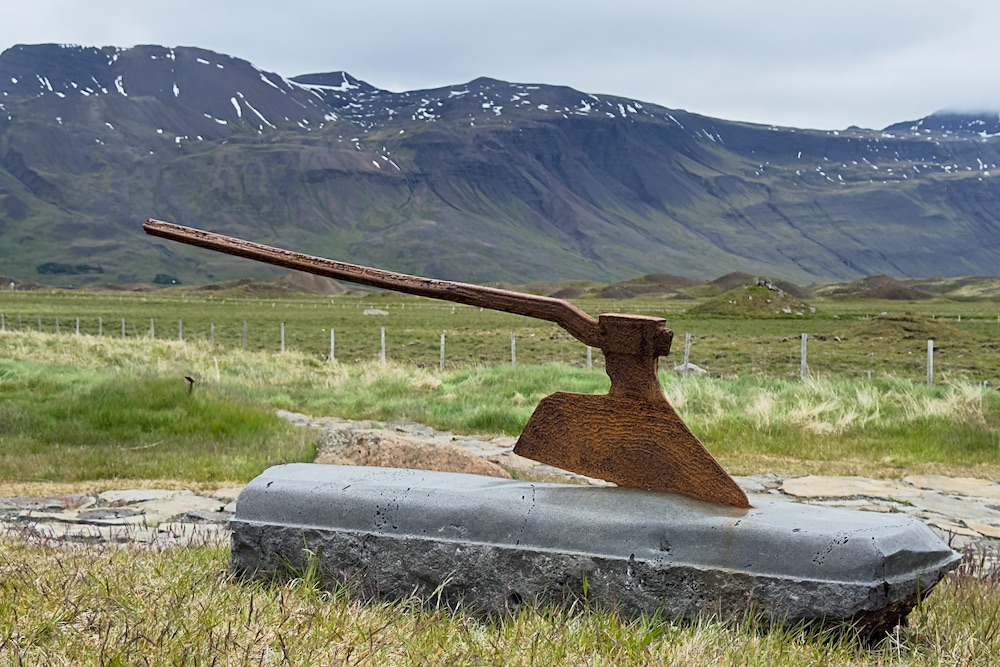
The axe sunk into the stone slab, with the mountains above Vatnsdalur behind
The case has kept writers busy ever since: Gisli Konradsson wrote it up in the 19th century, Þorgeir Þorgeirsson turned it into the novel Yfirvaldið (The Authority) in 1973, and Gudlaugur Gudmundsson called his book Let no-one look away. Outside Iceland the story is best known from Hannah Kent’s novel Burial Rites, told from Agnes’ side; passages from books like these are quoted on the boards along the path.
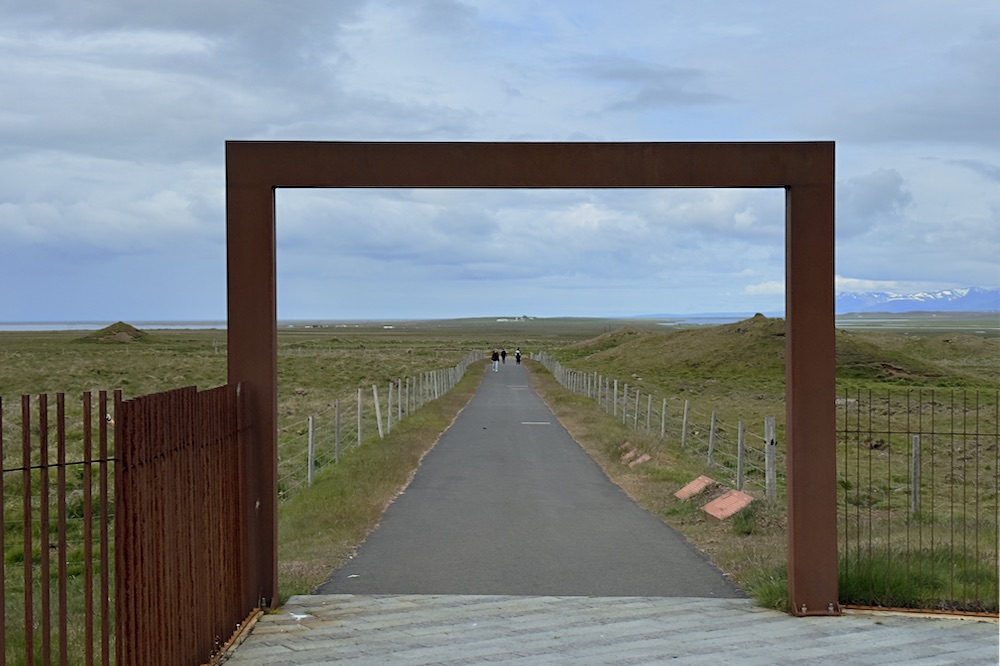
The steel frame marking the start of the path
How to get to Thristapar
Thristapar is located just off Highway 1, in northwestern Iceland, on the north side of the road at the western end of the Vatnsdalsholar hills, southeast of Lake Hóp, in the municipality of Húnabyggð. From Reykjavik it is about 225 km (140 miles), roughly three and a half hours of driving; from Blönduós only some 20 km (12 miles). The parking lot sits by the road and the execution site is about 200 m (650 ft) away, so count on a short walk with a beautiful view of the surrounding hills.
Two more stops of the same kind are close by: the natural basalt fortress of Borgarvirki, about 25 km (15 miles) west, and the basalt columns of Kalfshamarsvik, about 65 km (40 miles) north on the Skagi peninsula. The same road out onto Vatnsnes leads to the rock Hvitserkur, to Tjarnarkirkja and past Illugastadir itself.