


Glaumbaer (Glaumbær) is a restored turf farm with two wooden houses, showing what life in Iceland looked like in the 18th and 19th centuries. The buildings serve as a museum and stand in Skagafjörður, in northern Iceland.
Turf buildings typical of 19th-century Iceland
The farm’s turf buildings date from the 18th and 19th centuries. What makes them special is the building style used on the island until about 1900: the rooms at Glaumbær are timber-framed, separated from one another and insulated by thick turf walls, and roofed with a thick layer of the same material. Turf was used in the first place because of the shortage of large trees. In later years it gradually gave way to reinforced concrete, the material of most modern Icelandic buildings.
The farm was inhabited until 1947 and opened to visitors in 1952. It is the first open-air museum of its kind in Iceland. The turf farmhouse belongs to the Historic Building Collection of the National Museum of Iceland, and the museum itself is run by the Skagafjörður Heritage Museum (Byggðasafn Skagfirðinga), which also looks after the turf church at Víðimýri.
Guest rooms, kitchen and… relaxation area
Building large, spacious turf houses is not easy. That’s why Icelandic 19th-century farms are complexes of small, separate buildings – Glaumbær consists of thirteen of them, joined together.
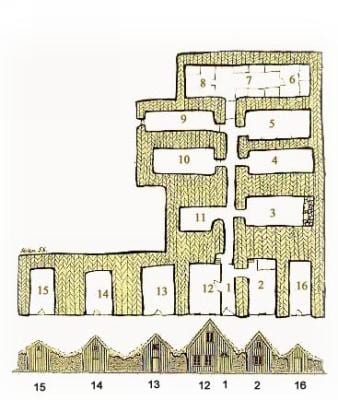
Plan of the Glaumbaer open-air museum.
source: glaumbaer.is
Glaumbaer consists of:
- north room,
- kitchen,
- north pantry,
- the “Gusa” guest room,
- relaxation area,
- pantry,
- dairy,
- south room,
- two utility cells.
The corridor is about 21 meters (70 ft) long and gives access to 9 of the farm’s 13 rooms. Two pairs of doors along the corridor keep the cold out of the living quarters.
Gilsstofa and Áshús
The museum grounds also include two wooden houses – the gray Gilsstofa and the yellow Áshús.
Gilsstofa was built in 1849 at Espihóll and was moved five times before being re-erected at Glaumbær in 1996-1997; in 1876 it hosted what is believed to be the oldest known theater performance in Iceland. Inside there is a museum exhibition, an information center and a gift shop.
Áshús was built between 1883 and 1886 at Ás in Hegranes and moved here in 1991; its style draws on the traditional Icelandic turf-roofed houses. Áshús is home to exhibitions and the Áshús Café (Áskaffi).
Glaumbaer – tips and practical information
The farm provides the backdrop for exhibitions that focus on the rural life of Icelanders in the 18th and 19th centuries.
The oldest parts of the turf house (the kitchen and the pantry) date from the mid-18th century, while the newest rooms were added between 1876 and 1879.
About 150 meters (500 ft) away, archaeologists discovered the ruins of a Viking Age longhouse and several other buildings dating from the 10th to 11th centuries. To see what such a farm may have looked like, visit Eiriksstadir in West Iceland or Stöng and the Commonwealth Farm in the Þjórsárdalur valley.
For up-to-date information, contact details and more, see the museum’s website: glaumbaer.is.
The Áskaffi Café
The café in the Áshús building gives museum visitors the chance to taste homemade refreshments the way housewives used to serve them: pastries, cakes, coffee and hot chocolate, plus a few lunch dishes.
In season 2026 the café is open daily from 10 a.m. to 5 p.m. from May 20 to August 31 and daily from 10 a.m. to 4 p.m. from September 1 to 20; in May and in late September it opens on weekdays only, and from October to April by appointment (source: the Áshús Café page).
Opening hours
You can visit Glaumbaer (season 2026, source: glaumbaer.is):
- May 20 to September 20 – daily from 10 a.m. to 6 p.m.;
- April 1 to May 19 and September 21 to October 20 – weekdays from 10 a.m. to 4 p.m.;
- October 21 to March 31 – by appointment (on weekdays between 10 a.m. and 4 p.m. you can also try ringing the bell, but booking ahead is recommended).
Ticket prices
Admission (prices 2026; from 2027 the museum has announced 2,400 and 2,000 ISK, about $20 and $17):
- adults (18+): 2,200 ISK – about $18;
- children and teenagers (0-17): free of charge;
- groups (6+), students and seniors: 1,900 ISK per person – about $16.
How to get to Glaumbaer
The Glaumbaer farm and museum lies on Road 75, about 7 km (4 miles) north of the junction with Route 1, in the rather unspectacular north-central part of the island.
If you’re driving along Route 1 and stop at the well-known turf church Vidimyrarkirkja (looked after by the same museum), it’s worth the short detour to Glaumbær as well to see more of this traditional architecture.
Alternatively, you can see similar, though perhaps slightly less “polished” buildings (but more of them, and more varied) at the Árbær open-air museum in Reykjavik – see its description in the article Top Museums to Visit in Reykjavik.