


Wind in Iceland is a real danger, and one that is routinely underestimated because nobody expects it. Strong gusts tear the doors off inattentive tourists’ cars, and combined with volcanic grit they will ruin paint and windshields.
Sparse public transport and attractions scattered across the whole island push most visitors to get around Iceland by car. What the roads are like, what the local habits are, which of the rules will surprise you, and how much the fines actually cost — it is all in the guide below.
Road conditions in Iceland
Iceland is a calm, safe country, and its roads are much the same. With the exceptions described below, they are well-maintained asphalt. Their one awkward feature is that they have no shoulders, so stopping anywhere outside a marked parking area or pull-off is difficult.
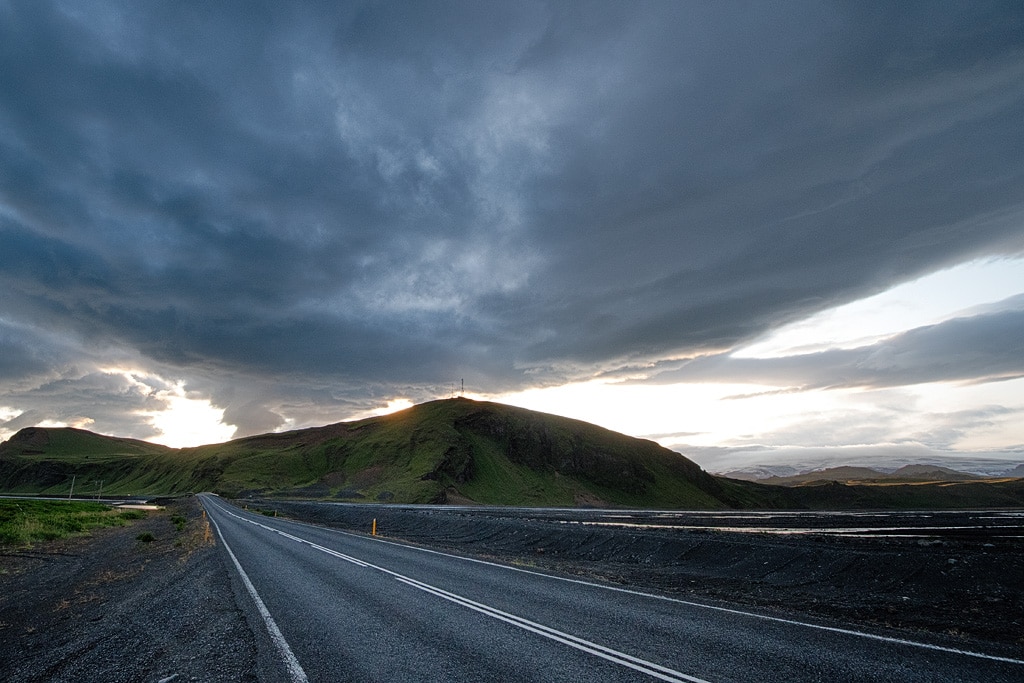
In the most popular part of the island — the southwest — gas stations, stores and campsites sit genuinely close together, usually no more than about 20 km (12 mi) apart.
Elsewhere in Iceland, as long as you stay near Route 1 or on Snaefellsnes, driving is easy for most of the year and gas stations come often enough. Do note, though, that out here they are frequently unstaffed self-service pumps — card only — with no store attached. You will not buy a hot dog there, nor spare wiper blades, nor a gas canister. For those you have to reach the nearest town.
A clearly separate category is the so-called mountain roads, marked not only with a number but with an F in front of it — F910, for instance. These are routes meant for off-road vehicles, and we come back to what that means later in the article.
Winter conditions
Out of season, through the long Icelandic winter from October to April, the main hazard is snow. The local proverb that if you don’t like the weather you should wait five minutes is an exaggeration, but a day really can start warm and sunny and end cloudy, wet or white.
Iceland’s road crews are very well equipped for bad weather, yet after a serious blizzard it can still take them a day or two to clear a road. So in winter you should always be ready for snow to cut you off for a while.
One hazard deserves its own name: black ice. It is a thin film of fresh ice that forms when snow lying on asphalt melts and freezes again. It can be almost perfectly transparent, so the road looks dry and clean when it is nothing of the sort.
Video: Prepare your car for winter in Iceland.
Winter in Iceland can be beautiful, but you have to drive far more carefully then — and, among other things, far more slowly than in summer.
Summer conditions
From spring to autumn the changeable weather has little effect on road conditions. What does have an effect — seriously so — is the wind.
Wind in Iceland is a real danger, and one that is routinely underestimated because nobody expects it. Strong gusts tear the doors off inattentive tourists’ cars, and combined with volcanic grit they will ruin paint and windshields.
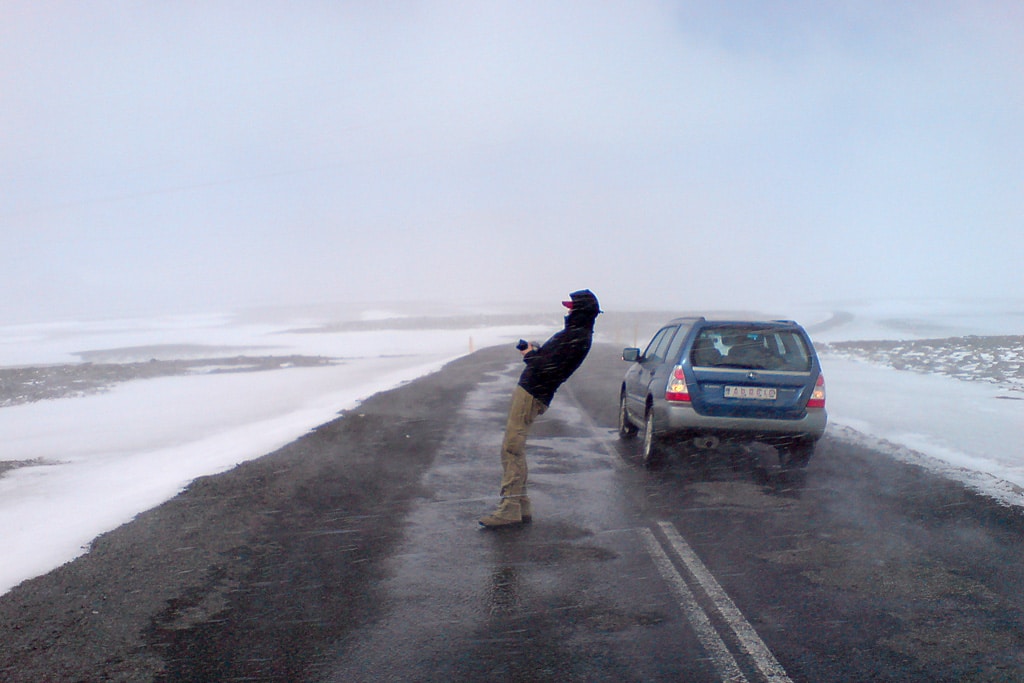
Ordinary road conditions in May
A door torn off by the wind is not an everyday event, but it happens. And no insurance covers it — it is treated as contributory damage — so the repair comes out of your own pocket. Watch for this.
Anyone driving a large motorhome or towing a caravan has to watch crosswinds constantly. A car being blown over is unlikely, but being pushed sideways is not — either into the middle of the road or off it. If it is howling, wait it out in the nearest parking area.
A rarer hazard is local flooding from glacial melt, and cracked pavement after tectonic tremors. When any of that genuinely threatens safety, the road authority reroutes traffic onto detours quickly and, in extreme cases, closes the section altogether. Day to day it is not something to worry about.
If you will be driving the main roads often, and especially if you plan to use the mountain roads, keep checking conditions at road.is.
Conditions on Iceland’s mountain roads
Iceland’s highlands — the interior — are reachable almost exclusively by mountain roads, the category marked with an extra F: F910, F88 and the like. Next to Alpine roads they look distinctly unmountainous; the elevations are modest and there are no great hairpins or viaducts over chasms. They still make real demands on both car and driver.

Road F347 seen from Hveradalir (Kerlingarfjoll)

Mountain road opening dates. [source: road.is]
Above all, these roads are not cleared of snow. They are therefore open and passable in summer only, usually from mid-June to mid-September. The exception is the specially built vehicles with hugely raised suspension and snow tires — the “super jeeps” — which will go anywhere at any time.
The current state of every road, including whether it is open at all, is published live by the Icelandic road authority at road.is. Passability runs from easily passable, through mountain vehicles and difficult, to impassable and closed.
Icelandic mountain roads are mostly gravel. The exception is stretches laid over relatively fresh lava crust, where you drive on rock rather than gravel — numerous sections of the F910, for example. They are usually narrow, with plenty of twisting and steep sections, which among other things makes passing difficult anywhere except at a proper pull-out. Steep climbs are common. If you have to stop on one of them on gravel — because a 4×4 bus is coming the other way — getting moving again uphill can defeat a car without four-wheel drive.
By custom, on a steep climb the car going up has priority: the one coming down stops at the widest available spot and lets the climber through. If a large bus or a 4×4 truck is coming down, though, give way even when you are the one climbing.
Where you can, don’t start up a steep section at all if you can see someone already on it coming the other way.
The trademark of Iceland’s mountain roads is the ford — a stream crossing with no bridge and no raised causeway. We come to those in detail in a moment.
Snow can fall on Iceland’s mountain roads in the middle of summer. Factor that in when you plan a route.
Because of where they run, there is virtually no infrastructure along the mountain roads. No gas stations, no stores, no restaurants. Parking areas, campsites and huts are sparse, and remember that you may not pull off the road to stop. Much of the interior has no cell coverage either. There are also far fewer tourists and cars out here — most of the time the road is yours alone.
All of which makes driving the mountain roads a wonderful part of getting to know Iceland, and a distinctly riskier one than circling the island on asphalt.
One consolation is how easy the navigation is on most of these routes. With minor exceptions the roads are clearly defined and well signposted, and junctions are rare and equally clearly marked. Satellite navigation is practically unnecessary; you can find your way almost as you would in a city, with the simplest map and instructions like “second left, then first right”… 🙂
Crossing streams in Iceland
Probably the most distinctive feature of Iceland’s mountain roads is that many of them cross local streams without a bridge, through fords. Most of those fords are shallow — wade one on foot and the water would rarely reach your knees. Only a few are almost always deep and dangerous: above all those on the F88, the road to Askja, and the crossings of the Krossa river on the F249 in Thorsmork. The ford at the entrance to the campsite in Landmannalaugar is often quite deep too.
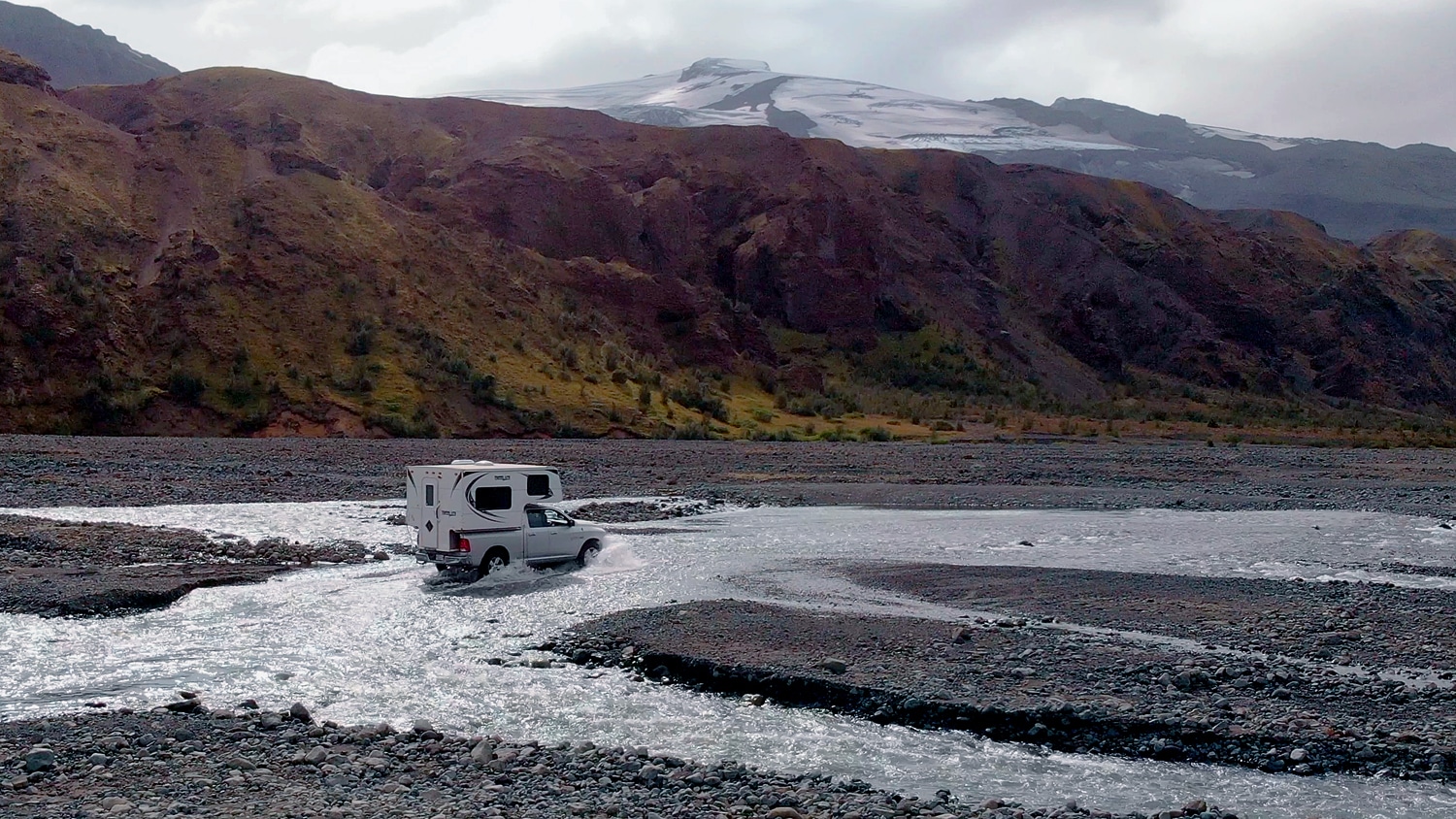
Car crossing the stream at Thorsmork – F249
Never take a ford lightly. The danger is the water and the soft bottom alike — and damage from flooding or drowning the vehicle is excluded from every insurance policy there is. If it goes wrong, the towing, the clean-up or the whole car comes out of your own pocket.
How much water is in a stream at any given moment depends heavily on recent rain and on temperature, since warm weather melts the glaciers harder. A ford that was shallow in the morning can be deep by afternoon. Tire tracks going in and coming out are no guarantee that you will get through as well.
On top of that — and this matters most for smaller cars — the hazard is not only the water but the uncertain bottom. Loose, quicksand-like material can turn out to be a trap with no way out, and large stones, though rare, will happily damage something under the car. If you are not sure you will make it, get out and wade the ford, checking the depth and how firm the bottom is. If you still don’t know after that, then: turn back, or wait for someone who might pull you out…
Let’s not go to the other extreme either. As a rule, if the bottom is firm, there are no hidden boulders in it, and you remember your low-range gearbox and your diff lock, water no higher than the top of your wheels should not be a problem. Above the axle line, exercise serious caution. In practice even the most common off-road rental in Iceland — the Dacia Duster — handles the vast majority of F roads without trouble. And the Duster is hardly a true off-roader.
If you intend to drive the mountain roads and have no off-road experience, consider even a one-day off-road course before you travel. Make sure it spends less time on sand and definitely covers the basics of crossing water.
Icelandic rental companies often forbid taking a two-wheel-drive car onto gravel roads at all. Rent a motorhome, for instance, and you are probably contractually stuck on asphalt. Even with a 4×4, insurance may be void on certain roads, and if you drive them anyway you do so at your own risk — see below.
Rules and fines – in short
You drive in Iceland on the licence issued in your country of residence, traffic drives on the right, and dipped headlights are required around the clock, all year round. The basic limits are 50 km/h (31 mph) in town, 90 km/h (56 mph) outside it and 80 km/h (50 mph) on gravel.
The fines bite. The lowest speeding fine is 10,000 ISK (about $85), and you pay it from 9 km/h over the limit. A hand-held phone costs 40,000 ISK (about $330), and the drink driving threshold is 0.05 percent BAC – from 90,000 ISK (about $750) upwards.
All the amounts, together with the tunnel toll, parking charges and the full tariff, are in a separate article: Driving Rules and Fines in Iceland.
Other guides on driving in Iceland
If you already know when you want to come and roughly where you want to drive, read our guide to renting a car in Iceland. It gathers what we know about the pros, cons and costs of every type of car and camper available on the island.
If you would rather get to know Iceland’s main roads first, then The Most Important Roads in Iceland is exactly for you. Forewarned is forearmed 🙂
We have also covered the broad subject of insurance separately. It can make a large difference to what the trip costs, so it is worth the read: Car Insurance in Iceland goes through the types, the terms and the prices.
Remember that the best descriptions of the places worth seeing are in our Top 10 lists. The general one is the place to start: Iceland’s Greatest Attractions [Top 10].
And if you are ready to start planning the route itself, this is probably the best place to begin: The best plan for Iceland (summer, 4×4, 15 days).