

Reykjavik is often the first, but sometimes also the last, stop on a trip to Iceland. What to visit and see in it I described in the article What to see in Reykjavik. On the other hand, in this article I will focus on how to organize your stay in this city.
Best time to visit Reykjavik
It is certainly best to visit Reykjavik on foot, and the walk itself can also be the highlight of the tour. However, the comfort and attractiveness of the walk is tremendously affected by the weather.
In general, although we often pay the most attention to the temperature, the most striking weather factors in Iceland and in Reykjavik itself are the strong wind and the amount of sunshine (sunshine hours) and, naturally, precipitation.
We describe in detail the weather for the whole year and for all of Iceland in a separate article: Iceland weather – temperature, wind, precipitation.
Icelanders say “nice weather” not when it’s sunny and warm, but precisely when there is no wind (although in the city center you don’t feel it as much as you would in the highlands). And although Icelanders are accustomed to it, for example, for most visitors the sun that barely sets in summer, and barely rises above the horizon in winter, can come as a big surprise.
On the other hand, the temperatures – not high, admittedly – are not unpleasant here. Iceland, despite its name that may bring to mind a perpetually cold, hostile land (after all, the English ‘ice land’ would mean country of ice), is characterized by a cool but fairly mild climate.
Air temperature in Reykjavik
An important element of Iceland’s weather is its variability. Typical temperatures change relatively little between different seasons, but there are often abnormal conditions that already vary considerably.
As you’ll see in the charts below, the air temperature in each season and month can be described as follows:
- Spring (May)
The typical temperature in May (maximum, during the day) oscillates around 10 °C / 50°F: 56% of days are characterized by temperatures between 8-12 °C / 46-54°F, and as many as 87% by temperatures between 6-14 °C / 43-57°F. At the same time, the highest recorded temperature between 2000 and 2022 is 18.5 °C / 65°F, but night frosts also do happen. Thus, it is a rather cold spring for most visitors. - Summer (July)
July is the only month during the year when the average maximum daytime temperature exceeds 15 °C / 59°F. For the period of 2000-2022 it was exactly 15.1 °C (59.2°F). More than 60% of days bring temperatures between 12 °C (54°F) and 16 °C (61°F), and almost all (92%) between 12 °C (54°F) and 20 °C (68°F). The heat record is 25.7 °C (78.3°F), but the lowest recorded temperature (at night) is only 3.4 °C (38°F). So again – most of us would describe such weather as warm spring rather than summer. - Autumn (October)
Autumn temperatures are noticeably lower than summer, but also lower than spring. A typical October temperature is about 8 °C / 46°F in Reykjavik and about 2/3 of the days bring temperatures between 5 °C (41°F) and 11 °C (52°F). There are still days that are really warm (the record for warmth in October is 15.6 °C – almost exactly 60°F), but more often we have to deal with cold, actually already winter weather. The overnight cold record is as low as -7.2 °C (19°F), and temperatures near the ground are sometimes even lower. Strong winds and frequent rains complete the picture of a really unpleasant autumn. - Winter (February)
Winter is perhaps the most unpredictable season of the year. The most memorable periods are those of arctic storms, when strong winds and snowfall are combined with quite deep frost. At ground level, at night, temperatures sometimes drop even below -15 °C / 5°F. But “average” weather oscillates around 4 °C (39°F), and as many as 78% of days record temperatures above 1 °C (34°F). Frost (during the day) is therefore not the standard, but frost at night is frequent (although the average night temp. is only -1.6 °C or 29°F). But if a storm comes – anything can happen.
You’ll see detailed data regarding typical temperatures in selected months in the charts below (the source of the data is Veðurstofa Íslands (the Icelandic Met Office); data for Reykjavik for the years 2000 – 2022):
According to data from the Icelandic Meteorological Office for 2000-2022 (see the charts below), the year-to-year swings in temperature here are fairly small, and so are the daily and monthly ones.
The daily mean temperature never drops below 0 °C (32°F) here, but it never climbs above 12 °C (54°F) either. Despite how close Reykjavik is to the Arctic Circle, hard frost is rare even in winter, and in the last 23 years the temperature has not once fallen below -20 °C (-4°F). The flip side is that summer temperatures above 20 °C (68°F) are just as much of an oddity: as the chart shows, the highest mean maximum over the last 23 years is only about 15 °C (59°F).
What is interesting is that the mean maximum and the mean minimum stay very close to each other all year round – the gap between them is only 5-6 °C (9-11°F). On average, then, days are not much warmer than nights, and nights are not much colder than days…
Sun, rain and wind typical of Reykjavik
Our perception of air temperature is greatly influenced by wind, rain and cloud cover. In Reykjavik, as in the rest of Iceland, these factors change significantly between summer and winter. And that is why our thermal comfort here will be quite different in summer than in winter.
Individually compiled from data from Veðurstofa Íslands, vedur.is
The wind in Reykjavik itself – as it usually is in cities – is usually not annoying. July’s average – 11 km/h (7 mph) – is the wind we feel when running not too fast. However, it is the gusts of wind that are troublesome, and these, even in the center and on a not overly windy day, can be really strong. That’s why thermal comfort in Reykjavik depends fundamentally on protecting yourself from the wind.
Veðurstofa Íslands, or the Icelandic Meteorological Office, collects weather statistics and publishes official state forecasts on Vedur.is (veður means ‘weather’). This service not only publishes the most accurate and up-to-date weather forecasts for the entire country and its individual parts. It also deals with tracking and, if necessary, warning of weather hazards. These could be severe storms or snowfall, but in Iceland earthquakes, volcanic eruptions, floods and other effects of volcanic activity also fall into this category. All data for the charts above are just from statistics published on vedur.is.
Reykjavik City Card
If you’re going to spend some time in Reykjavik – visit museums, go to the pool and ride the buses around town (they’re great!), it’s a good idea to buy yourself a City Card (Reykjavik City Card) for the duration of your stay. It entitles you to free bus rides, free admission to all city pools, and free admission (or discounts) to many museums and exhibitions. You can buy such a card in many museums and hotels – while walking around the city just look around for places selling them – there are really quite a few.
Reykjavik City Card prices
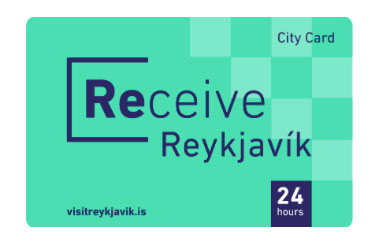
Reykjavik City Card (24 hours)
Prices checked 8 September 2026 · source: visitreykjavik.is.
Unlike in years past, now (2023) people under the age of 18 do not need this card. They are entitled to free admission to most museums, but they must make any (small) fare payments using the Klapp app (download it from: App Store or Google Play).
If you’re only interested in bus rides, and don’t want to install the Klapp app, you can also buy a 24-hour or 72-hour Klapp pass at major bus stops for 2,750 ISK (about $23) and 6,000 ISK (about $50), respectively – though Strætó has announced it is phasing these passes out, so check before you count on one.
The card can be ordered and paid for online, but to use it you have to pick up a physical version at one of the museums anyway. So it’s probably easier by the way to also buy it at such a museum 🙂
How to get around Reykjavik
Reykjavik is best explored on foot. Except for a few places, everything is within a really short walk (see What to visit in Reykjavik). However, for example, the Arbaer open-air museum, the Perlan exhibition or the Nautholsvik and Laugardalslaug swimming pools are a bit too far for a walk from the city center. And if you choose to stay outside the center, a bus will get you anywhere – they are comfortable, reliable and inexpensive.
City buses
In my opinion, the best solution for getting around Reykjavik is city buses. The basic lines are a fairly dense network of routes throughout the city. Individual lines also go quite far out into the suburbs, and long-distance lines basically run all over Iceland (the City Card is not valid for these rides, however – you have to buy a corresponding ticket for long-distance connections).
In the center, all lines meet at the Hlemmur stop. Here you can conveniently change to another line or walk from here to the city center. Hallgrimskirkja lies about 700 meters (0.4 miles) to the west, and Harpa only a little over 1 km (0.6 miles). So these are distances you can perfectly well cover on foot. Of course, if the weather is not conducive to walking or you have hiked enough, you can comfortably get from Hlemmur to almost any point in the city.
As I wrote earlier – the best way to purchase tickets is to buy a City Card. Within Reykjavik, it allows you to travel on buses at no extra charge. Alternatively, you can always buy a ticket from the driver. When buying a ticket from the driver, rather be prepared to pay by card – the driver does not give change. A single ride ticket for an adult costs 690 ISK (about $6), while young people aged 12-17 and anyone aged 67 or older pay half that price. Children 11 and younger ride for free. (Fares checked in September 2026 – see the Strætó price list.)
The city’s bus operator is Straeto. On their website, straeto.is, you get not only schedules, but also an interactive trip planner and a map showing the current position of every bus! So you can, for example, easily see at which stop it will be easiest to “catch” it…
The old Straeto app is gone. Tickets are handled by Klapp, the shared ticketing system of Icelandic buses, which you can download from the Google Play Store or the App Store. For the nearest stop, timetables and trip planning, use the straeto.is website.
Car
Reykjavik is not a multi-day destination, so it’s reasonable to rent a car right at the airport and drive it into the city (although we do recommend to leave the sightseeing for the last day). Just exploring the center is best done on foot anyway, but driving to further attractions or to an overnight stay on the outskirts of the city will be the quickest and most convenient in a car.
We describe this in more detail in the article Keflavik Airport, but in a nutshell: for a group of 4-5 people or a family, renting a car for 1 day should be cheaper than getting from the airport to the city by bus or cab. The cheapest way to do it, of course, is by city bus, but they, in turn, are the least flexible and convenient. You can find all the details in the article mentioned.
Also, having arrived in Reykjavik, it is best to park the car in a convenient place and explore the center on foot. You just have to watch out for paid parking zones, but if you park on the street then you only pay for it during the day.
There are 4 designated paid parking zones in Reykjavik. They are not large, but cover most of the inner city. Nevertheless, inside those zones the key challenge is to find a free spot for your car, anyway. As of September 2026 the fee is 660 ISK (about $5.50) per hour in the central P1 zone and 240 ISK (about $2) per hour in the other three. There are also 7 multi-level city parking garages, but they are not much cheaper and I think they are not worth bothering with (you can find the exact locations and the current rates at reykjavik.is).
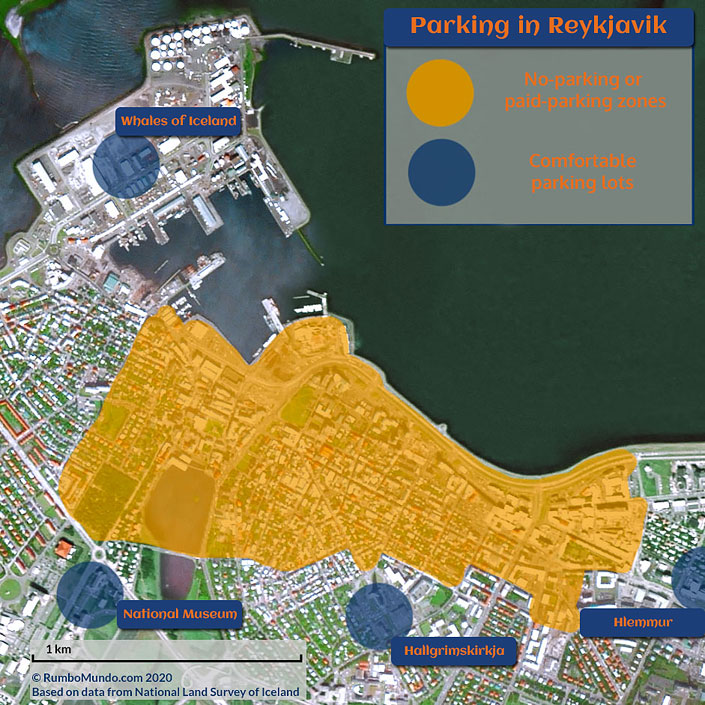
Parking zones in Reykjavik
In the area around the Hlemmur bus terminal, some streets are included in the paid parking zone, while others are not. So when parking there, you need to make sure whether and if so, how much you have to pay for parking. It is best to leave the car a little further east, in the parking lot near the small shopping center and supermarket Kronan (corner of Noatun and Hatun streets).
You can also park conveniently and for free near attractions a little further out – the Perlan exhibition, the Arbaer open-air museum, the Laugardalslaug swimming pools or the Húsdýragarðurinn Zoo.
Best Reykjavik accommodation
Reykjavik, as the country’s capital, has a wide range of accommodations. Depending on your budget, you can choose to stay in a posh hotel, hostel or guesthouse, or at a campsite. In the city center or in the ‘suburbs’.
There is plenty of any type of accommodation in the city itself: hotels, hostels, guesthouses and airbnb apartments. If you want to have all the major attractions, bars and restaurants at your fingertips, staying in the city center will obviously be the best choice. Be careful, though – there are quite a few bars in the lower part of Laugavegur, Bankastræti and Austurstræti, open until late at night, especially on weekends. And that means it can be really noisy there.
At the less expensive end, we’d recommend Central Guesthouse, Apartments Reykjavik, 101 Guesthouse and Bus Hostel. The latter is doubly interesting because it has the same owners as one of the companies running shuttle buses to and from Keflavik Airport: Airport Direct. Their buses come straight from the airport to the parking lot at this very hostel. It’s not the very center of Reykjavik, rather the area around the BSI terminal, but it’s not far to the center either.
If you’re on a budget – look for guesthouses in farther-flung neighborhoods or on the outskirts of the city. You’ll get to the center very quickly by car or bus, and the money you save on lodging will definitely come in handy for various other expenses. See on straeto.is how far you will have to the nearest bus stop, or immediately set yourself up to rent a car as well for the day(s) of sightseeing in Reykjavik.
If you’re backpacking or staying in an RV or campervan, then Reykjavik Campsite is likely your place of choice. It is inexpensive (compared to hostels) and located right next to the Laugardalslaug pool complex. Although it’s about 3 km / 2 miles to Hallgrimskirkja or Harpa from here, line 14 stops right at the campsite entrance, so it’s easy to get to the city center in no time.
Of the places that are slightly more expensive but also of a higher standard, Reykjavik Marina and Rey Apartments stand out as great value-for-money.
Finally, if you’re not ready to compromise on quality even slightly, or simply want to pamper yourself, have a look at The Black Pearl Apartment Hotel and The Reykjavik Edition. These two should satisfy even the highest standards.
History of Reykjavik
Reykjavik’s history began in 874, when the first permanent settler, Ingólfur Arnarson, arrived here. For years his farm was the only one in the area, but by the 16th century Reykjavik was already an important port and trading center. Residents also engaged in fishing, farming and animal husbandry.
In 1786, the settlement was granted a city charter and designated as the administrative center of the Danish-ruled island. In 1874, Iceland received its own constitution and took control of the economy. From then on it began to develop rapidly, and science, commerce, culture and industry flourished in Reykjavik.
Reykjavik today
Modern Reykjavik is the commercial, industrial and cultural center of the island. It has a rich, vibrant cultural and art scene, modern museums, world-class restaurants, galleries, stores, bars and clubs. It is a major fishing port and home to nearly half of the country’s industry. Among other things, Reykjavik produces processed fish and food products, machinery and metal products.
It attracts attention with its modern architecture and its unique… tidiness. Not everyone knows that it is heated by water from nearby geothermal wells and is one of the cleanest, greenest and safest cities in the world.
Reykjavik trivia
- Reykjavik literally means Smoky Bay. Today, fog is not particularly common here, but apparently it was a common phenomenon at the time of the first settlement.
- 64% of all Icelanders live in the capital itself and its suburbs.
- You will look in vain for crowded concrete apartment blocks in Reykjavik. Most residents live in single-family low-rise houses.
- Reykjavik is the only European capital without a Starbucks or McDonald’s.
- From 1924 to 1984, the city banned dog ownership. For this reason, until now Reykjavik has remained more of a cat city.
Souvenirs from Reykjavik
Iceland is full of souvenir stores. Especially the center of Reykjavik is saturated (or even oversaturated) with them. Walk around Laugavegur and you’ll find countless stores selling mascots in the shape of puffins, Viking hats or Icelandic sweaters. Keep in mind, however, that most of these items are mass-produced in other countries and imported to Iceland.
If you’re looking to buy locally made souvenirs with Icelandic soul, perhaps try buying one of the following items:
- Products made of wool such as the distinctive Lopapeysa sweater – very soft, very warm and a great gift idea;
- licorice candies available not only in gift stores, but also in discount stores and supermarkets;
- Omnom chocolate and bars produced in Iceland;
- local delicacies such as fermented shark or dried fish. Snacking on Icelandic snacks in the evenings will have you transported to wild Iceland in just a few moments (of course, if it ever occurs to you to take a mouthful of pickled shark again…);
- Brennivín liquor – I’m not urging you to drink it, but it’s certainly a traditional local beverage; the strong aniseed flavor of Brennivin is usually used to overpower the taste of Hákarl – fermented shark; personally, I can’t tell what tastes worse… 😉
- cosmetics with silica and algae – they wonderfully cleanse and moisturize the skin and usually come from the nearby Blue Lagoon resort; it’s certainly a nice and useful souvenir, although it will surely wear off at some point;
- Icelandic nature-inspired jewelry – strolling through downtown Reykjavik, you’re sure to find a boutique with jewelry designed and made by an Icelandic artist. A necklace with lava stones will not only be a wonderful memory of an Icelandic vacation, but also an original accessory.