


Motor insurance is organized somewhat differently in Iceland than in many other parts of the world. And priced differently, too. This article walks you through what each type of car insurance in Iceland covers, what it costs, and which ones are worth buying.
How car insurance in Iceland works
In Iceland, as a tourist, you can’t buy liability, collision and roadside assistance cover as separate policies. They all come bundled together. What you do get to decide is which specific types of damage are included, and how big your deductible is.
This leaves us with two things to decide:
- adding certain specific types of event that the insurer has excluded from the basic coverage;
- reducing our deductible, either across the board or for certain types of event;
Formally, of course, these are two separate things, but from the customer’s perspective there is little difference between them. If a given event (e.g., a broken windshield) is not covered, or is covered but with a very high deductible, we will still end up paying for that repair out of our own pocket…
What is the deductible
A key element of what we have influence over and can decide when buying car insurance in Iceland is the so-called deductible (excess, but in practice you also meet the terms self risk or personal risk). By default it is quite high, but for the right fee we can reduce it, even to zero. This is known as waiving the deductible.
A deductible is sometimes defined as a percentage (so, for example, you pay 15% of every repair bill), but in Iceland the standard is a flat amount. This means that regardless of the total repair costs, you always pay the deductible first and then the insurer covers the remaining part.
Specific values vary, but the typical deductible is around 400,000 ISK (about $2,900), or €3,000 (about $3,550). So regardless of the total repair cost, under standard insurance terms, you always pay that first $2,900 and the insurer only pays the rest. In a sense this means that you are only insured against damages larger than the deductible, because if the repair cost is lower, then you pay for it in full, even though you are insured.
So all in all, under the standard insurance conditions, almost all small damage, and a large part of the bigger repair bills, falls to you anyway. What you are really protected against is writing the car off, or damage close to that. And even then, only if the damage was not caused by something the policy excludes – which, in many cases, means theft, wind damage or flooding, and driving under the influence, of course.
Insurance for the interior
Specific to Iceland are mountain roads (F) and conditions for entering the interior. If you intend to enter the interior of the island, or drive on F roads at all, it’s worth asking the rental companies you are considering how they treat these roads, and whether they exclude particular ones.
You can read more about mountain road conditions (and more) in the article Iceland’s Roads — What to Expect.
The biggest enemy of rental cars in Iceland are rivers and streams, and that’s why some rental companies (and some insurance companies) ban such roads in general, where streams are plentiful or where fords are (or periodically happen to be) deep. And these are precisely some mountain roads.
In addition, some rental companies apply special penalties (deducted from your deposit) if they find that you entered a road you were not allowed to enter at all!
Pay special attention to this if you are going, for example, on F88 (one of the roads to Askja) or on F249 (Thorsmork). If the rental company does not allow you to enter some selected roads, it is usually these two. In addition, some rental companies may also exclude, for example, the F210 (north of Thorsmork), the western part of the F910 (between Askja and Nyidalur), the F894 (the end of the approach to Askja) or the F578 (the drive from the Vidgelmir cave area to the north). Apart from F894 – which for reasons I don’t understand was excluded by one of the companies – all these roads have one thing in common: a large number of fords, which every so often become deep, fast-flowing and simply impassable.
You can read more about these, and several other, interesting roads in Iceland in the article The Most Important Roads in Iceland.
Where I book my own Iceland trips
Best Iceland deals
Selected partner sites, best prices
Is insurance in Iceland expensive?
Iceland is a really expensive country, so the cost of possible repairs here is also much higher than elsewhere. Hence, insurance costs are also high. That’s why buying more extensive insurance than we have at home can be particularly justified here, although the prices of some policies are frankly exorbitant…
The exact choice of insurance options depends on your individual preferences and driving plan. It is best, of course, to choose such a version or such a package, so that you do not worry about your car, and focus on enthusiastic enjoyment of Icelandic nature.
On the other hand, if the cost of insurance is going to block you from coming, it might be better to plan in advance to drive very, very carefully, and save the money… It’s your call, but maybe it will be easier for you to compare the cost of renting a car, the cost of its insurance and the cost of selected accommodations, which we prepared in the article Renting a Car in Iceland.
Of course, everything in Iceland is expensive, so insurance – and repair bills – cost more here than elsewhere in Europe. Should this affect your decision on the different types of insurance, and how? Let’s go through them all one by one.
General waiver of the deductible – SCDW
Insurance or waiver of deductible (usually called SCDW – Special Collision Damage Waiver) reduces the level of cost accrued to you, i.e. the repair cost that you have to pay. Usually only Platinum (or similarly named) packages bring it down to zero. With standard SCDW, for example, your liability is capped at 90,000 ISK (about $650), or €750 (about $900).
If the repair cost is $1,500 and your deductible is $300, then you pay $300 and your insurance company covers the remaining $1,200. But if the repair cost is below $300, you pay for it in full (although there are variations on this).
SCDW covers you both for damage you cause to other people and their property, and for damage to the rental car itself. In other words, it rolls liability cover and collision cover into one.
| Costs of waiving the deductible | |||
|---|---|---|---|
| standard CDW | Super CDW / SCDW | Premium CDW / PCDW | |
| deductible | $2,700 – $3,200 | $550 – $800 | $0 (full waiver) |
| daily cost | included in the rental price | $15 – $22 | $30 – $35 |
| cost per 14 days | $0 | $225 – $300 | $400 – $470 |
Remember: with any repair you pay the deductible first, and the insurer only covers what is left (if anything).
Icelandic drivers are not aggressive, and the roads are in good shape. Traffic drives on the right, as at home. So if you are an experienced driver, you don’t collect parking-lot dings, you can remember to take it easy even on the straightest stretch of road, and you park well away from other cars – you can safely consider skipping this one.
In crowded parking lots, though, it does happen here that you come back to your car and find a fresh scratch on it, courtesy of a driver who is long gone. In addition, if you feel unsafe driving in a foreign country, or if you are renting a different car than the one you drive every day, then removing (or limiting) the deductible is probably a good product for you. It can be expensive, but after all, everything in Iceland is expensive (including repairs to even minor damage).
Note that if you want the deductible gone completely, a full insurance package (the so-called Platinum Package, for example) may cost you only a little more. We write about this at the end of this article.
Theft insurance – TP
Iceland is an island and no one steals cars here, not least because it would be very difficult to export them from here. As a result, theft insurance (TP – Theft Protection) is really cheap, and often left out altogether or offered only as part of a full package.
If you want complete peace of mind, then of course you can buy such insurance. But there is really no car theft in Iceland, so if you have the option to opt out of anti-theft insurance – you can safely do so.
Keep in mind that if you don’t buy this cover as part of one of the full insurance packages (Platinum Package / Premium Package), you are probably buying it with a deductible of, say, 100,000 ISK (about $715). This is not a lot, but nevertheless you will bear some liability for a possibly stolen car.
| Theft protection costs | |
|---|---|
| Theft Protection – TP | |
| daily cost | $5 – $7 |
| cost per 14 days | $80 – $100 |
| typical deductible | $700 |
If you buy such insurance – Theft Protection – as part of a full package (such as Platinum Package) then most likely your deductible is waived to zero.
Gravel damage insurance – GP
Many roads in Iceland are gravel roads. Today these are mainly mountain roads in the interior, but you will also find them off Route 1 and at some attractions on Snaefellsnes or in the Westfjords.
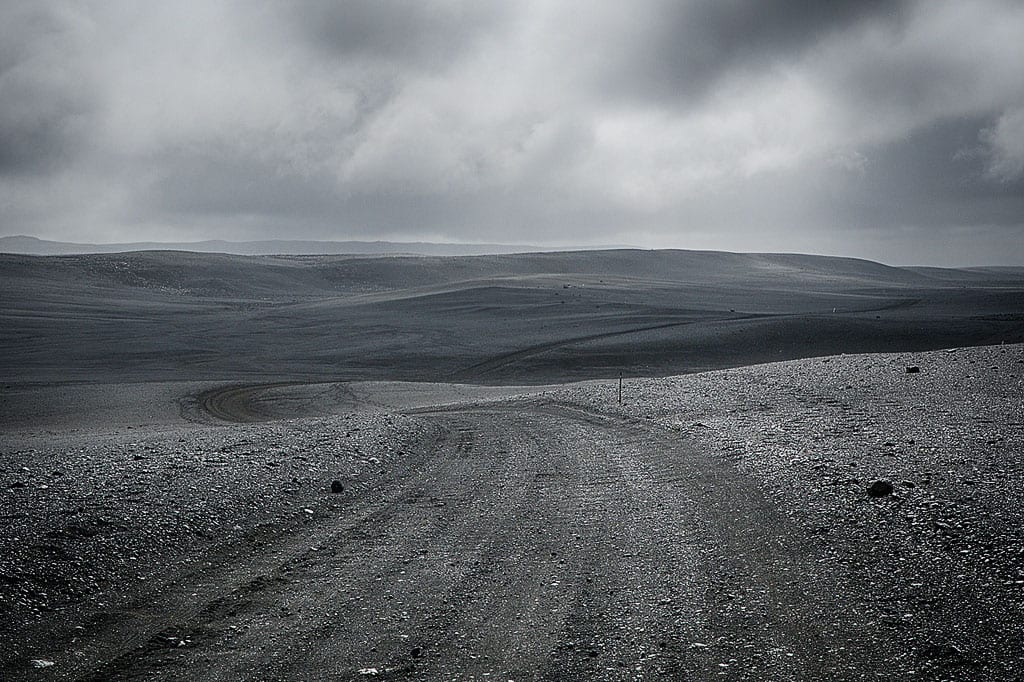
Pumice landscape on the F26 road
In Iceland there is also a real risk of very strong wind picking up gravel and hurling it at cars. If you are driving in a storm, or haven’t parked somewhere properly sheltered (which, admittedly, isn’t always possible), you risk losing every window in the car…
In our experience, rental companies turn a blind eye to really tiny chips. But even a small ‘spider’ on the windshield will be spotted, and will have to be repaired. I recently had a ‘spider’ repaired in Namibia. It cost the equivalent of about $55 there. In Iceland the same repair runs to 30,000 – 40,000 ISK, well over $200!
So you have two choices: buy the insurance and stop worrying, or make a point of staying well back from the car in front on gravel roads (and slowing down and keeping as much distance as possible when passing). $225, or even $300, for a simple ‘spider’ repair is a lot of money, and it’s no fun spending the whole trip worrying about a stray pebble. On the other hand, we drive fairly slowly on gravel anyway, and interior roads are fairly empty even at peak season. The chances of ending up behind another car are small, and the risk is easy enough to avoid.
| Gravel protection costs – GP | ||
|---|---|---|
| no additional protection | Gravel Protection – GP | |
| daily cost | included in the rental | ~$10 |
| cost per 14 days | $0 | $155 |
| deductible | ~$550 | $0 |
Windshield repairs are expensive in Iceland, but as the table shows, so is the insurance. On a two-week trip, buying this cover means that for the first repair we effectively pay half out of our own pocket anyway. Therefore, it seems to be an interesting offer for short trips, but for longer trips it is probably better to bet on caution.
On the other hand, this is another cover that is always included in the full packages, which does make them more attractive.
Sandstorm insurance – SAP
The full name of this insurance is Sandstorm and Ash Protection (SAP, or sometimes SAAP). This insurance is designed to protect against the effects of a sandstorm that could severely damage a car’s paint.
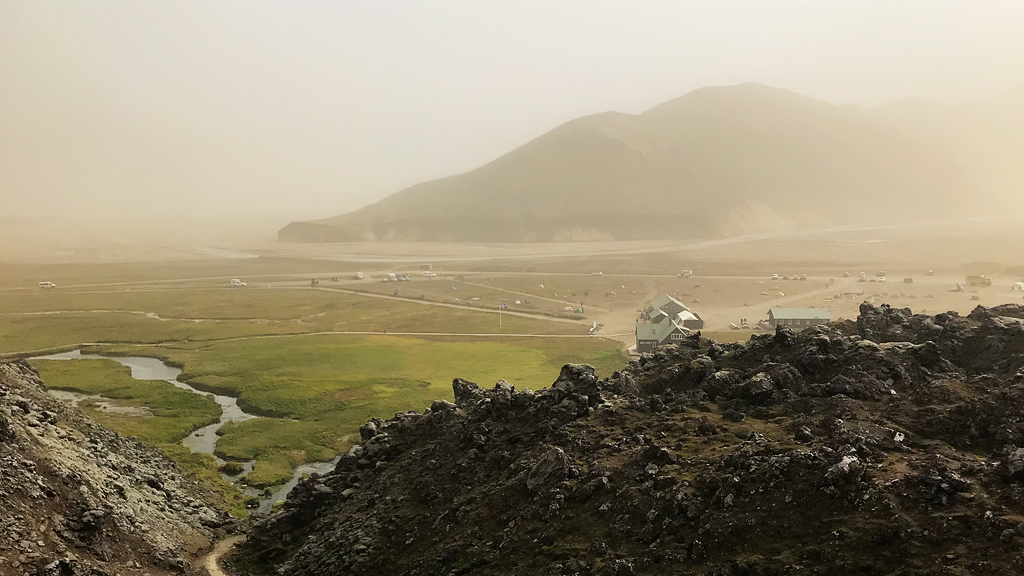
Sandstorm over the Landmannalaugar campsite
Campsites are usually in spots sheltered from the wind and reasonably safe from such risks. However, parking lots at major attractions no longer always offer this peace of mind.
On the other hand, there is practically constant strong wind in Iceland, so most of the dangerous particles are blown into the ocean as soon as they appear on the ground (so the wind blows, but there is nothing to pick up). Paint and glass are tougher than that, too: ordinary wind in a dusty place will do them no harm. However, if you happen to experience a particularly strong storm – anything can happen.
| Sandstorm and Ash Protection (SAP) | |
|---|---|
| SAP insurance | |
| daily cost | $10 – $30 |
| cost per 14 days | $155 – $400 |
| deductible | $670 – $1,350 |
Overall, the risk of a damaging sandstorm is not high. There is a good reason this cover is largely unknown outside Iceland. However, since March 2021, the Reykjanes peninsula has seen almost constant lava flows and ash outpouring from the Geldingadalir. Several other volcanoes have also increased their activity levels and are in danger of erupting. Therefore, of course, the risk is higher than usual and if you want peace of mind – buy this insurance.
Note that – as with theft insurance – if you buy this product separately rather than as part of a full package, you will most likely be subject to a pretty high deductible (as in the table above). On the other hand, compared to the cost of painting the whole car and replacing, for example, all the windshields on the windward side, such a deductible can probably be described as not much.
Vehicle flooding insurance – RFC
Unfortunately, a fairly common “insurance event” in Iceland is driving into a river or stream with a car that should not be there. Or driving into a stream when it is too deep or rapid. Or simply making a mistake by the driver and driving into some deep or soft bottom that immobilizes the car in the water. Or, finally, driving into a stream without four-wheel drive engaged…
Unfortunately, although this is a fairly common accident, and driving in the interior it is very hard to avoid fords altogether, nearly no insurer in Iceland offers coverage for flooding or drowning of a vehicle (known as water damage).
The only rental company I know of that offers such insurance is Thrifty.is. And they offer it only for two “urban SUVs”: the Mazda CX-30 AWD and the Ford Kuga AWD.
The insurance is called River Ford Crossing (RFC for short), and it just includes protection against the effects of flooding or drowning of the car while crossing fords. However, it can only be purchased for the two models indicated above, and for these cars the entire F88, F249, F578 and F894 roads are excluded from coverage (although there are no fords on F894 exactly).
All in all, therefore, only crossing relatively shallow and safe fords is covered. Especially since the insurance conditions specify that the water in the stream being crossed must not reach higher than halfway up the wheel. And after all, Mazda CX-30 and Ford Kuga don’t offer particularly high suspension anyway. Still, the cover exists and it’s worth knowing about…
| River Ford Crossing insurance – RFC | |
|---|---|
| River Ford Crossing – RFC | |
| daily cost | ~$65 |
| cost per 14 days | ~$950 |
| deductible | 500,000 ISK – about $3,500 |
As the table shows, the only company offering this cover does not, in practice, insure crossings of the genuinely dangerous fords – and what it does offer is expensive (more expensive than, for example, the full Platinum package – see below) and limited by a sizable deductible (it is not waived even in the Platinum package).
So first we pay over $900 for insurance, and then the first $3,500 for any repairs is also covered out of our own pocket. On top of that, the rental itself is clearly more expensive at Thrifty than the offers we listed in Renting a Car in Iceland. All in all it’s not a particularly attractive deal, and it’s hardly surprising that the company’s own staff admit there hasn’t been a customer who used it in years…
If you plan to drive in the interior, you will almost certainly do better putting that extra money into a bigger 4×4 than into this insurance. In many fords a taller vehicle will barely get water up to the axle, and will cross without the slightest trouble.
And we must approach any water crossing with extreme caution anyway. Note that even if the insurance company takes on the cost of repairing the damage, no one will give you back the hours lost waiting for help, towing the car to a garage, or swapping it for another one…
Full insurance packages (Platinum, Golden)
Many rental companies and insurance companies also offer customers so-called full insurance packages. These usually come in two variants.
One of such variants is really full and is usually called Platinum or Premium (sometimes, unfortunately, also PCDW, which is easily confused with the deductible insurance itself). This is a package that covers every type of insurance (except RFC) and takes the deductible down to zero on all types of damage. Often it is the only way to get the deductible to zero. It also usually includes the tire insurance we haven’t mentioned so far (and which is rarely available separately).
The second variant, this ‘almost full’ one, is usually called Golden or Grand (sometimes also GCDW). Unfortunately, in some rental companies, it is this not-quite-full package that is called Premium – as in other companies the truly full package… That is another reason to read the description or the terms of a package, not (just) its name. The terms of this almost full package sometimes vary. Sometimes it is a set of all insurances, but without lifting the deductible to zero. Most often, however, some “smaller” insurances (such as SAP or tire insurance and – of course – RFC) are also excluded from this package.
| Costs of the full insurance packages | ||
|---|---|---|
| Golden Package | Platinum Package | |
| insurance covered by the package | all except SAP, RFC and tire insurance | all except RFC |
| deductible | $350 – $800 | $0 |
| daily cost | $20 – $35 | $30 – $50 |
| cost per 14 days | $315 – $500 | $425 – $715 |
As you can see from the table above, the price we have to pay for a gold package in one company may be enough for a platinum package at another… So we urge you to always compare the price of a car rental together with the price of the corresponding insurance package.
On the other hand, in general, the combined cost of all the individual coverages listed above can reach $900. So if we want to be thoroughly insured, it almost certainly pays to do so just as part of a package, rather than buying selected insurance coverages separately.
Travel insurance and EHIC
Personal insurance is a separate topic. I have not heard of equipment or valuables being stolen from cars or tents in Iceland. But anyone can twist an ankle or accidentally damage someone else’s property. So for travel insurance, buy the same kind of policy you would for any other trip.
One thing worth checking before you go: most US health plans cover little or nothing outside the country, so a doctor’s visit or a hospital stay in Iceland comes out of your own pocket. Travel insurance with medical cover – ideally including evacuation – is the sensible answer. Travelers from the EU, the EEA and Switzerland should instead bring a European Health Insurance Card, which covers state healthcare in Iceland on the same terms as locals: What the EHIC is.
Other guides about driving in Iceland
If you already know what kind of insurance you’re interested in, you can move on to an article describing the different types of cars available in Iceland. We compare their advantages and disadvantages, usefulness on different trips and, of course, costs. Read all about the cars, off-road vehicles and various types of RVs available in Iceland here: Renting a Car in Iceland.
Also consider the specific road conditions in Iceland and familiarize yourself with some of the laws and – just in case – the amount of fines for certain traffic offenses. We have compiled this information here: Driving Rules and Fines in Iceland.
Finally – it’s a good idea to know more about the roads you are traveling on. This will come in handy both for choosing the right car (and insurance) and for final decisions on your itinerary. Read our subjective selection of the most important roads in Iceland here: the most important roads in Iceland.
If you need inspiration for planning your itinerary, you can start with our TOP10 lists – such as Top Road 1 Attractions (+ 10 bonuses) – or our suggestions for Best Iceland itinerary (summer, 4×4, 14 days).