


Whales have fascinated humans for centuries. Back in the old days it was mainly the sheer size of these animals that gripped our ancestors. Over time we have learned to appreciate their complex social behavior, their intelligence and the many biological secrets we still have not cracked. The topic is as huge as a whale, but let’s at least take a shallow dive into it.
Whales vs fish
First things first: how do whales relate to fish?
The systematic division may seem complicated to the layman, but it is worth knowing the basics – they make the behavior of the different groups and species much easier to follow.
Whales are not fish, even though they spend their whole lives in the ocean. They are mammals, and they breathe atmospheric air. Marine mammals as a group take in the cetaceans, the sirenians (yes, those warmth-loving manatees and dugongs), the pinnipeds (seals, sea lions and walruses), a couple of mustelids (the sea otter and the Patagonian otter) and also the polar bear [1].
When we think of whales, we think of sizeable mammals of the order Cetacea. This order also includes dolphins and porpoises, among others. At least 12 different species of whales can be found in the waters surrounding Iceland (some sources count as many as 23 species). You can find a fairly detailed description of these species in a separate article: Whale Species You Can See in Iceland.
The word “whale” itself is a colloquial one, used for the largest members of the order. Within the cetaceans we distinguish baleen whales (Mysticeti) and toothed whales (Odontoceti) [2], [3]. The first group is defined by baleen – a comb-like set of horny plates that filters food out of the water. Toothed whales are equipped with conical teeth instead, which lets them hunt actively, usually for fish, cephalopods or smaller mammals.
What attracts whales to Iceland

Distribution of currents around Iceland (Astthorsson et al., 2007).
Iceland has a specific environment that many animals have taken a liking to. Here, warm Atlantic waters clash with cold water masses coming from the Arctic or even the polar regions (FIG.1). In summer the surface water is also freshened locally – meltwater running off the land lowers its salinity [4].
This peculiar arrangement of warm and cold currents creates a dynamic environment, and with it the conditions for the growth of phytoplankton and of the larger animals that feed on it.
In spring, when the temperature rises slightly, the so-called phytoplankton bloom is observed – a phenomenon of mass development and multiplication of plant plankton. The high availability of food promotes the appearance of more zooplankton and herbivorous fish. This creates a huge food base for plankton-eating animals. The largest amounts of phytoplankton around Iceland appear between May and September. That is when feeding conditions are at their best for baleen whales and for the plankton-eating fish that toothed whales in turn feed on [5].
Whale migrations: when is the best time to spot whales in Iceland
Most whales make seasonal migrations in search of food (in summer – to polar areas) and for breeding (in winter – to tropical waters). They travel thousands of kilometers to deliver their young to the world and return to cold waters to build their energy back up.
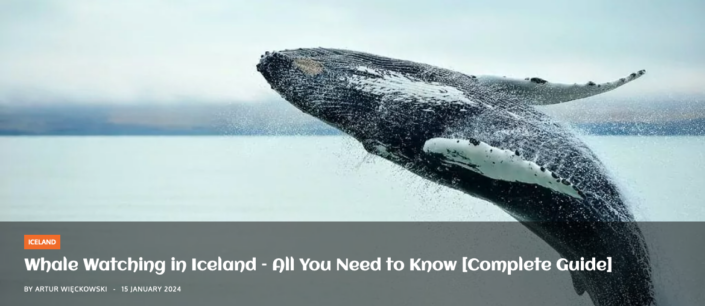
Whale Watching in Iceland: All You Need to Know
The exact reasons for whale migration are not yet fully understood, and scientists are still arguing about the mechanisms that push these animals to travel such vast distances. What is known is that the young of migratory species are born without the subcutaneous layer of fat that protects these animals from the cold. They would not be able to survive if they were born in the frigid polar waters. During their first months of life they feed on their mother’s milk, which lets them build up enough fat to make their first trip to the Arctic feeding grounds.
Humpback whales are among the animals that make the longest migrations in nature. During migration they swim an average of about 5,000 kilometers (3,100 miles). The record belongs to a female humpback whale, which covered almost 10,000 km (6,200 miles) in 2010!
Scientists point to one more reason for whale migrations: that the animals travel to warm waters to keep their skin healthy, which protects them against parasites and microorganisms. Whales migrating to warm waters are observed to shed their epidermis, and with it any microorganisms living there [6].
In 2015, scientists noticed changes in the whales’ migratory route. After careful analysis they found a coincidence between some of the anomalous behavior and geomagnetic disturbances caused by solar flares. This may have disrupted the navigational abilities of sperm whales, among others, and contributed to the mass strandings of these animals.
Nowadays, migrations are also affected by a warming climate, which shifts the limit of plankton occurrence toward the poles, so whales have to travel longer distances to their feeding grounds. Their behavior is also affected by underwater noise, generated mainly by ship traffic and by various underwater works such as drilling or laying pipes and cables.
Whale songs: scale and range of sounds made by whales
Whales are highly social animals. They communicate with each other with the help of sounds that can spread in the water for tens of thousands of kilometers.
Individual species are capable of producing sounds of varying frequencies, resulting in complex songs that can reverberate in the oceans for hours. Some species can hear as many as 12 octaves (compared with the 8 octaves heard by humans), and the extreme frequencies heard by some whale species range from 16 Hz to 200 kHz (for humans it is usually 50 Hz to 16 kHz). Whales also have ears (or more accurately: organs of hearing) tuned to the fact that sound propagates almost 5 times faster in water than in air [7].
There are several hypotheses regarding whale songs. They are thought to serve to establish hierarchy in a group, for echolocation or to confuse fish. We are not yet able to say conclusively what the whales use these show-off arias for.
Why whales live in pods
Many whales obtain food by swimming in groups (pods), which makes their attacks more organized and more effective. It shows how social the lives of these animals are.
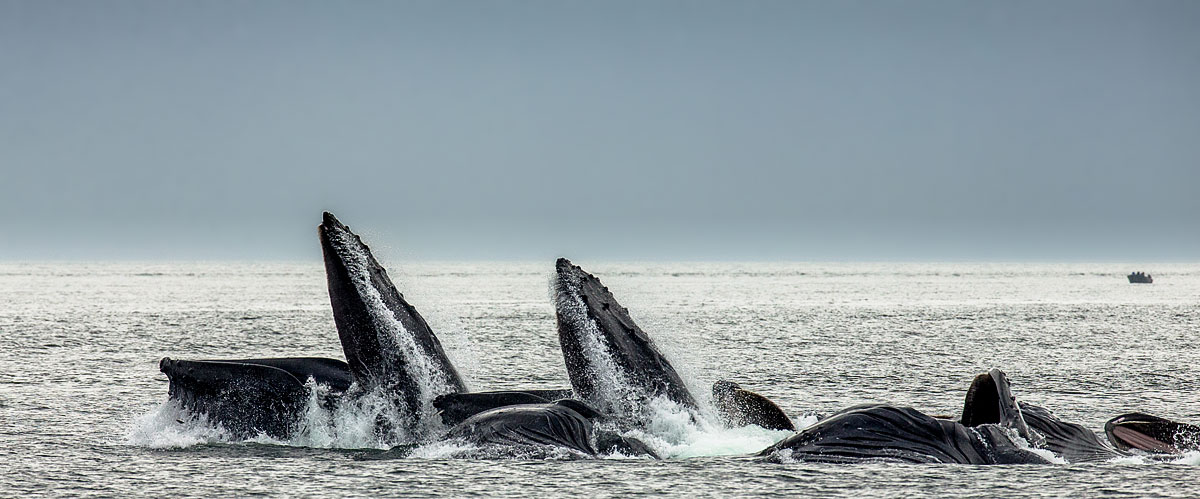
Most whales also take care of young, old and sick individuals and protect them from predators. Groups of females with their young are most often observed; males prefer a rather solitary lifestyle. Sometimes they form small groups of males of similar age and size. They also join larger groups of females for the breeding season.
Many whales also form interspecies pods, which is rather unusual behavior in the natural world. Such mixed groups include humpback whales, fin whales, blue whales, minke whales, gray whales, North Atlantic right whales, bottlenose whales and sperm whales [8]. Within the groups they form, the animals help each other hunt and protect their young.
Some whales, such as humpback whales and sperm whales, also protect animals of other species. There are well-documented attempts to protect seals, walruses and penguins from attack by orcas, as well as to support smaller whales of other species when threatened. Humpback whales have also been observed protecting divers: when they recognize the threat of an attack from a predator such as a tiger shark, they are able to shield people and try to draw them away from danger. They present altruistic behavior, then, selflessly helping representatives of another species.
In 2012, during behavioral observations of sperm whales, scientists noticed an unexpected member of the pod. On closer inspection they found that the sperm whales had taken care of a disabled, deformed dolphin – a common bottlenose dolphin. It was observed traveling with the sperm whales, who helped it get food, and the younger sperm whales played with it.
Why whales jump out of the water
A very interesting behavior of whales is their acrobatic, aerial feats. They always inspire the greatest awe during whale-watching cruises. These leaps are most often performed by humpback whales and sperm whales, but sometimes you can see fin whales, blue whales, sei whales or minke whales jump out of the water, too.
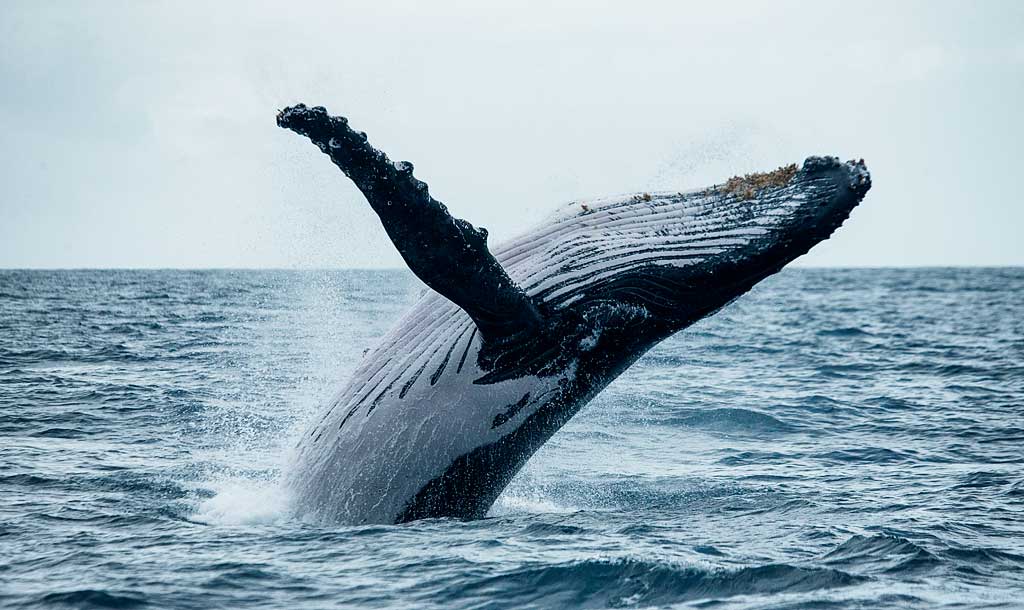
The reason for these jumps has not been clearly established, but most likely it is a peculiar way of taking food (before jumping, the animal emerges and consumes huge amounts of water with zooplankton), and it also serves to communicate with members of the pod. It is probably a form of play as well.
It is also believed to be a way of demonstrating strength and establishing dominance in the pod. As in other sea creatures in which aerial acrobatics are observed (manta rays, devil rays of the genus Mobula, some sharks, and cownose rays of the genus Rhinoptera), it is suspected that the cause may be a mechanism for clearing the skin of debris and parasites.
From whaling to whale protection
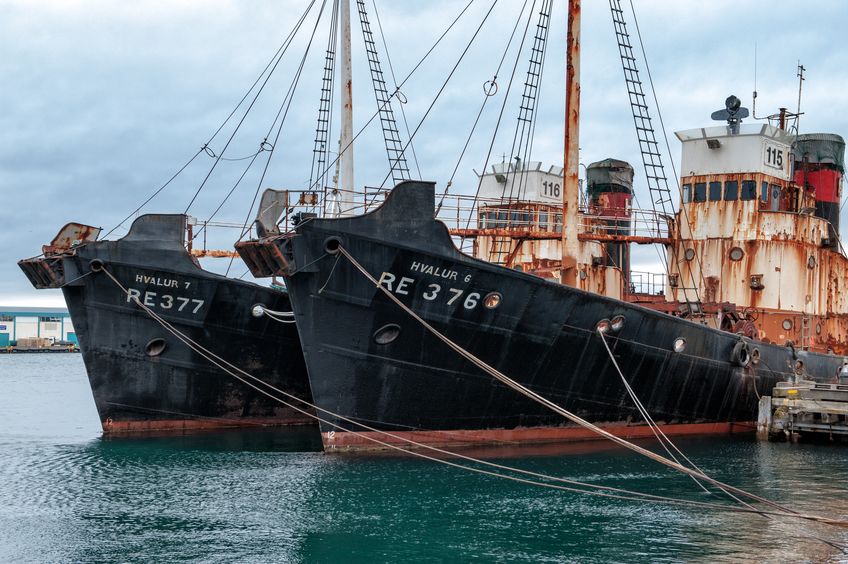
Whaling cutters rusting in Reykjavik harbor
The many dark years in which whaling flourished have wrought great damage to whale populations.
It left its mark on the numbers of many species, which were caught for their fat, meat and bones. These were used to make lamp oil, lubricants, waxes, cosmetics, medicines, ornaments, corsets and many other items of daily use. As long as this was the work of quite a few whalers using fairly primitive tools, nature compensated for the losses without trouble. The real problems began when people approached whaling industrially.
Many whale populations were driven to near extinction. In the 1930s, about 50,000 whales were killed annually [9]. Large-scale whaling was banned in several countries in 1969, but it was not until 1986 that the moratorium of the International Whaling Commission banned it worldwide.
Despite the moratorium, a handful of countries still hunt whales commercially, on cultural or scientific grounds. The International Whaling Commission lists three of them: Norway, which lodged a formal objection to the moratorium when it was introduced; Iceland, which left the IWC in 1992 and rejoined in 2002 with a reservation to it; and Japan, which left the Commission altogether in 2019 and is no longer bound by the moratorium [11].
Today, many whaling companies have transformed themselves into entities that support the conservation of these animals and organize whale-watching tours. These companies often put pressure on whalers and persuade them to stop their hunts [10]. In Iceland, the consumption of whale meat has been declining year after year.
The impact of environmental pollution on whales
Another factor, highly detrimental to whales, is environmental pollution. They are particularly badly affected by the presence of heavy metals in the water and in their food. These metals accumulate throughout the whale’s life and damage its health, immunity and reproductive capacity.
They are also very badly affected by increasing plastic pollution, which they often ingest with their food and which can lead to poisoning or suffocation. Ocean acidification hits them too, reducing the amount of available food.
Viewing whales – only in the natural environment
Speaking of the dangers affecting whales, one must also mention amusement parks that hold representatives of species such as orcas, dolphins and belugas in pools.
Certainly, a visit to a zoo or water park is the easiest way to learn about these beautiful animals and instill a love for them among children. We should remember, though, that whales tolerate confinement very badly – the limited space and the absence of other pod members. Very rarely are they given really good conditions in captivity, and even the largest pool is microscopically small in relation to the ocean. Self-harm and suicide have been observed among whales kept in captivity. So it is best to watch them in the wild.
But when going to observe these magnificent animals in their natural environment, let’s also keep in mind the dangers these huge mammals have to face. Let’s choose cruise organizers carefully to limit the negative impact on marine animals. It is safest to pick companies affiliated with one of the organizations that care about good practice in whale watching (such as the Icelandic Whale Watching Association, known as IceWhale, or Orca Guardians Iceland). We are then assured that the crews are trained and know the rules of boat handling when approaching whales, keeping both the animal and the passengers safe.
Bibliography
- Perrin, W. F., Würsig, B., & Thewissen, J. G. M. (Eds.). (2009). Encyclopedia of marine mammals. Academic Press.
- Kowalski, K., Krzanowski, A., Kubiak, H., Rzebik-Kowalska, B., & Sych, L. (1973). Mały słownik zoologiczny. Ssaki [Small Zoological Dictionary: Mammals]. Wiedza Powszechna, Warsaw (in Polish).
- Langer, P. & Giessen,. (2007). Wilson, D. E.; Reeder, D. M.: Mammal Species of the World: A Taxonomic and Geographic Reference. 3rd Ed. Baltimore: Johns Hopkins University Press 2005. XXXV + 2,142 pages, two-volume set, hardcover: US$125. ISBN 0-8018-8221-4. Mammalian Biology – Zeitschrift für Säugetierkunde. 10.1016/j.mambio.2006.02.003.
- Astthorsson, Olafur & Gislason, Astthor & Jonsson, Steingrimur. (2007). Climate Variability and the Icelandic Marine Ecosystem. Deep Sea Research Part II: Topical Studies in Oceanography. 54. 2456-2477. 10.1016/j.dsr2.2007.07.030.
- Zhai, L. & Gudmundsson, Kristinn & Miller, Peter & Peng, Wenjun & Gudfinnsson, Hafsteinn & Debes, Høgni & n, Hja´lmar & White, George & Hernandez-Walls, Rafael & Sathyendranath, Shubha & Platt, Trevor. (2012). Phytoplankton phenology and production around Iceland and Faroes. Continental Shelf Research. 37. 15-25. 10.1016/j.csr.2012.01.013.
- Pitman, R. L., Durban, J. W., Joyce, T., Fearnbach, H., Panigada, S., & Lauriano, G. (2020). Skin in the game: Epidermal molt as a driver of long-distance migration in whales. Marine Mammal Science, 36(2), 565-594.
- Ketten, Darlene & Madin, Kathleen. (2005). How to see what whales hear. Oceanus. 43. 59-63.
- Deakos, Mark & Branstetter, Brian & Mazzuca, Lori & Fertl, Dagmar & Mobley, Joseph. (2010). Two Unusual Interactions Between a Bottlenose Dolphin ( Tursiops truncatus ) and a Humpback Whale ( Megaptera novaeangliae ) in Hawaiian Waters. Aquatic Mammals. 36. 121-128121. 10.1578/AM.36.2.2010.121.
- Miller, C. E. (2007). Current state of knowledge of cetacean threats, diversity and habitats in the Pacific Islands region. WDCS Australasia Incorporated.
- Stachowitsch, Michael. (2015). Whale-watching: Sustainable Tourism and Ecological Management. J. Higham, L. Bejder, R. Williams (Eds). Cambridge: Cambridge University Press, 2014. 387 pages. ISBN 978-0-521-19597-3 (hardback). Marine Ecology. 37. 10.1111/maec.12278.
- WWF: Great whales are still recovering from a history of whaling.