


Apart from its Nordic charm, Reykjavik offers a few interesting exhibitions. Some are devoted to Iceland’s nature, while others showcase the country’s art and culture.
Surely both types of exhibitions will help us to better understand and appreciate the country we have come to visit, as well as its people, who we will meet along the way.
Whales of Iceland – the largest exhibition of marine mammals
Whales of Iceland is the largest whale exhibition in Europe (and, as the museum itself puts it, possibly in the world), introducing us to the beauty of these animals. It is located in Reykjavik’s port district, on its western end.
What makes this exhibition special and different from any other is that you get to see full-scale models of all the 23 species of cetaceans – whales, dolphins and porpoises – that inhabit the waters of Iceland.


These full-size models are really impressive, both for young and older visitors. Only here do we realize how huge these animals are and how little we see of their gigantic bodies when they emerge for air. Here we can also take a close look at their teeth, flippers and fins and other body parts, as well as compare different species. This exhibition is priceless when it comes to education.
The idea behind Whales of Iceland is that of respect for these amazing animals. In order to learn more about them and protect them, the exhibition works closely with the Marine and Freshwater Research Institute (Hafrannsóknastofnun) and companies involved in whale watching.
Whales of Iceland – address, directions, opening hours, admission
- Whales of Iceland is located in a giant hall in the western part of the Reykjavik port (Fiskislóð 23-25, the Grandi district). You can take bus 14 or walk – it is about 15 minutes on foot from the city center.
- In the vicinity you can also see the Saga Museum, go to a cafe, get some ice cream, try fish and chips or visit the iconic Seabaron restaurant.
- On the other side of the port (eastern) there is the enchanting concert hall – Harpa, and a bit farther on and to the south – Reykjavik city center.
- Whales of Iceland is open all year round, daily from 10:00 to 17:00.
- Admission costs 4,000 ISK for adults (about $35), 2,000 ISK (about $17) for kids aged 7-15, and free for younger children. Two adults and two kids will pay 8,000 ISK (about $65). Reykjavík City Card holders get 30% off. You can purchase your tickets here: Whales of Iceland admission ticket.
- The exhibition is open for visitors of all ages.
- If you want to learn some interesting facts about whales while on your tour, use the free audio guide – available in 17 languages, either as an app on your own phone or on a device borrowed at the museum. The building has free wi-fi and headphones for visitors.
Perlan – Iceland interactive
Perlan is an interesting multimedia exhibition housed in a building with a glass dome on top of the Öskjuhlíð hill in Reykjavik. Inside you will find a planetarium and a museum. Surrounded by a forest, Perlan is one of Reykjavik’s landmarks.
In the museum you can see a few really interesting exhibitions explaining the geology, fauna and flora of Iceland. One of the most exciting ones is Underwater Journey, surrounding you with plenty of tiny algae, whales and a multitude of other species of fish – it is a great, unforgettable interactive experience. Surely another exciting place in Perlan is the ice cave. It is made with about 350 tons of real ice and offers a path over 100 m (330 ft) long that illustrates the appearance, activity and role of glaciers in our environment.
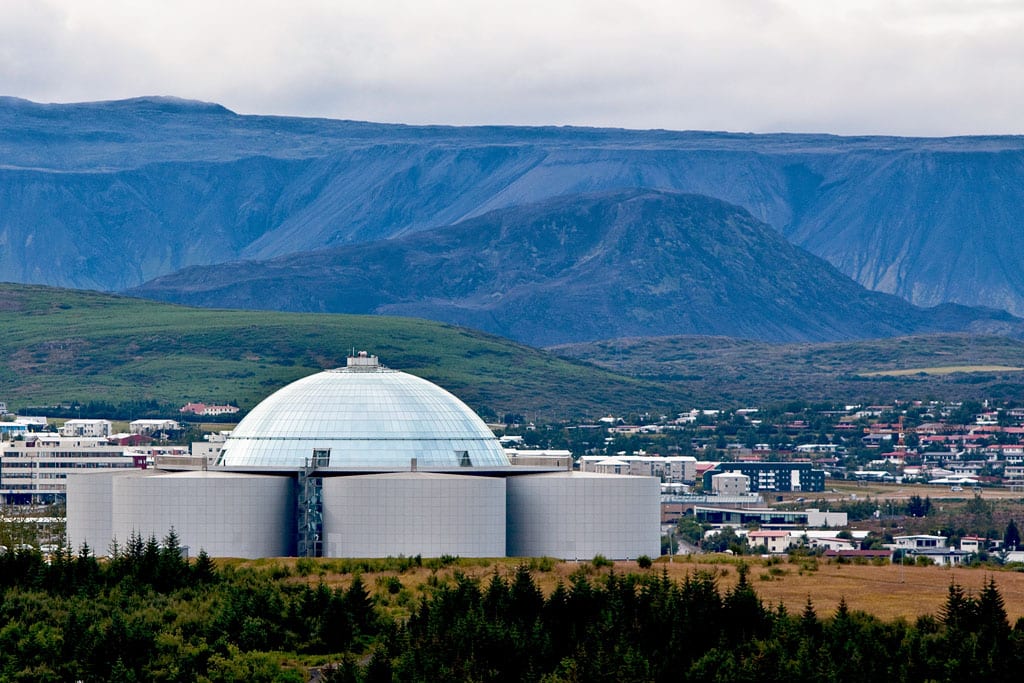
Perlan exhibition
Perlan also has an observation deck, a souvenir shop (one of the oldest in town), a cafe and a restaurant serving seasonal Icelandic dishes. The Öskjuhlíð hill offers scenic walking and bike trails.
If you have a few hours and especially if you are traveling with children, Perlan is really worth visiting. Its exhibitions offer useful facts about things and phenomena that you can actually see while driving through Iceland.
Perlan – address, directions, opening hours, admission
- Perlan is located on the Öskjuhlíð hill, in the southern part of town, not far from the Reykjavik City Airport.
- The nearest bus stop, served by lines 18 and 13, is called Perlan.
You can also take a free shuttle bus from Harpa. For all visitors with valid admission tickets the service is free and the shuttle bus leaves every hour on the hour between 10:00 and 18:00. - From Hallgrimskirkja it is only 2 km (1.2 mi) to Perlan, which means a 30-minute walk. After (or before) your visit to Perlan it is nice to stroll through the park south to the thermal beach (you can read a separate article about Nautholsvik here: Reykjavik hot pools).
- Perlan is open daily from 9 a.m. till 9 p.m. Allow 2-3 hours for the visit, depending on how fast and how thoroughly you want to see it.
- Admission to the Wonders of Iceland experience – all the exhibitions, the Áróra northern lights show in the planetarium, the volcano show, the ice cave and the observation deck – costs 7,190 ISK (about $60) for adults and teenagers from 13 years, 5,190 ISK (about $45) for children aged 5-12, and is free for children up to 4. Get your tickets here: Perlan – Wonders of Iceland ticket or here: Perlan entrance tickets.
- Perlan is wheelchair accessible.
- There is a free parking lot in front of the building.
Husdyragardurinn: zoo and amusement park in one
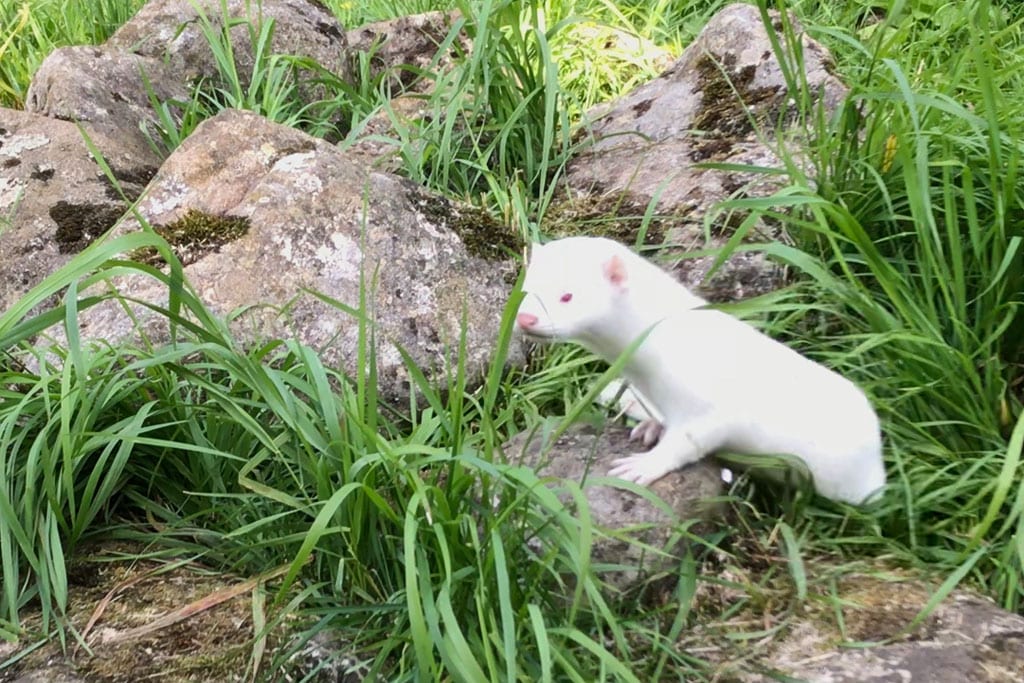
A mink in Husdyragardurinn
This zoo is different from any other zoo in the world in that it has no exotic animals. Visitors can admire exclusively species that live in Iceland. Many of them, like reindeer, can be approached, touched and fed, provided they are not too shy.
The decision to build Húsdýragarðurinn Zoo was made on April 22, 1986. The purpose behind it was to educate the public about Icelandic animals, show breeding practices and strengthen the connection between humans and animals. The construction started in 1989 and within just a year they built a pond for seals, areas for foxes, minks and reindeer as well as an enclosure for goats. The place opened on May 19, 1990. Currently the Húsdýragarðurinn Zoo is also home to farm animals, such as pigs and horses. There is also a small exhibition of amphibians, reptiles, insects and fish here.
A day in Húsdýragarðurinn Zoo & Park
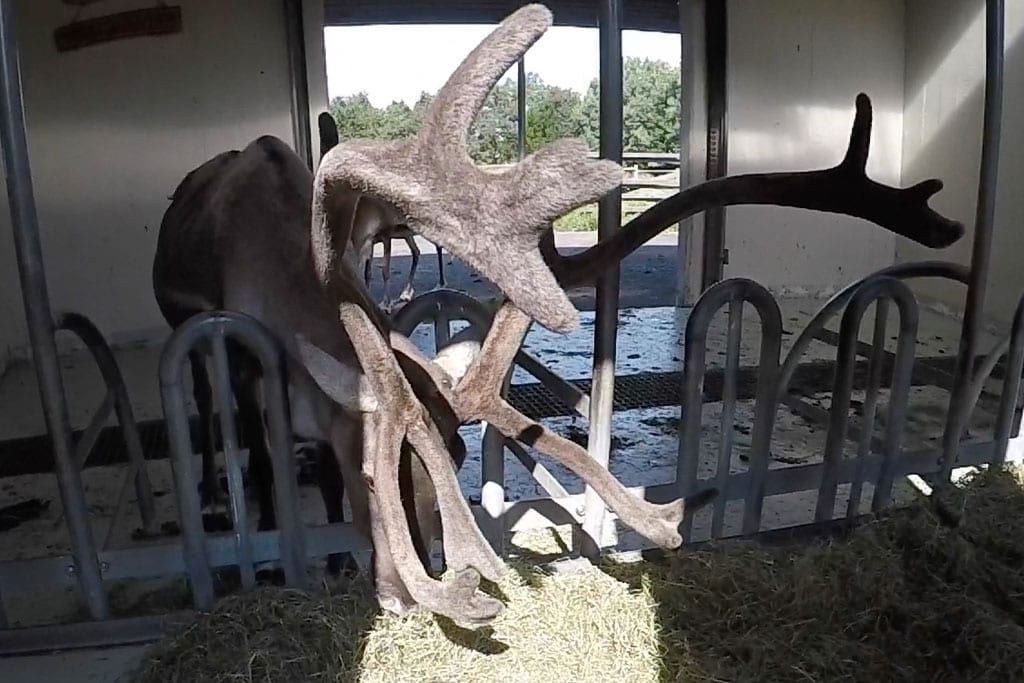
Reindeer in Husdyragardurinn
10:30, 15:30 – reindeer feeding and presentation
11:00, 16:00 – seals feeding and presentation
11:30 – foxes feeding and presentation
14:00 – environmental enrichment for the animals (changing locations)
15:45 – small animals and birds feeding
16:30 – cattle and pigs feeding
17:00 – closing time (18:00 in summer)
Activities and times can vary depending on the weather. The current program is on the zoo’s website (see below).
Husdyragardurinn Zoo – address, directions, opening hours, admission
- Husdyragardurinn Zoo is in the Laugardalur valley in the eastern part of Reykjavik, some 3 km (about 2 miles) east of Hallgrimskirkja.
- You can easily get here by car (free parking shared with the ice rink) or by bus – the Laugardalshöll stop with lines 2, 5, 15 and 17.
- The Grasagardur botanical garden and Fjolskyldugardurinn amusement park are right next door.
- The zoo is open daily, 10:00-17:00 in winter and 10:00-18:00 in summer.
- With the Reykjavik City Card admission is free. Without the card: adults (18 and over) pay 2,800 ISK (about $23), children and teenagers aged 6-17 – 1,600 ISK (about $13), and children up to 5 enter free of charge.
- Húsdýragarðurinn Zoo & Park has a cafeteria that serves snacks, light meals and drinks (in season it is the famous Bæjarins Beztu hot dog stand). If you don’t fancy eating here, you can bring your own food and… make a barbecue. In Húsdýragarðurinn Zoo & Park there are a few electric grills that visitors can use for free.
- You can get your tickets at the ticket counter in the zoo, but all the details, the daily program and special offers are published on its website: Reykjavik Park and Zoo.
Harpa — modern concert hall and conference center
Harpa is the main concert hall and conference center in Reykjavik. It is also one of the major landmarks in the city.
The idea to build a concert hall in Reykjavik came about already in the 1880s. However, construction did not start until 2007, and in 2008, due to the financial crisis, works were temporarily put on hold. The government of Iceland decided, nevertheless, that Harpa was a building that the country could benefit from, and therefore its completion was financed. The facility opened in 2011 and is a product of collaboration between Ólafur Elíasson, a Danish-Icelandic artist, and the Danish company Henning Larsen Architects.
Futuristic architecture of Harpa
According to many tourists, Harpa is completely out of place among the low, traditional buildings in the center of Reykjavik. Others, however, are charmed by its modern, futuristic design. The look of the building is said to reflect the basalt landscape of Iceland, and the dark glass produces delightful visual effects, both in natural and artificial, evening light. Just like Hallgrimskirkja church, it is a striking element of the cityscape that brings something new and unprecedented. Whether these two landmarks make the cityscape more or less beautiful… Well, you’ll have to decide for yourself…
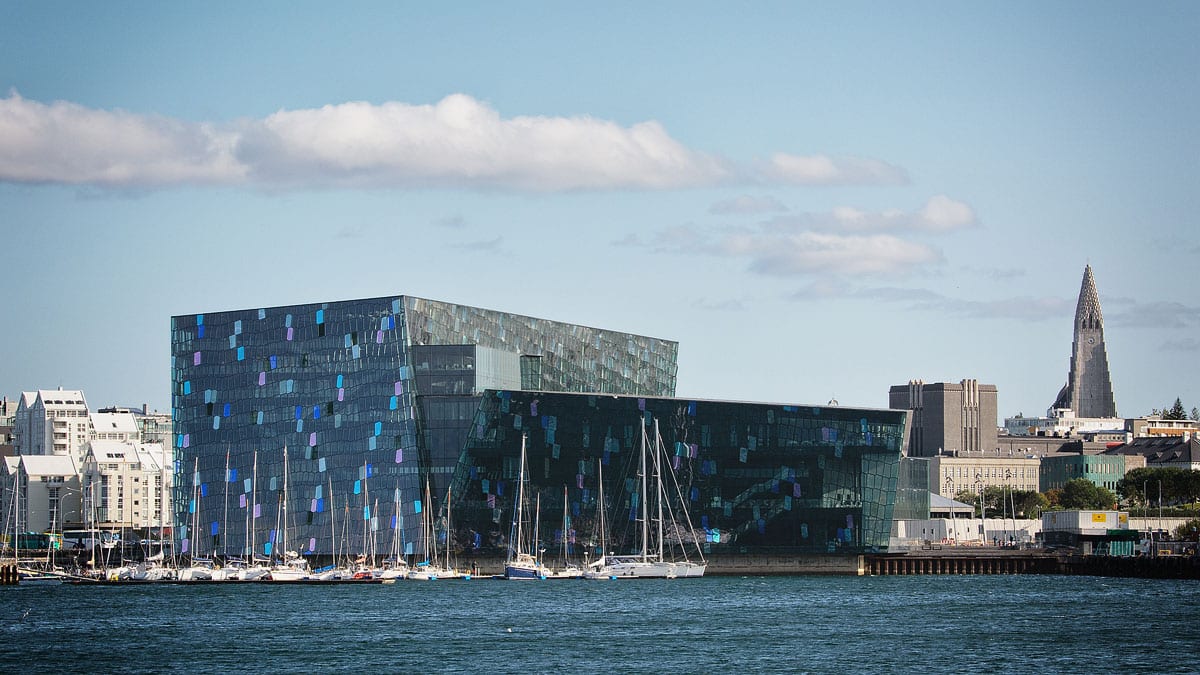
Harpa and Hallgrimskirkja seen from the docks.
Harpa — musical and cultural center
Harpa is an undisputed center of Icelandic art and culture. It hosts concerts, cultural events, meetings and festivals: Iceland Airwaves, Reykjavik Midsummer Music, Dark Music Days, Reykjavik Arts Festival, Reykjavik Jazz Festival, Sónar Reykjavík, Tectonics, and Harpa International Music Academy. Many famous international artists have performed on its stages, such as Eddie Izzard and Cyndi Lauper, as well as Iceland’s own talents, including Björk and Of Monsters and Men. The building is also home to the Iceland Symphony Orchestra and the Icelandic Opera.
Harpa also rents out conference rooms of different sizes for outside events. All the facilities are top-notch and come with all the necessary conference equipment.
Harpa – address, directions, opening hours, admission
- Harpa is located in the very city center, on the waterfront (Austurbakki 2), close to Reykjavik’s main junction of Laekjargata and Saebraut streets. There is a bus stop right in front of its entrance where line 3 stops. And another bus stop, Laekjartorg – 200 m (650 ft) away – is served by lines 1, 6, 11, 12 and 13.
- The view of Harpa is best enjoyed as you walk from the vicinity of Hallgrimskirkja, crossing the Ingólfur square, and continuing toward the port.
- Definitely the best way to see more of Harpa is to go to one of the concerts. Ticket prices start at approx. 3,000 ISK (about $25), but of course when we are talking about big stars, like Björk, one has to pay much, much more (provided that you are lucky and tickets are still available).
- However, if you don’t fancy anything that is on at the moment or tickets are sold out, you can still walk around and access the open space. Harpa is open Sunday to Tuesday from 10:00 to 18:00 and Wednesday to Saturday from 10:00 to 20:00; the box office is open daily from 10:00 to 18:00 and longer on event nights.
- You can also go on a guided tour (in English). Scheduled tours are offered in the summer season – the dates are published in the “What’s On” section of Harpa’s website – and a private tour for a group of at least 10 people can be arranged by e-mail at any time of year. Expect to pay around 2,500 ISK (about $21) per adult for a scheduled tour; with the Reykjavik City Card you get 25% off.
- All the streets in the vicinity are a vibrant collection of restaurants, bars, shops and various (usually smallish) museums. A stroll along Laugavegur and Hafnarstraeti is the best way to experience the more traditional architecture of Reykjavik.
- Official Harpa website: Harpa Concert Hall.
National Gallery of Iceland
The National Gallery of Iceland (isl. Listasafn Íslands) mostly features Icelandic art of the 20th and 21st centuries. It is obviously the most extensive (more than 15,000 works) and most valuable collection of Icelandic art.
The Gallery, which occupies 3 floors of space, is unable to showcase a significant part of its collection at any one time. Therefore, it organizes various thematic shows of paintings, sculpture, photography and other genres of Icelandic art. Usually at least one exhibition is devoted to folklore and the traditional legends, sagas or beliefs of the Icelandic people.
The Gallery’s longer-running shows are housed in its second building – The House of Collections (isl. Safnahúsið), the former Culture House, described below.
The National Gallery of Iceland – address, directions, opening hours, admission
- The Gallery is at Fríkirkjuvegur 7, right on one of the main streets, with the Fríkirkjuvegur bus stop right next to it (lines 1, 3, 6, 11, 12 and long-distance 55). Reykjavik is not a big city, so the distances to cover are not long at all. Hallgrimskirkja is about 650 m (700 yd) to the east, Harpa approx. 750 m (800 yd) north, and the National Museum only about 500 m (550 yd) away to the southwest.
- The Gallery is open daily from 10 a.m. till 5 p.m., all year round.
- Admission for an adult costs 2,500 ISK (about $21), and the same ticket is valid for the House of Collections; students and seniors (67+) pay 1,250 ISK (about $10), children and teenagers up to 17 enter free. A combined ticket that also covers the Einar Jónsson Museum costs 2,900 ISK (about $24). With the Reykjavik City Card you get in for free.
- National Gallery of Iceland website: National Gallery of Iceland.
The House of Collections (The Culture House)
The House of Collections (isl. Safnahúsið), long known as The Culture House, is a handsome building from 1908 that originally housed the National Library, the National Archives, the collection of the Natural History Museum and the country’s antiquities. For years it was a joint project of six Icelandic cultural institutions – the National Museum, the National Gallery, the Natural History Museum, the National Archives, the University Library and the Arni Magnusson Institute for Icelandic Studies – which together ran the Points of View (isl. Sjónarhorn) exhibition on Iceland’s cultural heritage. Today the building belongs to the National Gallery of Iceland and shows its long-running exhibitions of Icelandic art – currently “Collected Treasures of Icelandic Art” (until 2028) and “Folklore in Icelandic Art” (through 2026).
The House of Collections – address, directions, opening hours, admission
- The House of Collections is located in the very heart of Reykjavik – Hverfisgata 15. It is rather precisely half-way between Hallgrimskirkja and Harpa.
- The nearest bus stop is Thjodleikhusid (Þjóðleikhúsið), with lines 1, 6, 11, 12, 13 and 14. But it is best to just walk here, especially since the street parallel to Hverfisgata – Laugavegur – is Reykjavik’s main promenade. There are precious few parking spaces in the vicinity, plus it is a paid parking area (250 ISK – about $2 – per hour).
- It is open daily from 10 a.m. till 5 p.m.; the National Gallery ticket (2,500 ISK, about $21) is valid here as well. Website: The House of Collections.
Reykjavík Art Museum
Reykjavík Art Museum (isl. Listasafn Reykjavíkur) is all about Icelandic modern art. Its exhibits are showcased in three buildings scattered around Reykjavik: Hafnarhús, Kjarvalsstaðir and Ásmundarsafn. Two of these are devoted to specific artists, while the third one features a more general collection.
Kjarvalsstaðir
As the literal name, the Kjarval place (Kjarvalsstaðir), suggests, the exhibition in this building holds works by one of the most famous Icelandic artists, Jóhannes Kjarval (1885-1972). You will find here mainly paintings and sculptures by this renowned modernist. To my unenlightened eye, some are really interesting.
The building itself, an example of modernist architecture, is at Flókagata 24, on the edge of the Klambratún park, some 700 m (half a mile) southeast of Hallgrimskirkja. The nearest bus stop is Kjarvalsstaðir, with line 13, but it is only a 10-minute walk from Reykjavik’s main bus terminal – Hlemmur. Open daily 10:00-17:00.
Ásmundarsafn
Ásmundarsafn is also home to the legacy of just one artist – sculptor Ásmundur Sveinsson (1893–1982). Sveinsson himself designed the building, which slightly resembles an astronomical observatory. The artist lived and worked in this building for many years. It is situated at Sigtún (105 Reykjavík), in the eastern part of town. It is adjacent to the sports and leisure district, where you can find the Laugardalslaug swimming pool, the Husdyragardurinn zoo, as well as the main city campsite and the HI hostel. The nearest bus stop is called Nordica and is served by lines 2, 5, 15 and 17. Open daily 13:00-17:00.
Hafnarhús
This museum showcases the most diverse exhibitions of both local and international modern artists. Hafnarhús used to be a port warehouse in the old, formerly port district near the docks and the Ingólfstorg square. The address is Tryggvagata 17 and it is best reached on foot from the vicinity of Harpa. The neighborhood where Hafnarhús is located is vibrant with small galleries, restaurants and bars. Across the street you will find the Reykjavík Museum of Photography. Open daily 10:00-17:00, on Thursdays till 22:00.
Admission to all three galleries costs 2,550 ISK (about $21); students pay 1,550 ISK (about $13). Tickets are valid for 24 hours. Children and youth under 18 as well as Reykjavik City Card holders are admitted free of charge.
Website: Reykjavík Art Museum.
Map of exhibitions in Reykjavik
All the exhibitions described above are marked on the map below.
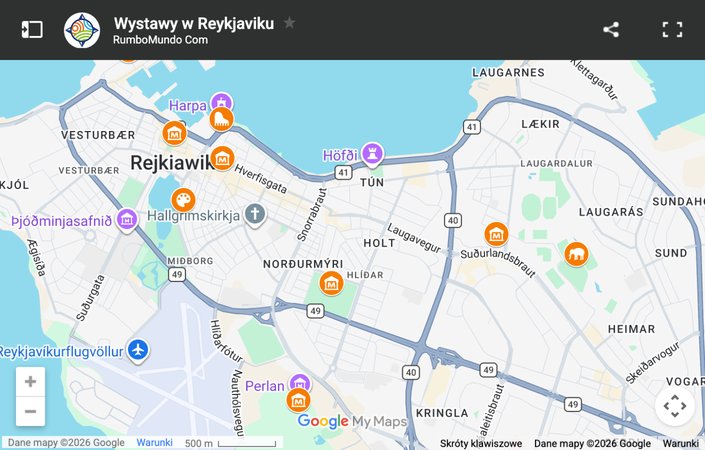
Map: exhibitions in Reykjavik — click to open the interactive map