Of course, for a climatologist, a period of 23 years is certainly not enough to determine a country’s climate on this basis. Nevertheless, a comparison of weather from the end of the 20th century and the beginning of the 21st century clearly shows the direction of change.
A separate article discusses at length the weather Iceland actually had between 2000 and 2022 (see Weather in Iceland – temperature, wind, precipitation).
The year 2000 is actually still the 20th century, but compare the data shown there to the results from the end of the 20th century: the years 1977-1999 (that is also 23 years). From the comparison it is clear that Iceland used to be (still) more inaccessible: colder and noticeably windier.
The satellite photo in the header of this article comes from the Copernicus Sentinel-2 mission: European Union, Copernicus Sentinel-2 imagery. The full photo, with the front of the Breiðamerkurjökull glacier above Jokulsarlon marked for several years back:

The extent of the Breiðamerkurjökull glacier (by Jokulsarlon) over the last decades
source: European Union, Copernicus Sentinel-2 imagery
Changes in air temperature in Iceland
own analysis based on 1977-2022 data from Veðurstofa Íslands, vedur.is
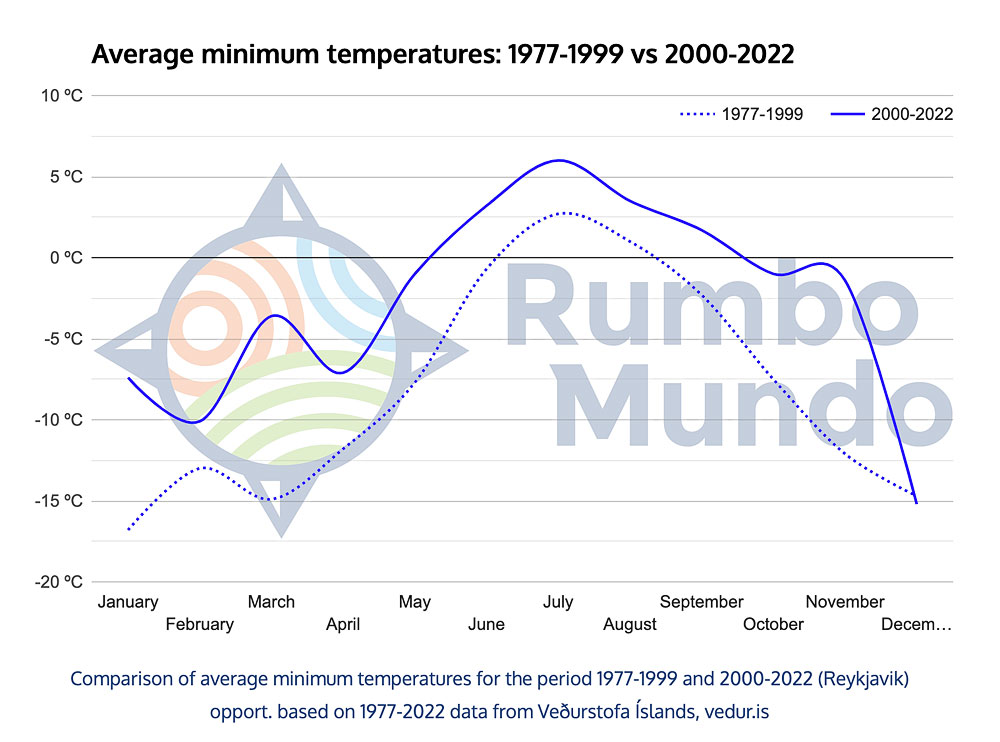
Perhaps (even) more telling is the chart of the lowest recorded temperatures. The minima recorded in the 1977-1999 period were as much as 5.5 °C (9.9°F) lower than in the last “nearly a quarter century” (chart below). The record difference on the chart (March) was as much as 11.3 °C (20.3°F).
own analysis based on 1977-2022 data from Veðurstofa Íslands, vedur.is
Where I book my own Iceland trips
Best Iceland deals
Selected partner sites, best prices
Changes in wind strength in Iceland
The recorded average wind speed, on the other hand, is now just over 6 km/h (3.7 mph) lower. Again: 6 km/h may look inconspicuous, but in relative terms it is a drop of more than 30%!
own analysis based on 1977-2022 data from Veðurstofa Íslands, vedur.is