


Jökulsárlón is the best place in Europe to admire glacier calving. One of the spectacular effects of this phenomenon is the nearby Diamond Beach. Another place worth visiting in the area is the Fjallsárlón lagoon.
Jökulsárlón glacial lagoon
Jökulsárlón glacial lagoon is relatively new. It began forming in 1934 as a result of the Breiðamerkurjökull retreating. Fed by water from the naturally melting glacier, the lagoon keeps expanding as the glacier keeps retreating. Since 1970 it has grown 4 times in size. Its current area is about 25 km2 (10 sq mi) and its maximum depth over 280 m (920 ft) — which makes it the deepest lake in Iceland (source: Wiki).

The extent of the Breiðamerkurjökull glacier (at Jokulsarlon) over the past decades
source: European Union, Copernicus Sentinel-2 imagery
Jokulsarlon is unique in that it is fed by the (rather intense) calving of the Breiðamerkurjökull glacier. The process involves small fragments separating from the glacier and floating down the lagoon – in the form of icebergs – into the open ocean. However, the passage separating the bay from the ocean is narrow, making water flow slowly and unpredictably (often ocean water flows into the lagoon instead of the other way round). As a result these icebergs tend to pile up in the lagoon. Also the mix of fresh and salty water gives the lagoon its exceptional color.
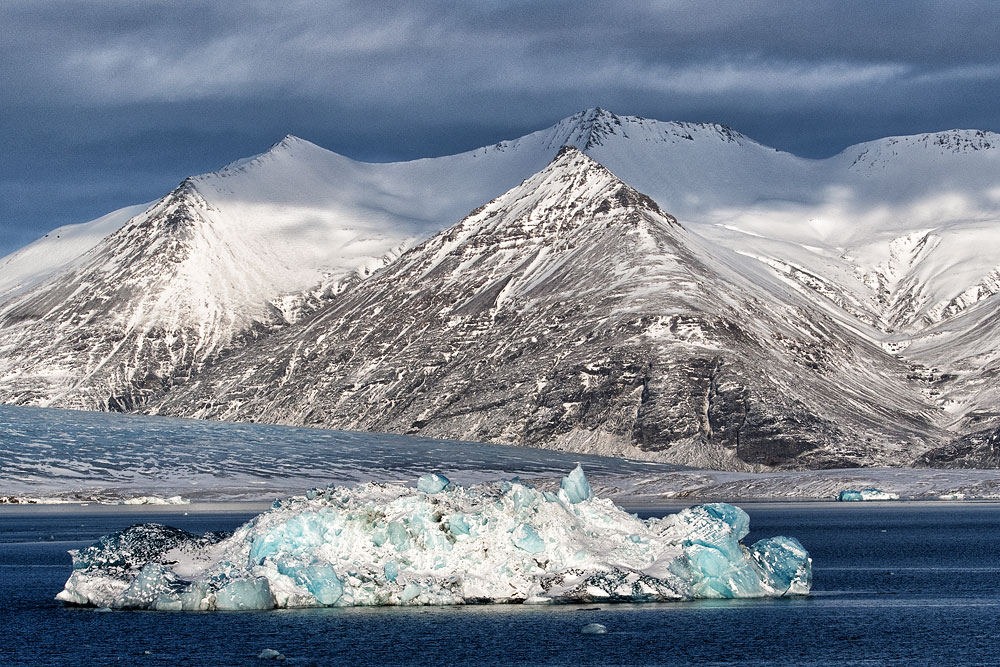
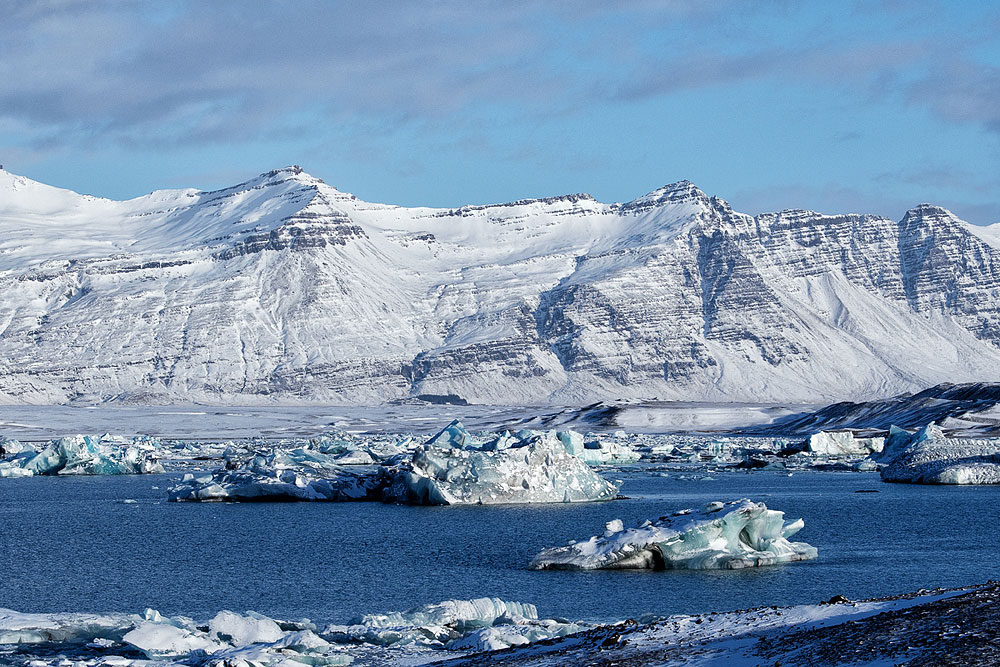
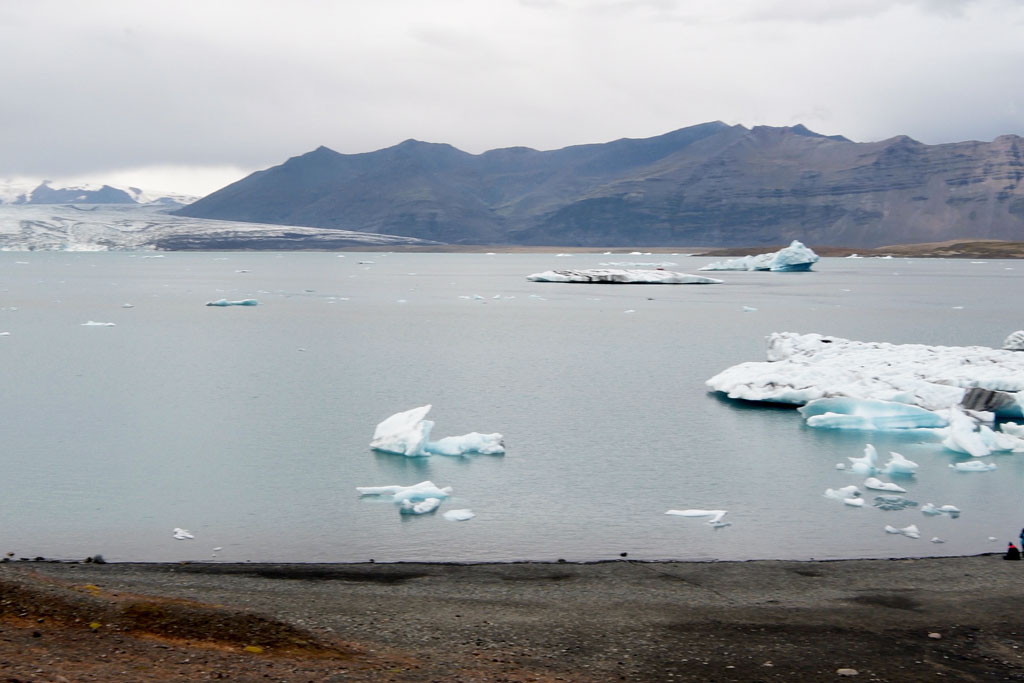
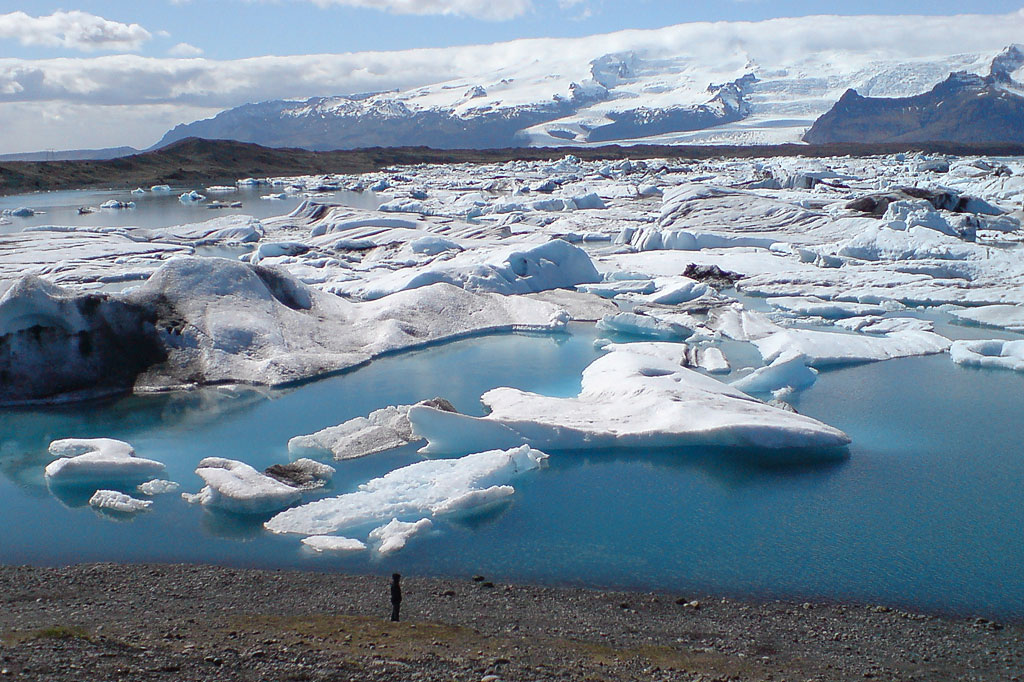
Additionally, Jökulsárlón is a great place to spot seals, which like to get in here through the narrow passage from the ocean to swim in the icy water or lounge on the shore. In summertime it becomes the nesting place to many bird species, including the Arctic tern (Sterna paradisaea).
The lagoon attracts plenty of tourists. In winter it is a popular place for Northern Lights hunters. They all want to see Northern Lights reflecting in the lagoon. It is said that the sight of the unique light reflected in the water of this iceberg-filled bay is unforgettable.
Video: See the Jokulsarlon lagoon with its icebergs and diamonds.
Cruises on the lagoon are offered by a great many companies, but so realistically in the end only one company – owned by the former private owner of the lagoon area – carries them all out. The cruise season runs from May to September, and sometimes into October. The organizers provide lifebelts, and for the RIB cruise also suitable raincoats (it’s worth using wellingtons, too, if available!).
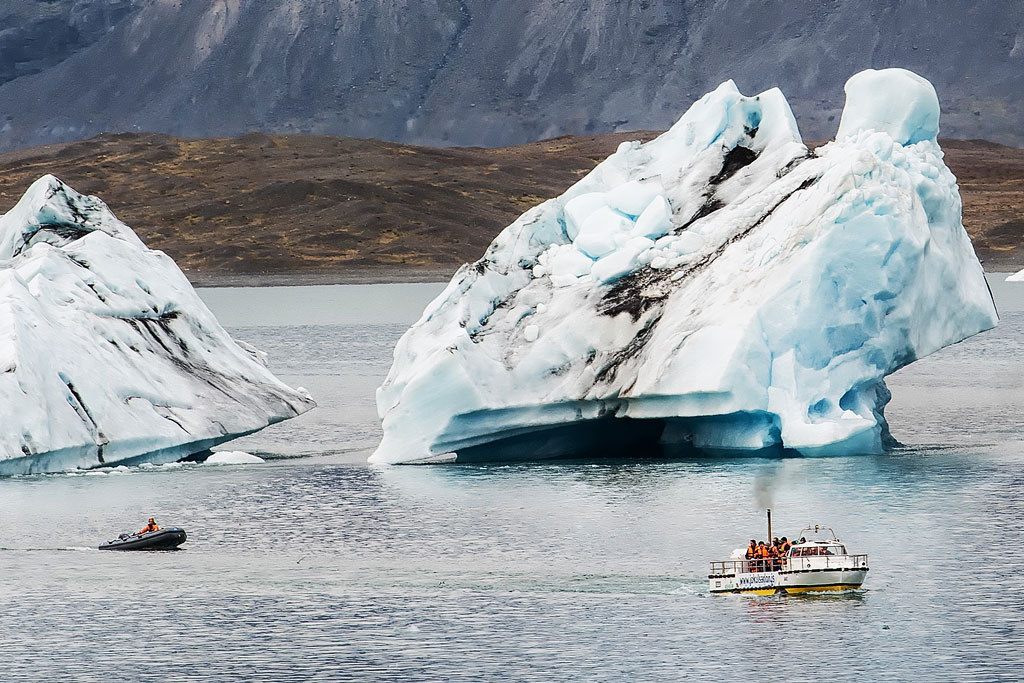
An amphibious cruise lasts about 35 minutes, costs just over 6,000 ISK (about $50; prices as of 2025) per person, is more comfortable, and essentially involves cruising between the icebergs on the bay. Children under 13 pay half the price, and children under 5 can participate for free (accompanied by an adult, naturally).
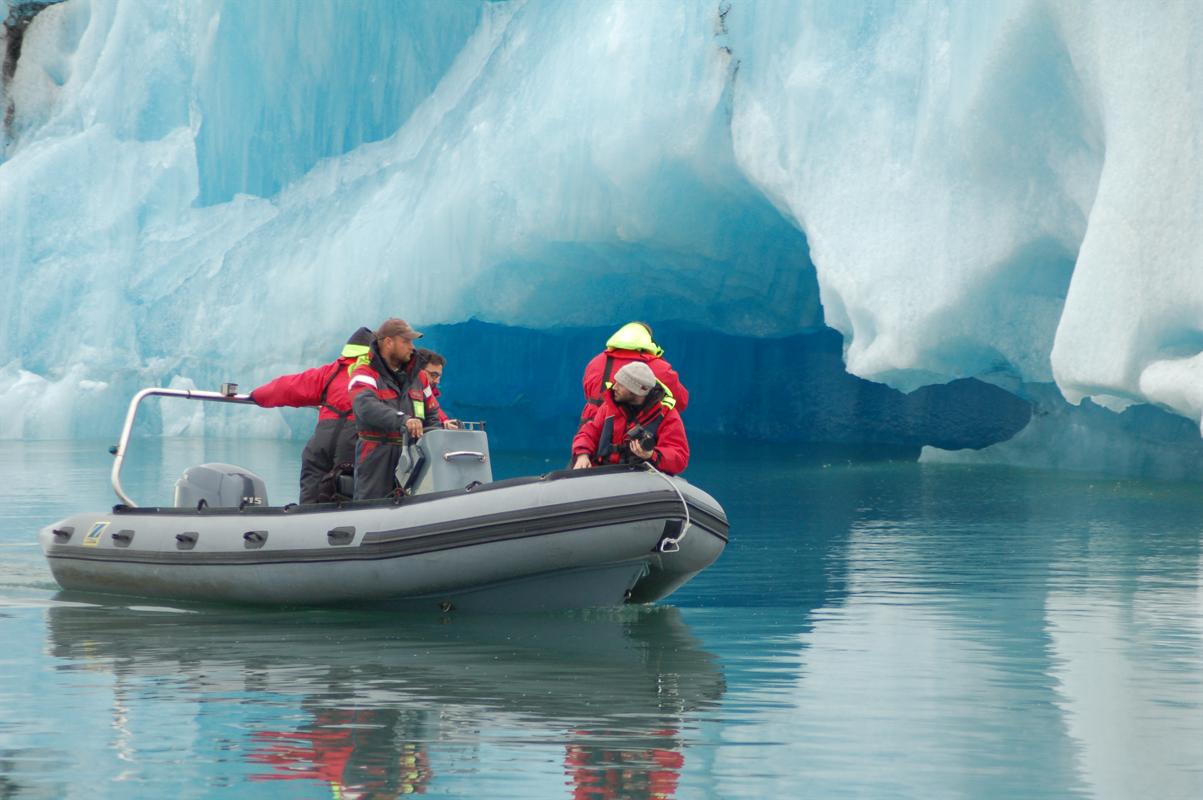
On the other hand, the Zodiac cruise (which is a rib or hard-bottomed dinghy) is longer (takes about 1 hr) and allows you to see the icebergs on the bay up close, and to go right up to the head of the glacier. These are certainly big advantages, but, as it were, in return, the cruise itself is much less comfortable (the wind blows harder, the dinghy splashes and you can hardly move around). Such a cruise is also more than twice as expensive – it costs almost 14,000 ISK (about $115) per person (prices as of 2025). The cruise is not available for children under 130 cm (4 ft 3 in) tall.
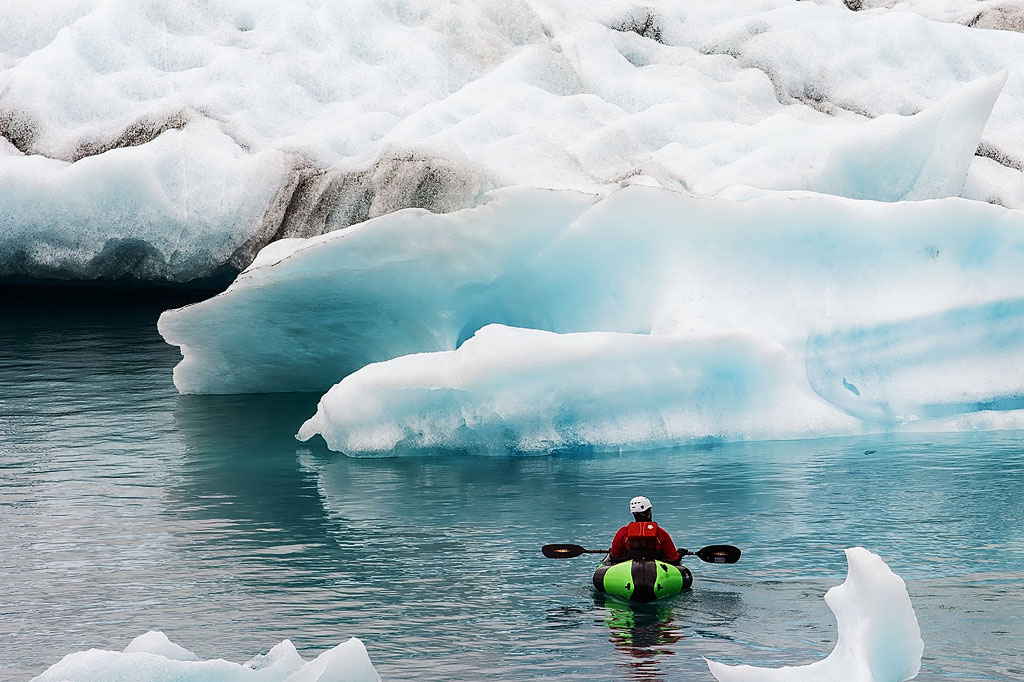
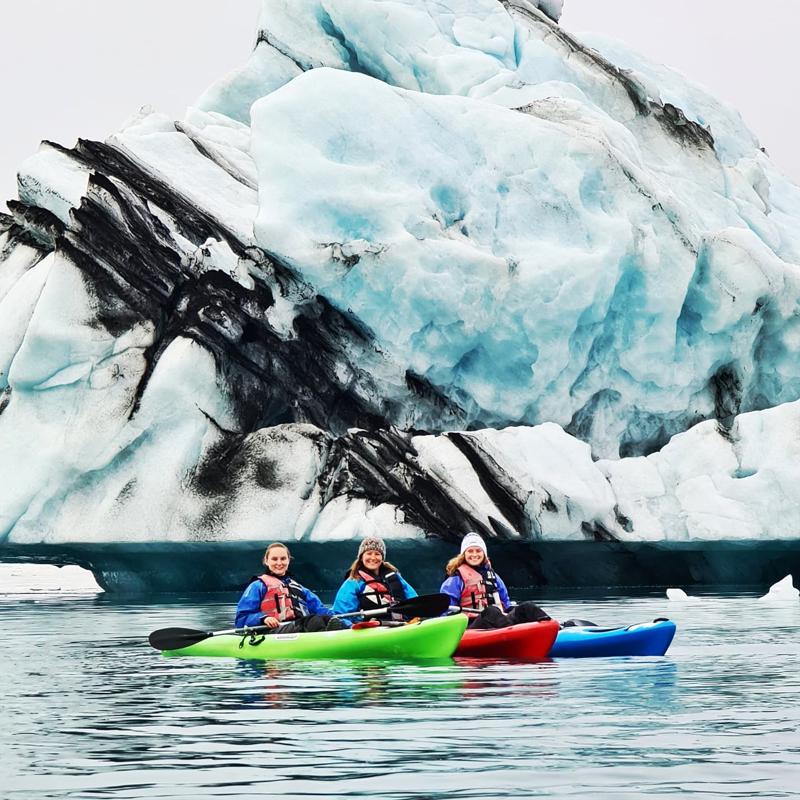
Finally: you can also take a kayak cruise on the lagoon! 🙂 Although your range is probably the smallest, and the risk of getting wet potentially the greatest, it is certainly the most private way to encounter the glacier and the only one done in silence. We sail naturally in a small group of several kayaks, accompanied by a guide. Renting a kayak costs 12,900 ISK (about $105). You have to be at least 14 years old to join this tour.

- Book an amphibious cruise here: Amphibious cruise on Jokulsarlon (about $50);
- Book a rib cruise here: High-speed dinghy cruise on Jokulsarlon (about $115);
- Book a kayak cruise here: Kayak cruise on Jokulsarlon (about $105);
There are also tours to Jokulsarlon from Reykjavik. We do not recommend the 1-day ones, because Jokulsarlon is quite far (almost 400 km / 250 miles!) from Reykjavik and such a trip is very tiring. On the other hand, 2-3 day tours are a much better idea and also give you more time to see other attractions of the South Coast. You can book such a tour here: Two-day tour to Jokulsarlon with lagoon cruise
Famous Diamond Beach
Right next to Jökulsárlón you can find the Diamond Beach (Icelandic: Fellsfjara), which is equally unusual as the lagoon.
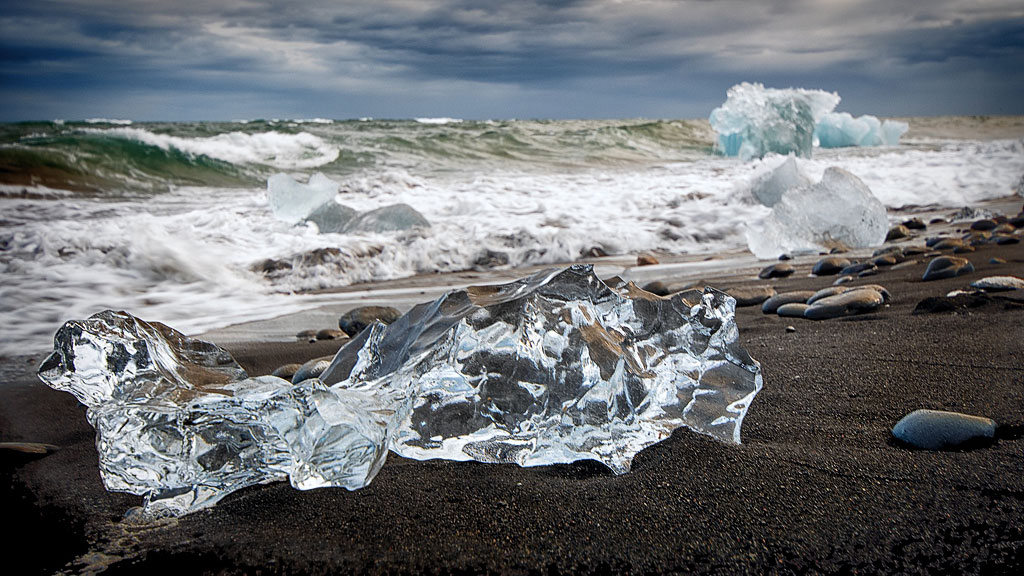

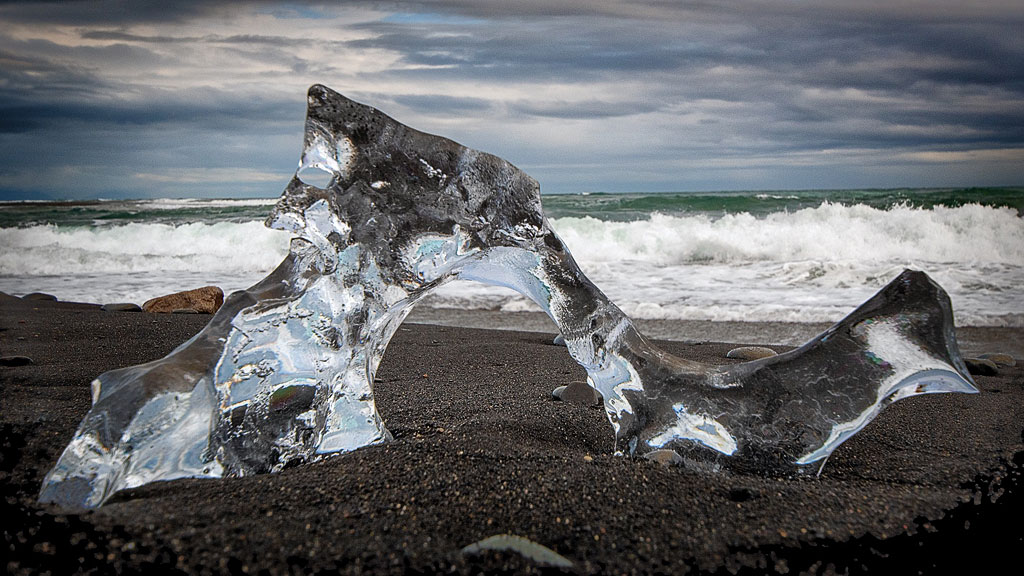
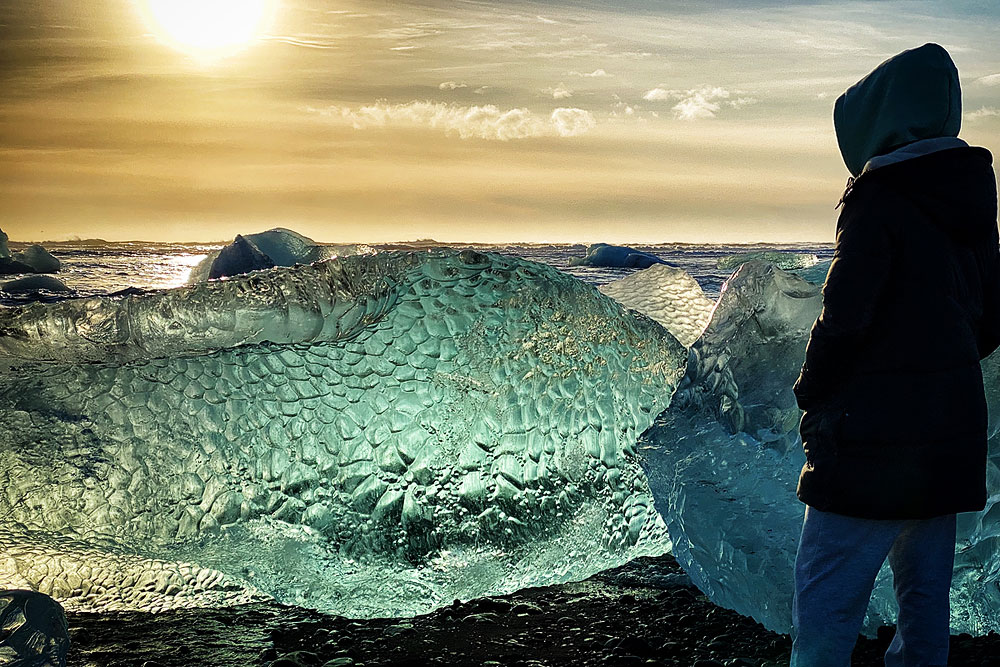
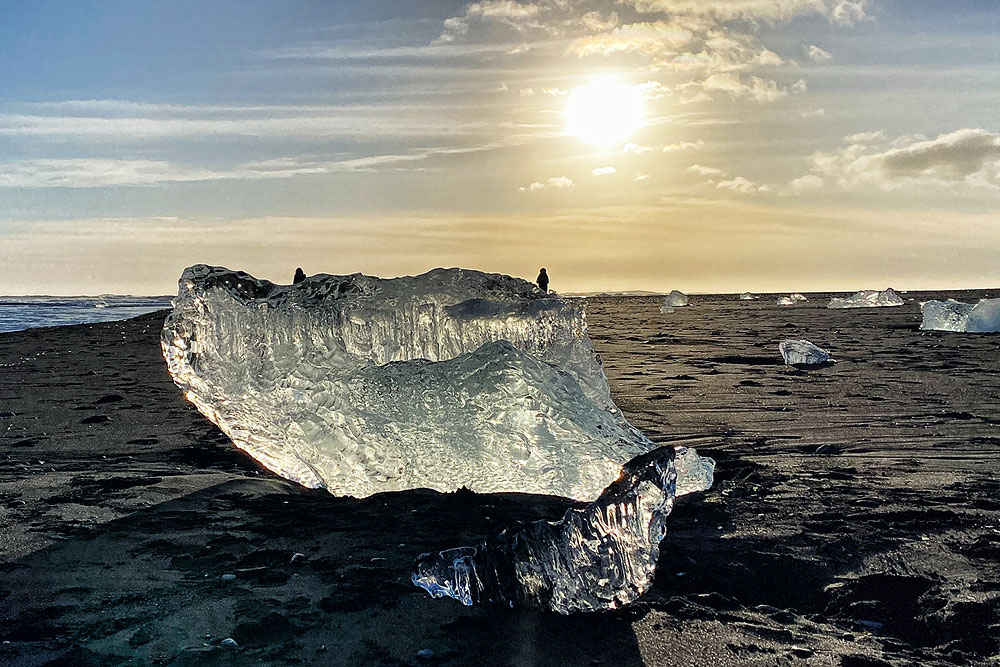
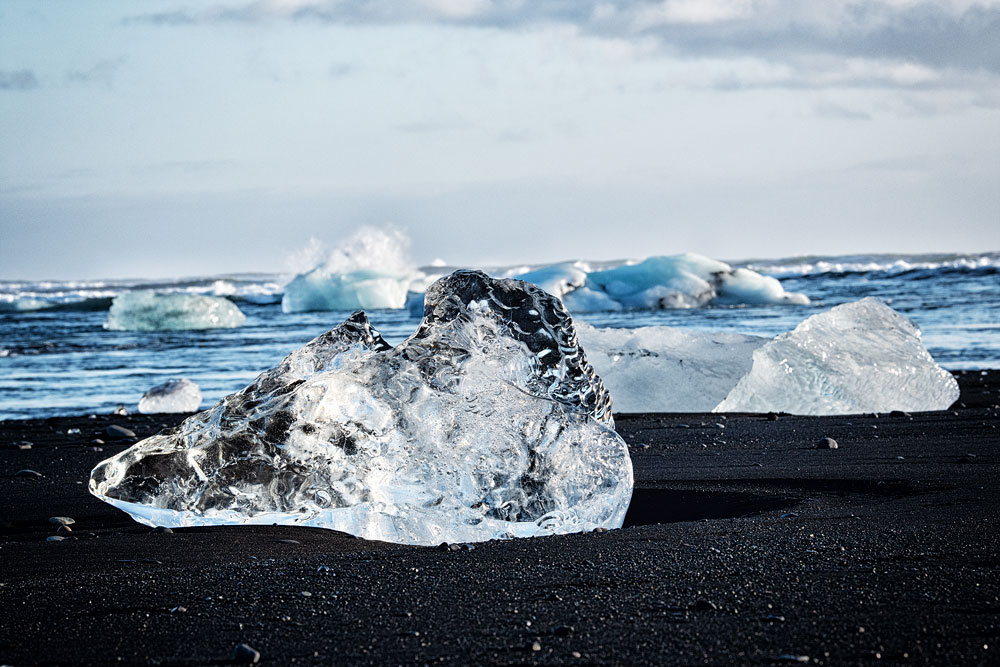
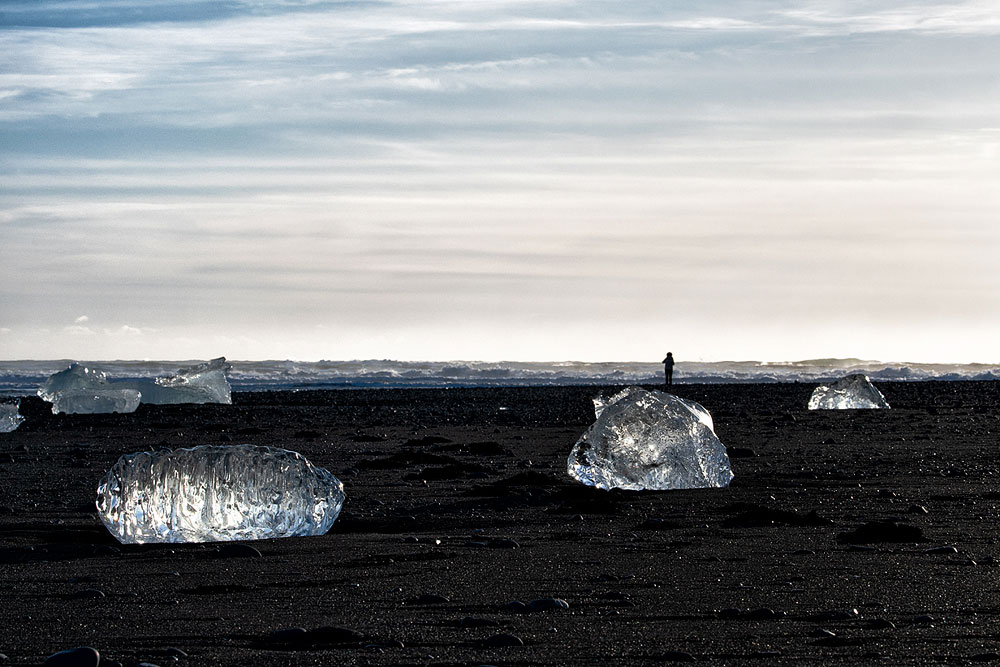
Diamond Beach owes its appeal – and catchy name – to the fragments of glacier that come down here from Jokulsarlon to melt. These icebergs exit the lagoon via a narrow passage and then the current brings them to the beach, where most of them slowly melt.
Small remains of icebergs melting into the black volcanic sand make for very interesting, albeit short-lived, shapes and forms. These white gems made of ice, gleaming in sunshine are the reason this amazing place received such a name. Indeed, when many smallish ice boulders sparkle on the black beach it is hard not to imagine a diamond necklace displayed against exquisite dark canvas.
If you are looking for splendid visual effects, try to come here at sunrise or sunset. The sun hanging right over the horizon plays beautifully on these chunks of ice. A thermos filled with coffee, a warm cap and a cloudless sky are absolutely necessary to make this an unforgettable (in a good way!) experience.
Fellsfjara or Breiðamerkursandur?
In guidebooks, on blogs and even on maps, the two names are often used interchangeably — and so did we. For clarity, we checked the source that settles such questions: Iceland’s official place-name register, kept by Náttúrufræðistofnun, the Natural Science Institute of Iceland, together with the Árni Magnússon Institute.
The register tells two things apart. Breiðamerkursandur is listed as a “sandur”, a glacial outwash plain built up by glacial rivers: the stretch of land that separates the Suðursveit and Öræfi districts, 27 km (17 mi) from farm to farm. Both lagoons, Jökulsárlón and Fjallsárlón, lie on it. The beach has names of its own, listed as “fjara” (shore, beach): Vestri-Fellsfjara west of the lagoon outlet and Eystri-Fellsfjara east of it.
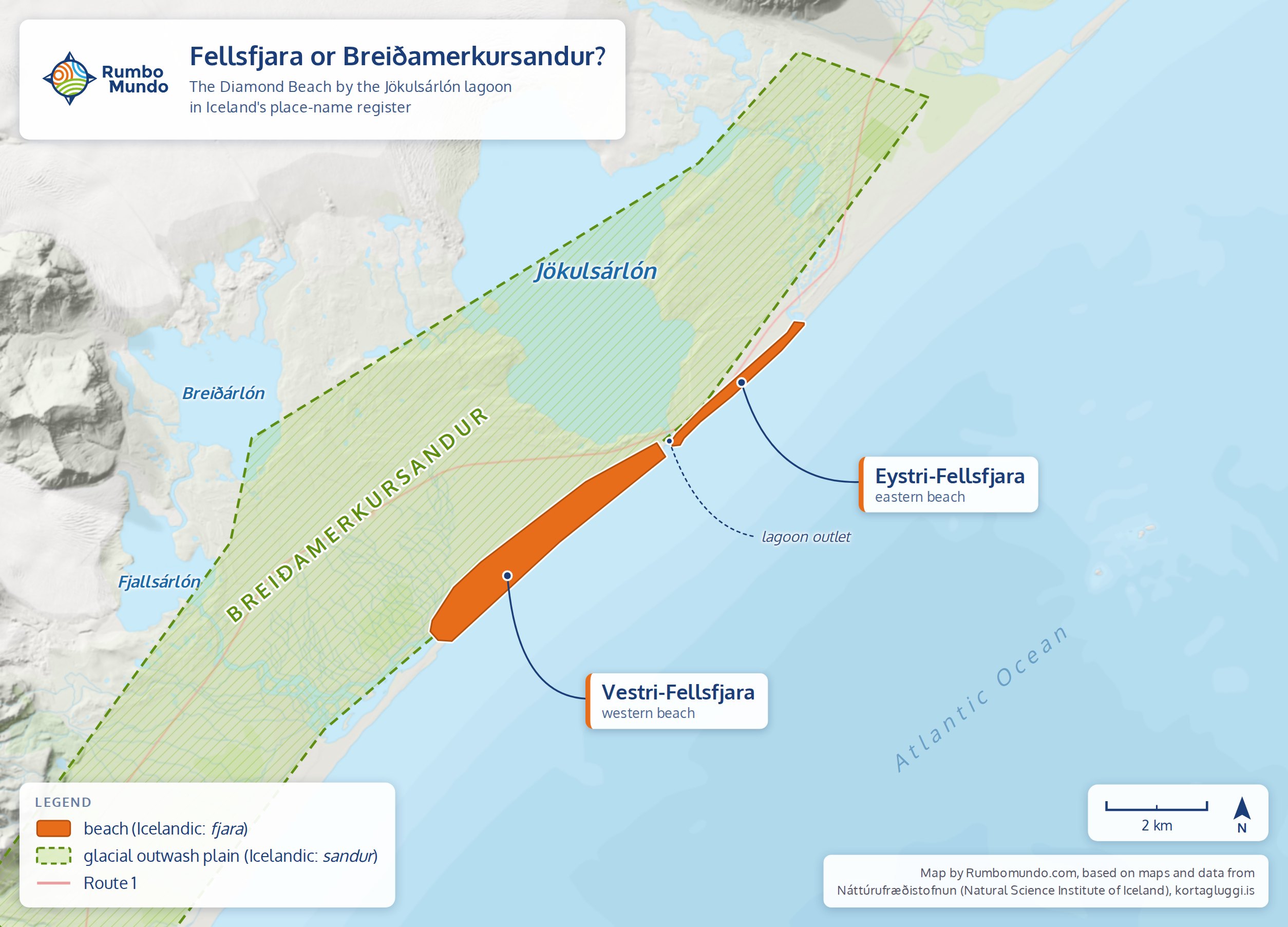
The Fellsfjara beaches and the Breiðamerkursandur plain in Iceland’s place-name register
map by Rumbomundo.com, based on data from Náttúrufræðistofnun (Natural Science Institute of Iceland), kortagluggi.is
These names were not made up by mapmakers. In the list of place names of the Fell farm, written down on July 23, 1961 by Professor Stefán Einarsson from the words of Þorsteinn Guðmundsson, a farmer at Reynivellir, the shore below the road is “Fellsfjara vestri” and the one east of the Jökulsá river is “Fellsfjara eystri” (copy at Þórbergssetur). Vatnajökull National Park, which has managed the area since 2017, uses the same names.
Fellsfjara literally means “Fell’s beach”, after the Fell farm, which stood below the Fellsfjall mountain (“fell” is Icelandic for a mountain) and was abandoned in the 19th century, when the glacier and floods took its land. It was the Fell estate that the Icelandic state bought in 2017. As for Breiðamerkursandur: “breiða” means wide or broad, “mörk” (plural “merkur”) an expanse of open land — or a wood, and “sandur” an outwash plain. Nothing here has anything to do with diamonds.
Amazing crystal ice caves

Beautiful ice cave
This utterly unique place can only be visited in winter (usually from November to March), but it is worth every hour and every penny you spend on it.
An ice cave is a beautiful natural tunnel inside a glacier, or at its bottom. It is formed by glacial streams flowing down it, and looks like a magnificent glass dome built or at least decorated by an inspired artist. The beautiful shapes and colors of the cave’s ceiling and walls are made of thick, compressed ice. However, this ice is so clear and transparent that it is quite bright inside the cave during the day…
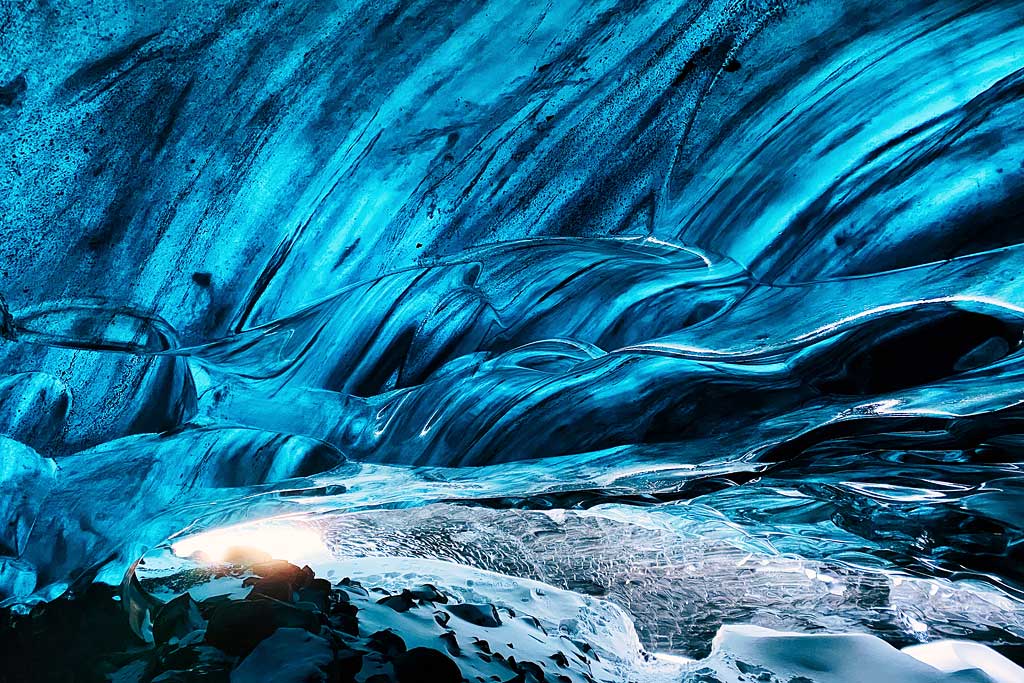
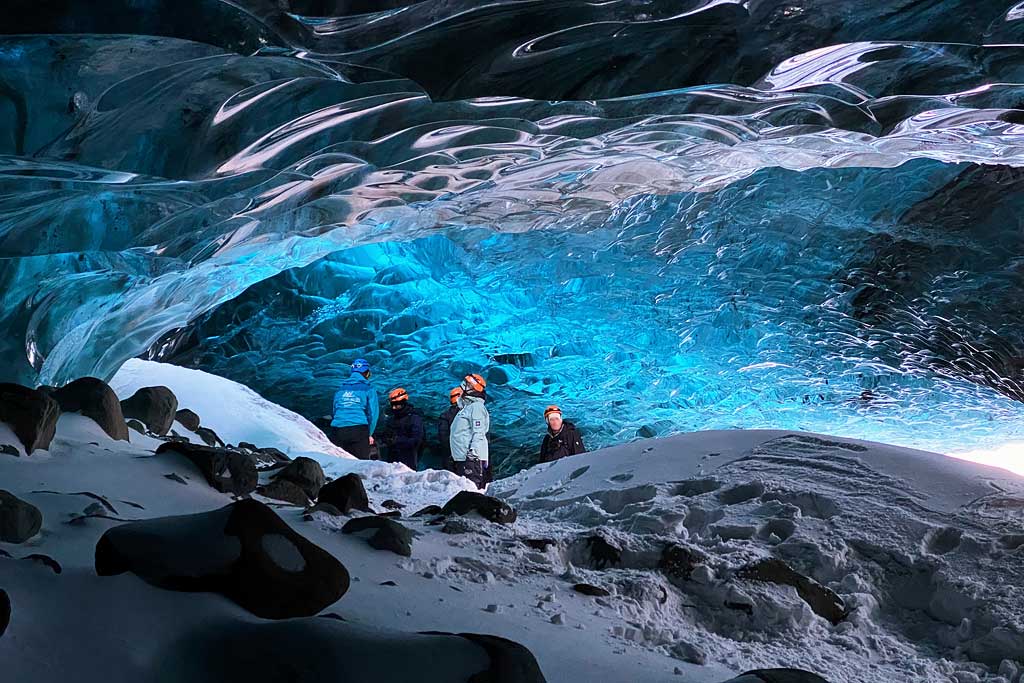

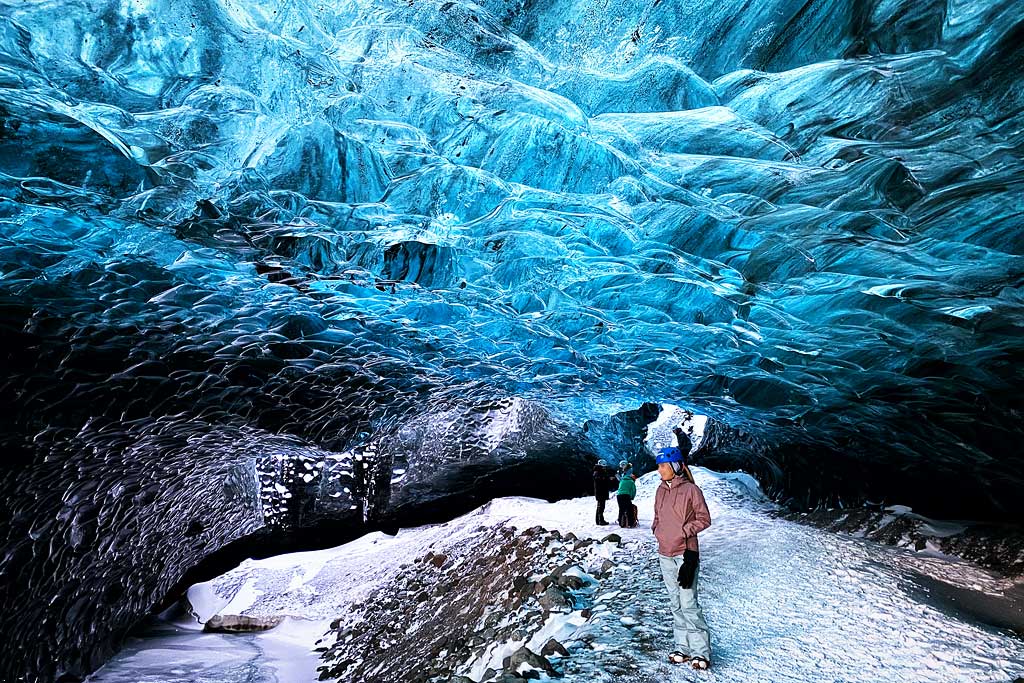
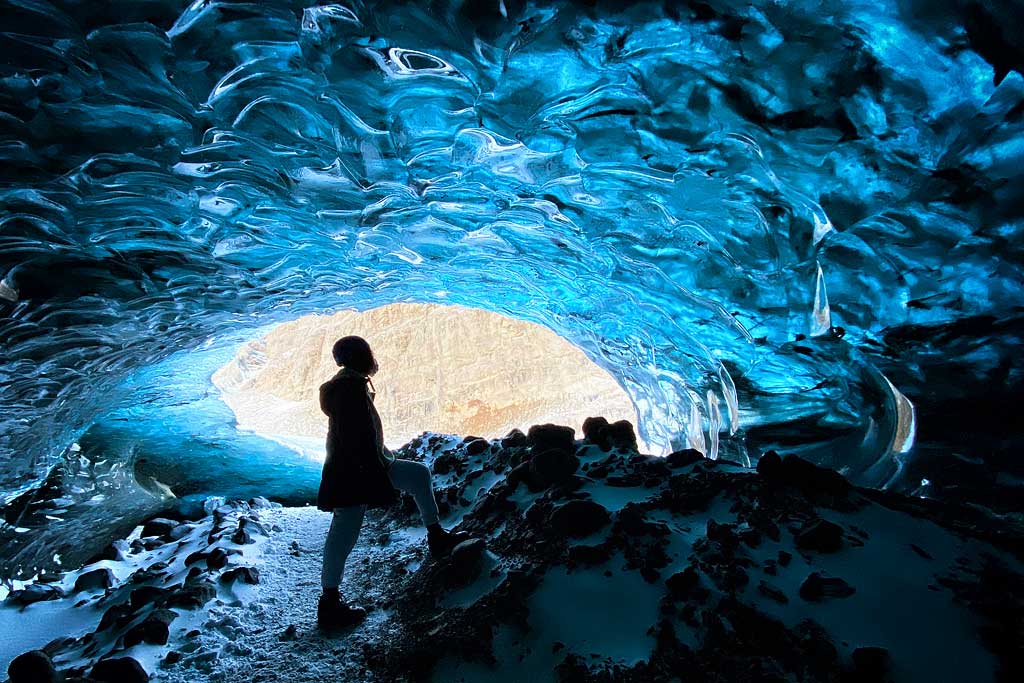
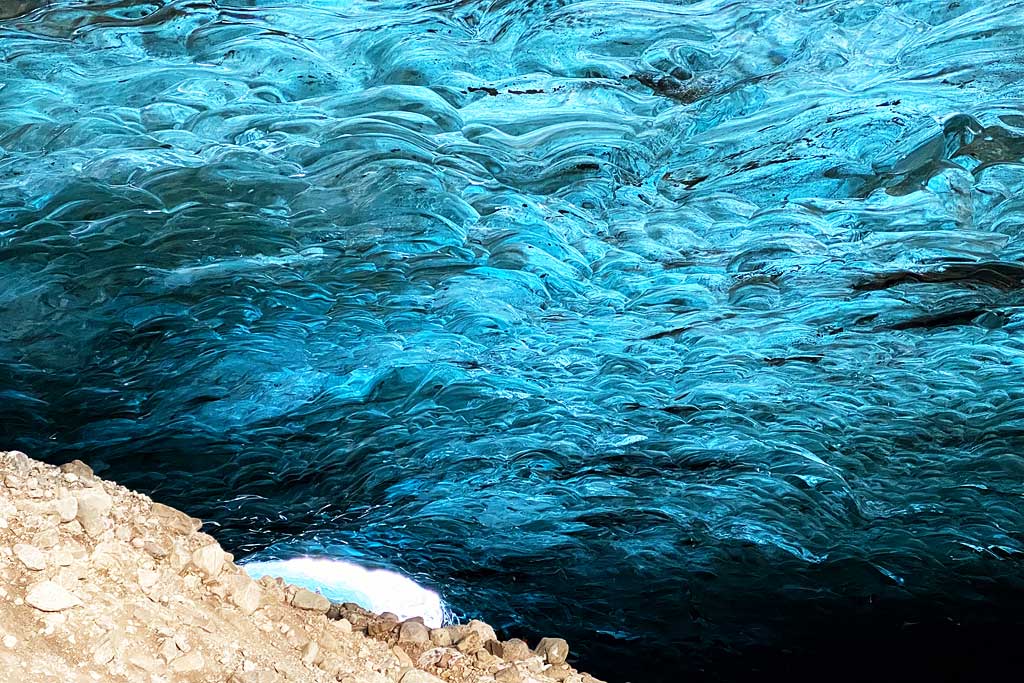
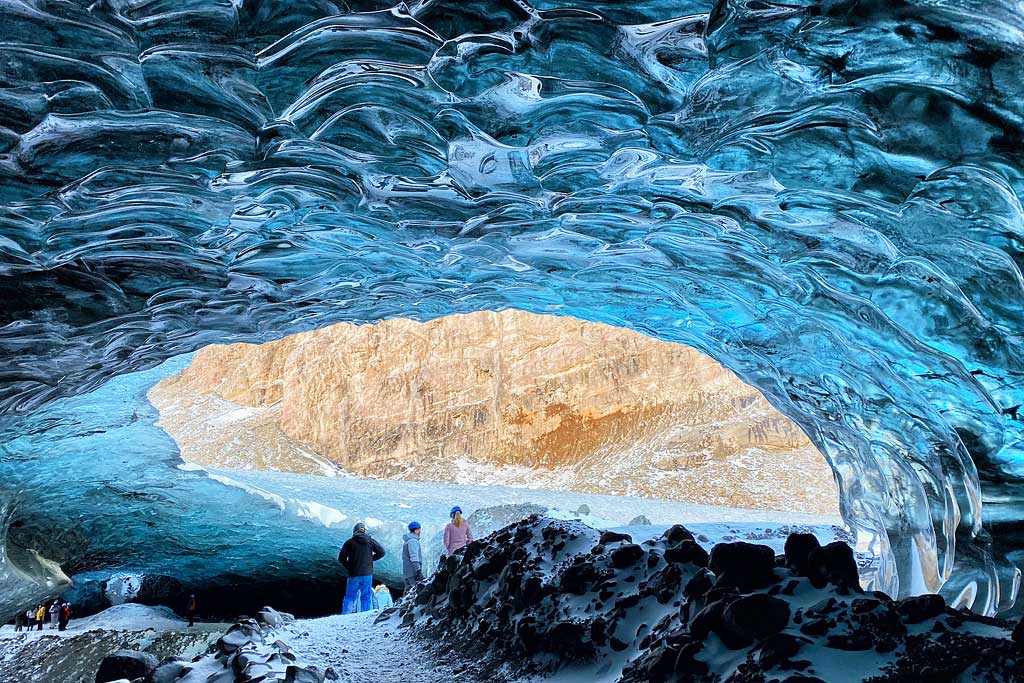
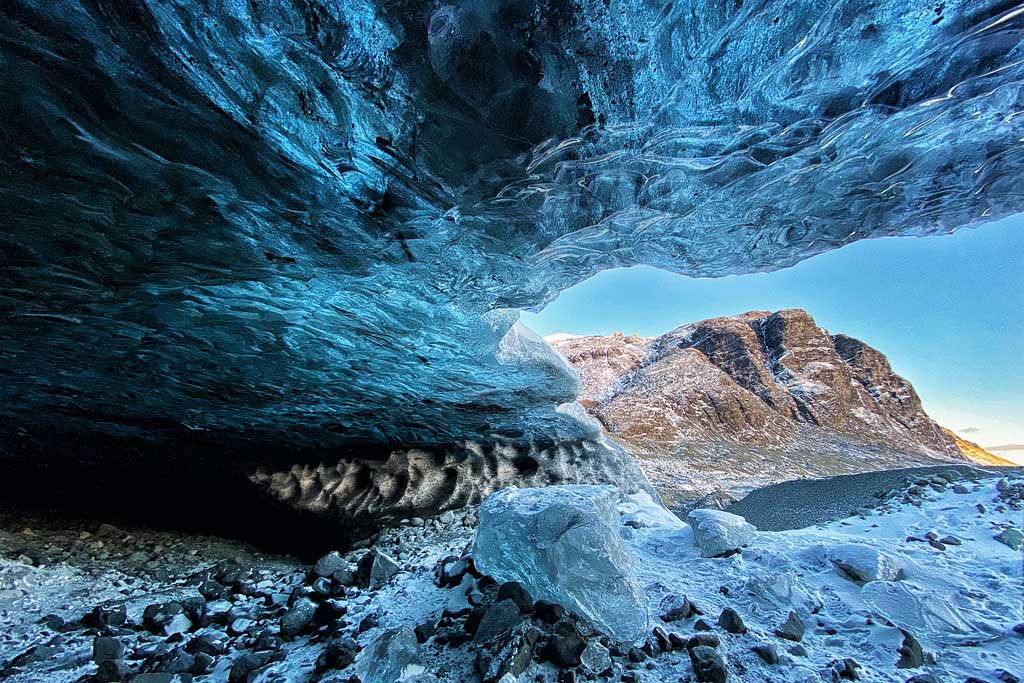
In Iceland, we can see an ice (or glacial) cave in several places, but the one here is by far the most beautiful and spectacular of them. If you are in the area in winter, this is not just a must – it is an absolute must-see!
Book your seats on the ice cave tour here: Jokulsarlon ice cave tour.
You can read more about this – and other – ice caves in a separate article: Icelandic ice caves – Iceland’s natural wonder.
Fjallsárlón — colorful spectacle brought to you by nature
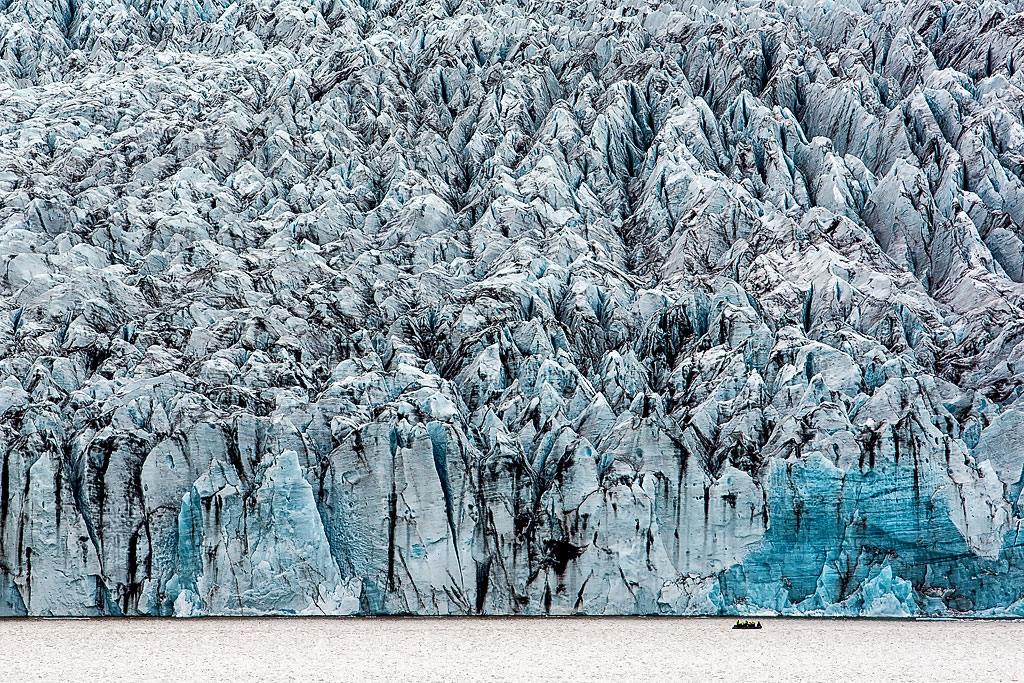
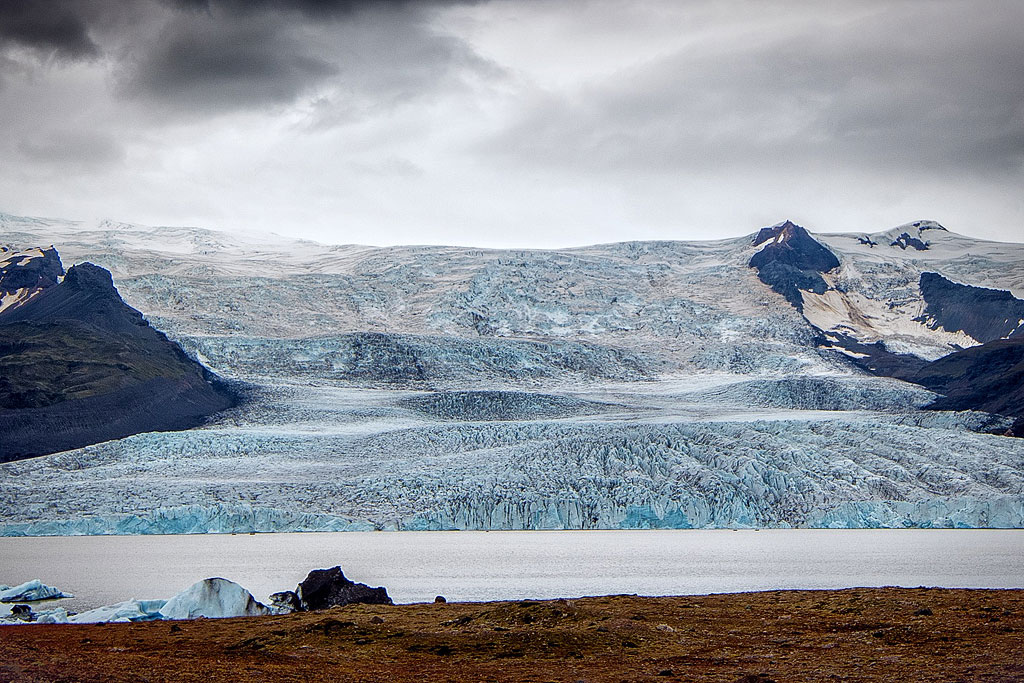 Fjallsarlon (Fjallsárlón) is a clearly smaller lagoon, approx. 10 km (6 mi) west from Jokulsarlon. It is unique in its own right because – although smaller than Jökulsárlón – Fjallsarlon gives you a better view of the edge of the glacier: the very place where icebergs separate to dive into the water. The glacier is rather far away – across the bay – but it is so huge that this perspective makes it even more impressive.
You can book a speed boat tour on the lagoon and appreciate the glacier front at hand’s reach. You join a larger group (it’s a 10-person boat) or rent the boat for yourself here: Book a Fjallsarlon Iceberg Boat Tour.

Practical tips
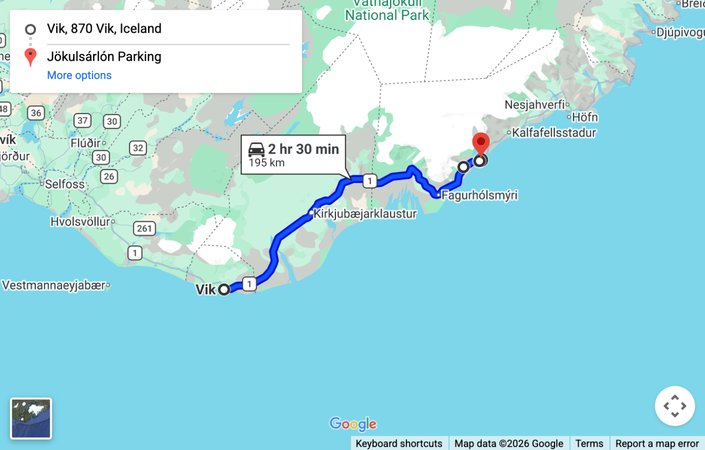
Map: driving route from Vik to Jokulsarlon — click to open the interactive map
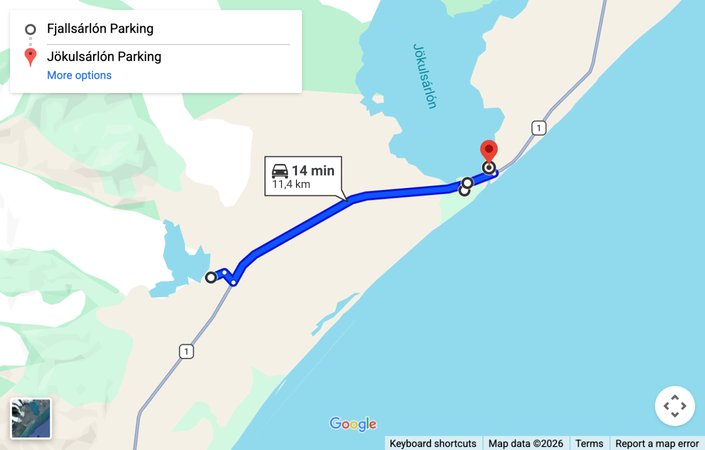
Map: driving route from Fjallsarlon to the Jokulsarlon parking — click to open the interactive map
- Both lagoons and the beach are situated off Route 1, about 200 km (125 mi) northeast of Vik and 80 km (50 mi) southwest of Hofn. Naturally, they are accessible all year round.
- Jokulsarlon and the Diamond Beach are practically in the same spot. The Fjallsarlon lagoon lies about 10 km (6 mi) away.
- Administratively this is already East Iceland, and as you continue eastwards you will encounter fewer and fewer tourists. All of the one-, two- and three-day trips from Reykjavik turn around here to go back to the capital.
- From May to September there are cruises on Jokulsarlon and Fjallsarlon, which let you see the icebergs and the glacier up close. They take from about 35 minutes to an hour. If you want to go, follow the links in the appropriate section above.
- Never, ever swim in the lagoon or try to climb the icebergs. This is extremely dangerous.
- Both lagoons have small cafeterias serving snacks, sandwiches, salads, soups and cakes, etc.
- The beauty of Jokulsarlon was not lost on the film industry. This place is featured in such films as Die Another Day, A View to a Kill, Tomb Raider and Interstellar.