


Iceland is not a car-obsessed country, and it shows in the numbers: it has the lowest road fatality rate in Europe, with just a handful of deaths on the roads in a typical year.
The rules themselves are simple and, by European standards, entirely conventional. What can surprise you is the price of breaking them.
The most important rules
You drive in Iceland on the driving licence issued in your country of residence, as long as it is in the Latin alphabet and carries your photograph. There is no need for an International Driving Permit. Iceland drives on the right.
- Basic speed limits:
- in town: 50 km/h (31 mph)
- outside towns, paved roads: 90 km/h (56 mph)
- gravel roads: 80 km/h (50 mph)
- towing a trailer: 80 km/h (50 mph)
- Using a hand-held phone while driving is prohibited.
- Seat belts are mandatory in the front and in the back.
- Dipped headlights are required around the clock, all year round. Daytime running lights do not meet this requirement – and Icelandic cars usually do not have them fitted anyway.
- You must not drive off the road. This matters most in the interior: it may feel like off-roading, but you still have to stay on the marked tracks.
- Motorcyclists must wear helmets.
- Cyclists must wear helmets until the age of 14.
Tolls and parking fees
There are no toll motorways in Iceland, but there is one toll tunnel: the Vadlaheidi tunnel on the eastern approach to Akureyri. A passenger car pays 2,216 ISK (about $18), under the price list valid from March 2, 2026. How to pay – and how to skip the tunnel on a prettier road – is covered in the linked article. The new stretch of road 1 across Hornafjörður in the southeast is tolled as well – 1,500 ISK (about $13) for a passenger car, paid at spolur.is.
Paid parking applies only to part of Reykjavik and costs 190 to 370 ISK an hour (roughly $2 to $3). The paid zones cover only the tight city centre, and you can see the city perfectly well parking just outside them – see Reykjavik by car.
You also pay for parking in Akureyri, and these days at almost every popular tourist attraction.
How much the fines cost
Iceland runs a penalty point system, like most of Europe, but points are of little concern to someone who is on the island for a week. The size of the fines is another matter.
Drink driving fines in Iceland
A driver stopped after drinking has their licence taken on the spot, and the fine comes with a driving ban of at least two months.
The penalty schedule was set in 2019 (Regulation 1240/2019) and is still in force today.
The legal threshold is 0.50 g/l of alcohol in the blood – that is 0.05 percent BAC – or 0.25 mg/l in breath. These limits are very much in line with most European countries, and notably stricter than the 0.08 percent that is the standard drink driving threshold across the United States (a few states set it lower).
The fine for driving with a blood alcohol level of 0.50-0.60 g/l is 90,000 ISK (about $750). It rises with the reading, up to 270,000 ISK (about $2,250) above 2.51 g/l, and the driving ban rises with it – from two months to three and a half years.
Breath tests and tests for drugs and other intoxicants follow the same structure and the same amounts. The details are in the regulation linked above.
Speeding fines in Iceland
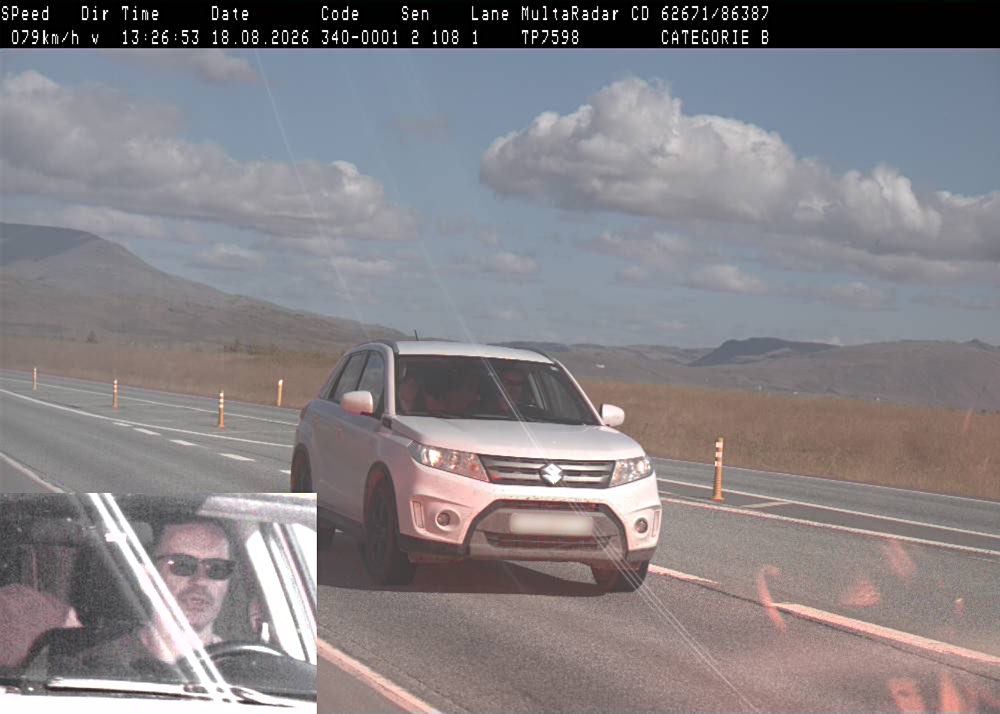
My own ticket: 79 km/h in a 70 zone. Taken from a police car, not from a fixed camera.
You pay the lowest fine if you exceed the limit by at least 9 km/h (about 6 mph), but in an area where the limit is under 90 km/h. That means in town, or on a stretch of road where the limit is posted on a sign – usually 70 or 80 km/h. In theory gravel roads fall into this category too, since the limit there is 80 km/h.
The minimum amount is 10,000 ISK (about $85). Pay within 30 days and it is reduced by 25%, so this particular fine drops to 7,500 ISK (about $65).
If the police stopped you, you can pay on the spot. If a camera caught you, the police will ask the rental company for your details and email you everything you need. You can pay by transfer or by card online. As is usual in Iceland: modern, quick and painless.
If the police decide, or are obliged, to bill the rental company rather than you directly, the rental company will add its own handling fee to whatever it then claims from you.
Fines for other traffic offences in Iceland
Many of the everyday offences carry flat-rate fines. These are the current amounts (2026):
- Hand-held phone while driving: 40,000 ISK (about $330) and a penalty point.
- Running a red light: 50,000 ISK (about $420) and two points.
- No seat belt: 20,000 ISK (about $165) for every passenger over 15.
- A passenger under 15 without a child seat or belt: 30,000 ISK (about $250).
- Ignoring a road sign or road marking: 20,000 ISK (about $165).
- Failing to give way at a give-way sign: 30,000 ISK (about $250) and a point.
- Snow or ice blocking the driver’s view: 20,000 ISK (about $165).
- Not carrying your licence: 10,000 ISK (about $85).
Source: the Icelandic police traffic fine calculator, checked 2 September 2026.
Parking tickets in Reykjavik are set by the city, not the police, and they grow if you forget about them. Parking without paying is 4,500 ISK (about $40), parking where you should not is 10,000 ISK (about $85), and taking a disabled bay is 20,000 ISK (about $165). Paying within three working days takes 1,100 ISK (about $9) off.
Other guides on driving in Iceland
Rules are one thing, the road surface is another. What the roads are actually like season by season, what the mountain F-roads demand and how to handle a river crossing is all in Road Conditions in Iceland.
Before you pick up the keys, it is worth reading Renting a Car in Iceland – what the different categories of car and camper really cost, and what they let you reach.
And if you want to know the roads themselves before you drive them, The Most Important Roads in Iceland walks through the ones that matter.