


Eldgjá, also known as the Fire Canyon, is a massive eruptive fissure of the Katla volcanic system. Its slopes are also home to the beautiful Ófaerufoss waterfall.
Eldgjá – a geological wonder of Iceland
Eldgjá is a unique natural phenomenon: raw, unspoiled, and a vivid illustration of the immense power of Icelandic nature. Together with the beautiful two-tier Ófærufoss waterfall, the Ófærá river flowing along its floor and the caves in its rock walls, it forms a picturesque landscape unlike any other place on the island.
Geologically, Eldgja is an eruptive fissure of the Katla volcanic system, whose main crater lies about 40 km (25 mi) to the southwest. Katla is one of Iceland’s more active volcanoes (more than 20 eruptions in 1,100 years), and it lies beneath the Mýrdalsjökull glacier, whose ice is up to 700 meters (2,300 ft) thick. The last Katla eruption to break through the ice was in 1918.
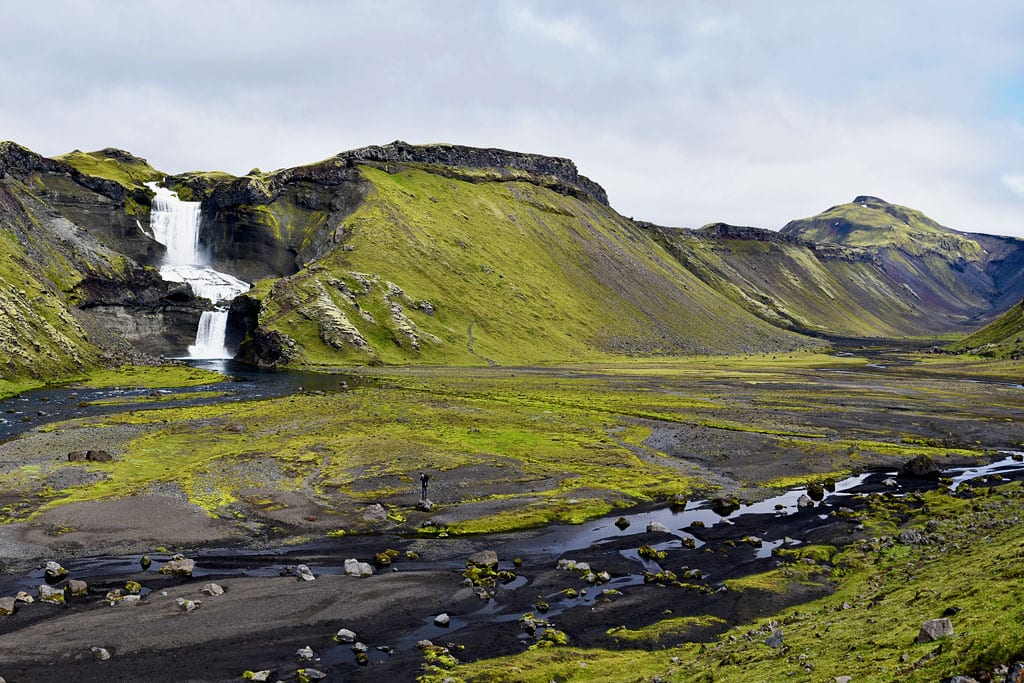
Eldgja and Ofaerufoss
Eldgja itself, on the other hand, although very long, is far less active: it has seen only 3 eruptions in the last 8,500 years. The last one, however (around 939), was truly powerful. It destroyed the barely established farms south of here and decimated the surrounding woodland. As much as 18 km3 (4.3 cu mi) of lava poured out of the fissure along a length of about 75 km (47 mi) (source: Catalogue of Icelandic Volcanoes). We describe this eruption in more detail in the article on Iceland’s largest volcanic eruptions.
The picturesque surroundings of Eldgjá, full of contrasts between islands of green moss and black and red soil, offer great hiking. If you are interested in a longer trek in the area, possibly all the way to the Laki crater row (Lakagígar), you should book a night at the Skælingar hut (16 places, run by the Útivist touring club) or at the campsite next to it.
Ófaerufoss – an impassable waterfall?
Ófaerufoss is a picturesque two-tier waterfall on the river Ófærá (Nyrðri-Ófæra), which flows into the Eldgjá canyon here.
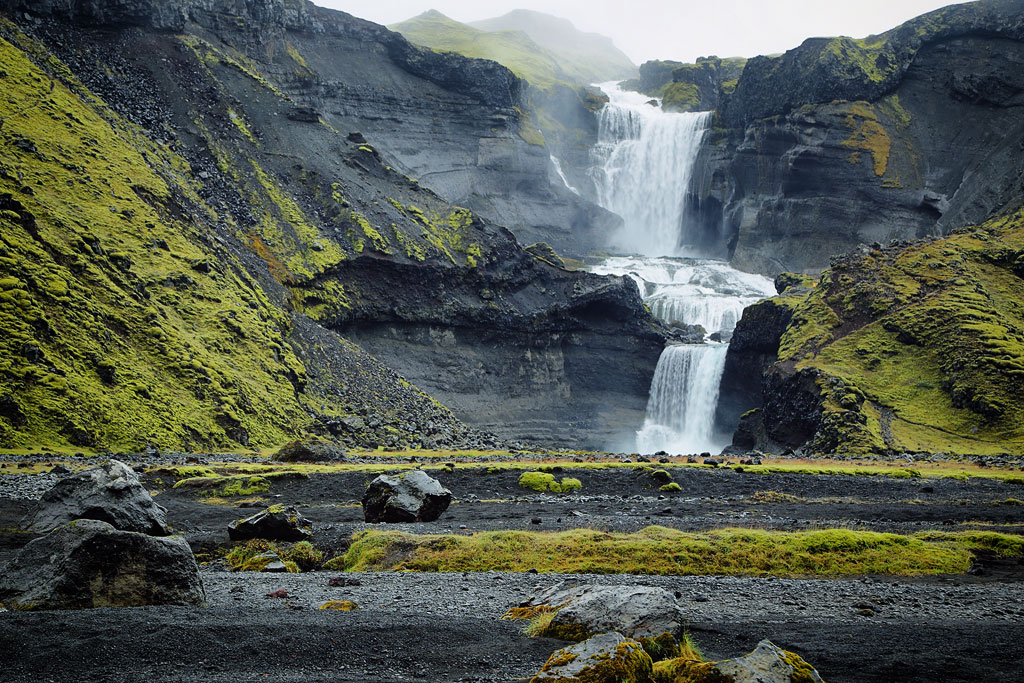
Ofaerufoss waterfall
The waterfall takes its name from the river that forms it – Ofaera (Icelandic: Ófærá). In Icelandic the name means something impassable, impossible to cross or get past. For the river, the name makes perfect sense. “Impassable waterfall”, however, sounds a bit odd 🙂 All the more so because, until 1993, the waterfall’s hallmark was a natural rock bridge spanning the lower cascade – was that impassable too? Erosion, combined with the frequent small earthquakes here, eventually brought the bridge down.
How to get to Eldgja and Ofaerufoss
The Eldgja canyon lies in the southern part of the Icelandic interior, about 20 km (12 mi) east of Landmannalaugar and 35 km (22 mi) northwest of Kirkjubaejarklaustur (ah, those Icelandic names, eh? 🙂 ). The canyon belongs to Vatnajökull National Park, and in summer park rangers are on site during the day.
Eldgjá is therefore only accessible while the mountain roads are open, F208 in particular. The southern section of this road, from the Skaftártunga district (about 20 km / 12 mi southwest of Kirkjubaejarklaustur), is usually open from mid-June to mid-September (current conditions and opening dates: umferdin.is). The entrance from the north, from Landmannalaugar and Hrauneyjar, usually opens about 2 weeks later.
Naturally, you need a 4×4 to reach Eldgja. The road to the canyon is rough and crossed by rivers in quite a few places. They are not deep, but take care not to get your car stuck in the soft bottom. The turnoff to the parking lot is about 3 km (2 mi) southeast of the junction of F208 and F235 (the road to the beautifully situated Langisjór campsite).
From the parking lot a path of about 1.5 km (1 mi) leads to the Ófaerufoss waterfall (trail E1 in the park’s trail description). You can also follow it farther into the Eldgja canyon, although you can already see the canyon very well from around the waterfall. Because rivers in Iceland are so unpredictable, the trail often disappears, washed away by the waters of the Ófærá. Even so, in summer getting to the waterfall is no problem.