


The black wooden church of Búðakirkja stands in Búðir, a hamlet that was once a busy trading post. It is known for its exceptionally pleasing appearance and its rather unusual history.
Búðir Church, or Budakirkja
Only small white accents – the doors and windows – stand out against the uniformly black body of the church. Búðakirkja is a protected parish church, owned and looked after by the local parish (according to Náttúruverndarstofnun, the Icelandic agency that manages the Búðahraun nature reserve).
The minimalist but very distinctive shape contrasts wonderfully with the sky and the mountain peaks in the distance. It almost looks as if Budakirkja had fallen from the sky… No wonder it draws not only photographers, but also couples planning their wedding and reception.
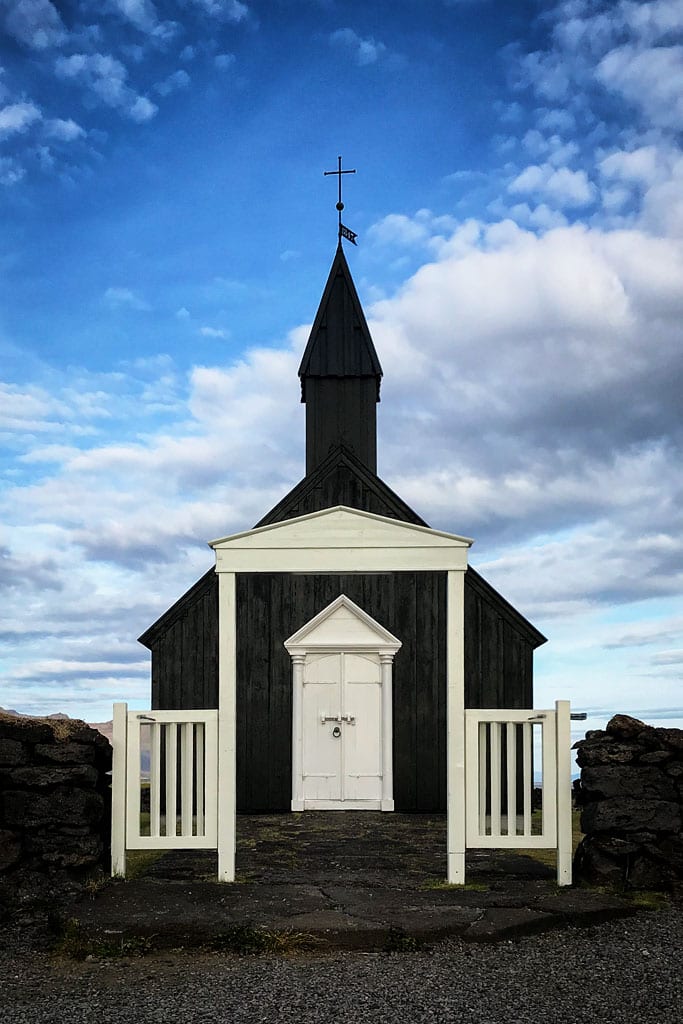
Budakirkja Church
The church also has a rather unusual history. The first church here was built in 1703, by Bent Lárusson. Unfortunately, it later fell into ruin, and in 1816 the local parish was abolished. One of the parishioners, however – Steinunn Sveinsdottir – made it her goal to rebuild the church or put up a new one here (legend has it that Bent Lárusson himself asked her to do so in a dream). Her requests were turned down by the leaders of the Church of Iceland (a Lutheran church), and she only got permission to build at the royal court, in 1848. That’s why the church’s door knocker bears a rather unusual inscription. The church was finished in 1848, but it was not consecrated until 1851. Steinunn, unsurprisingly, was buried in the churchyard. In 1984-87 the church was reconstructed and rededicated: it was moved in one piece from the old churchyard onto a new foundation and restored to the way it is believed to have looked in 1848.
The church has historic furnishings: a bell from 1672, a knocker from 1703 (with that unusual inscription), and an altar, a silver chalice and two candlesticks from the mid-18th century.
“This church was built in 1848 without the support of the clergy.”
The hamlet of Búðir
Búðir, where the church stands, is a small hamlet on the southern coast of the western part of the Snæfellsnes peninsula. Once a prosperous fishing village and one of the busiest trading places on Snæfellsnes, today it lives mainly off tourism. Eyrbyggja saga already mentions its harbor, Hraunhafnarós (today Búðaós), as a trading place, and the 1703 census lists about 100 people living here.
Búðir lies within the Búðahraun lava field. It stretches east of the village along the shore of Faxaflói Bay, and west to the Hraunlandarif reef. The lava flowed 5,000-8,000 years ago from the 88 m (290 ft) high volcanic crater Búðaklettur, in the middle of the field. An opening on its southwest side leads into the 382 m (1,250 ft) long Búðahellir cave.
Búðahraun is famous for its rich plant life: some 130 plant species grow here, including rare and protected ones, as well as 11 of the 16 fern species known in Iceland. The eastern part of the lava field has been an official nature reserve since 1977.
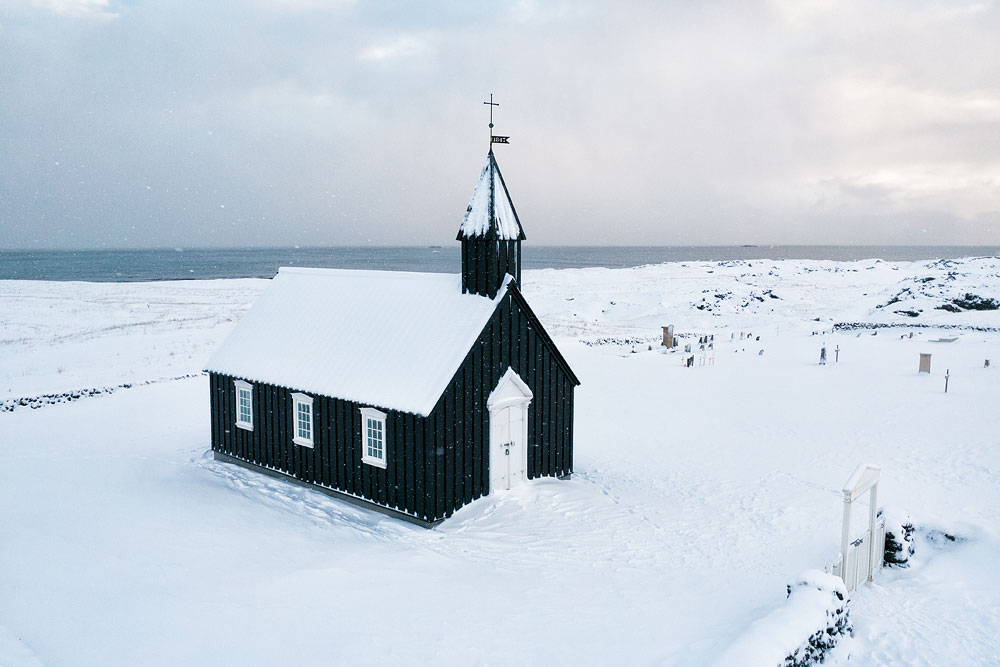
Budakirkja in winter
How to get to Budakirkja Church
Budir lies only about 2 km (1.2 miles) south of the junction where road 574, which circles the westernmost part of Snaefellsnes, meets road 54, the peninsula’s main road. The church is reached by the short side road 5723 (Búðavegur), which branches off road 574.
It’s about 20 km (12 miles) northeast of Arnarstapi and about 40 km (25 miles) south of Grundarfjordur (in a straight line, only about 12 km / 7.5 miles).
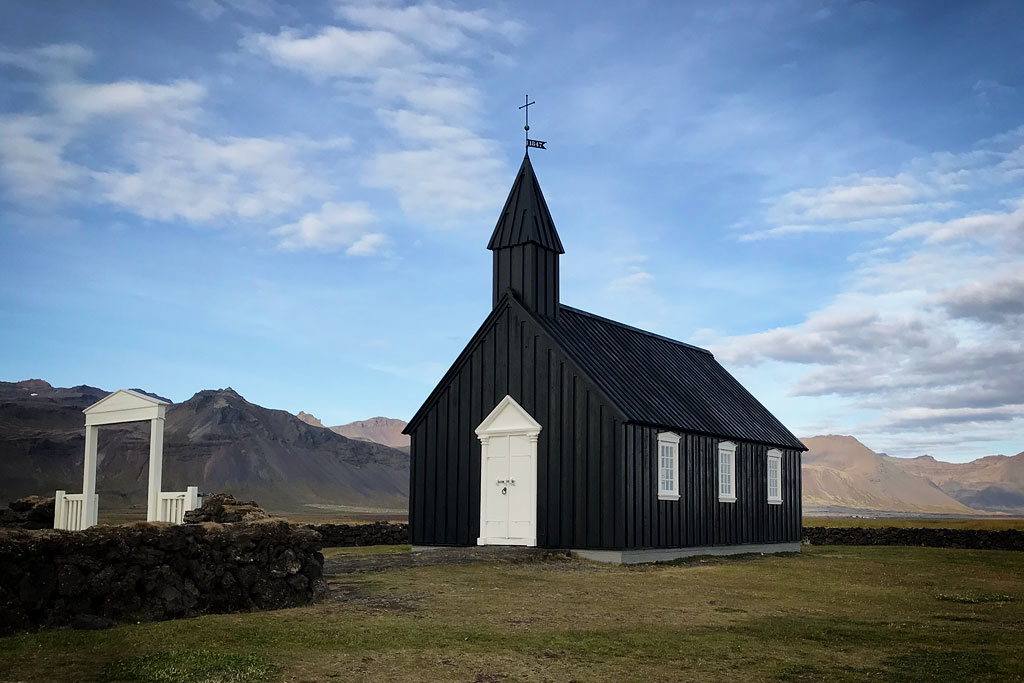
Budakirkja Church