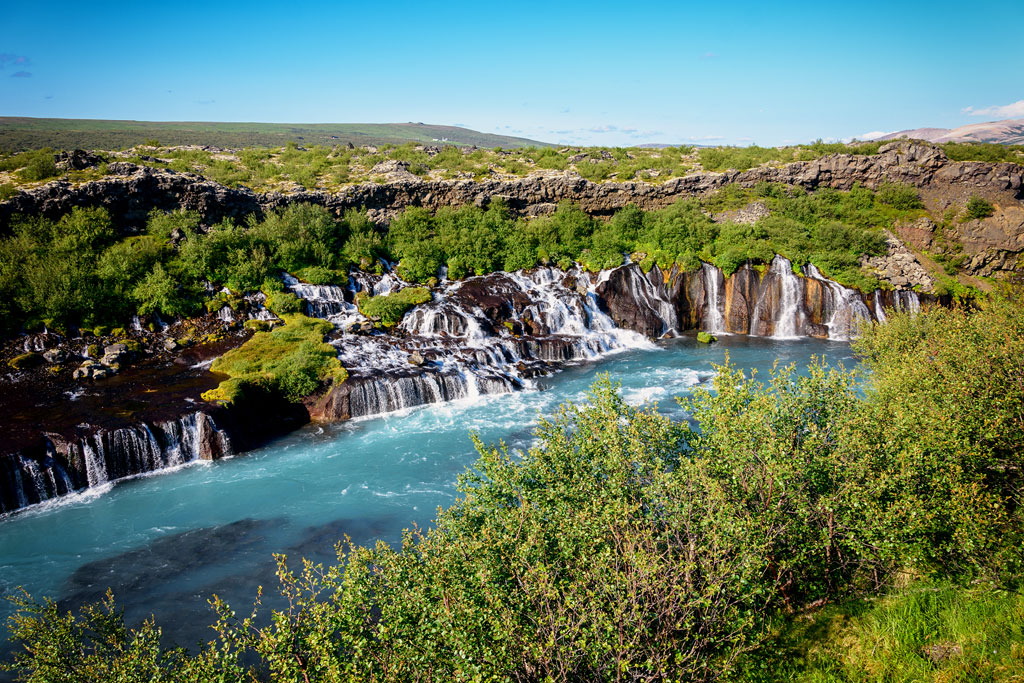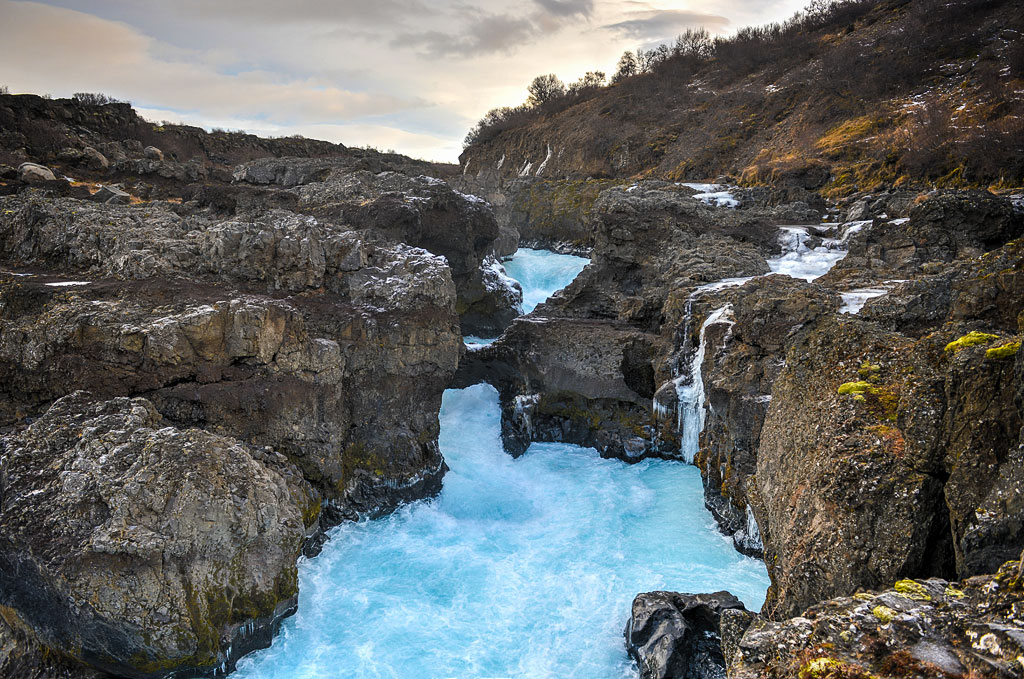


Hraunfossar stands out for its unusual geological structure. The name Barnafoss, on the other hand, is associated with rather unusual events of the past. This is a very interesting, although intimate, pair of waterfalls.
Hraunfossar – Iceland’s most interesting waterfall?
Hraunfossar is actually a group, or rather a series of waterfalls. That is why its name is usually used in the plural – Hraunfossar, instead of Hraunfoss. Although it is not particularly tall, there is no denying its beauty, and it is certainly unusual, thanks to its unique structure. It also made our list of the most spectacular waterfalls in Iceland.
The thing is that this waterfall is not formed by a stream running over the surface of the ground and dropping from a rock step, as is usually the case. Here the waterfall is fed by underground water that comes to the surface halfway up the wall of the ravine, which is quite unusual. The name of the waterfall comes from the same thing: its water flows out from under, or from between, layers of lava. Hraunfossar means “lava waterfalls.” The picturesque cascades run down the slope into the Hvítá River along a stretch of about 900 meters (3,000 feet).
The lava field through which the water of Hraunfossar makes its way, Hallmundarhraun, is the result of an eruption of one of the volcanoes that lie under the nearby Langjökull glacier, the second largest glacier in Iceland.
Barnafoss – Children’s Waterfall
Barnafoss waterfall forms a cascade of several steps with a total height of 9 meters (about 30 feet). It is very pretty and has an interesting structure, but in the reality of Iceland – well, it is an average, ordinary waterfall. What is interesting, however, is the legend associated with its name.
The name of the Barnafoss waterfall literally means Children’s Waterfall. Associated with its origin is a legend about children whose parents supposedly left them at home when they themselves went to church for Christmas mass. Why the parents left the children at home – the legend does not explain. In any case, when the parents returned home, they did not find their children in the house. The tracks left by the children were said to end at a damaged natural stone bridge just above this waterfall. The distraught parents concluded that the children had fallen into the waterfall, so the mother put a curse on the bridge and had it brought down completely, so that no one else would fall off it into the water.
Of course, another version states that natural stone bridges are vulnerable to earthquakes, which are common in Iceland, and collapse from completely natural causes…
How it really was – it is hard to say 😉 but it is certainly interesting that the legend associated with this place does not mention trolls at all, and this is a real rarity among Icelandic legends 🙂
Practical information
- The falls are located on road 518, north of Reykjavik, in the Kalmanstunga region, about 5 km (3 miles) west of the village of Husafell and 15 km (9 miles) east of Reykholt. When driving here, turn off Route 1 onto Route 50 and then 518, which is about 125 km (78 miles) and almost a 2-hour drive from Reykjavík.
- Both waterfalls are “served” by a common parking lot, at which there is also a restaurant with a gift shop and public toilets, which are paid.
- The waterfalls can be viewed from vantage points, and Barnafoss can also be viewed from a footbridge built over the waterfall (said to be spell-proof). The total length of the path to both waterfalls is about 500 meters (1,600 feet), so they are really close to each other and close to the parking lot.
- Part of the site can be visited in a wheelchair, the trails are marked and the viewpoints laid out, and there is an information board by the parking lot. The area is open all year round and has a ranger on duty.
Other attractions near Hraunfossar and Barnafoss
There are several other really “top” attractions near the waterfalls.
- First and foremost are Iceland’s largest lava caves – Vidgelmir – Iceland’s most popular cave and Surtshellir – a great lava cave for free.
- A little farther west you will find Deildartunguhver, the hot spring with the highest flow of water in Europe, and the SPA Krauma built right next to it.
- A little further on – already on Road 1 – we can enter the small but very picturesque Grabrok – volcanic crater surrounded by houses.