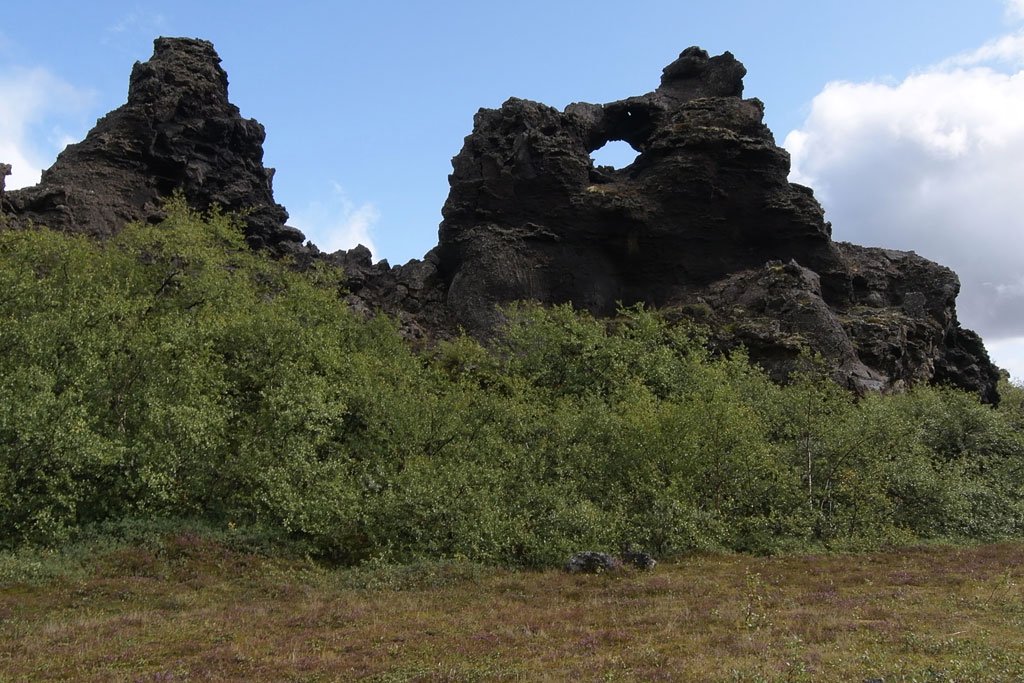
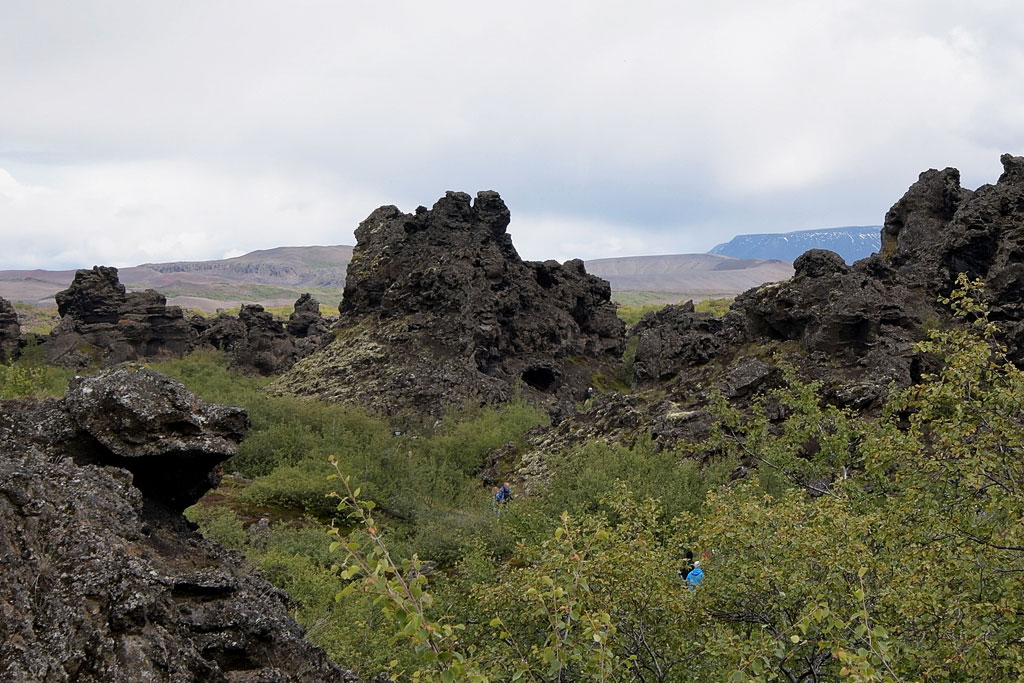
Dimmuborgir, also known as the Black Fortress, is a large area of strangely shaped lava formations on the eastern side of Mývatn. Lava pillars like these are said to be found nowhere else in the world except…the ocean floor off Mexico. If you are anywhere nearby, this gem really is worth seeing.
How Dimmuborgir formed
Dimmuborgir formed in an eruption that took place here 2,300 years ago, from the Threngslaborgir-Ludentarborgir row of craters about 10 km (6 mi) to the southwest. Lava from that eruption covered the entire Myvatn region, and its encounter with the lake water created all the most interesting geological formations around the lake.
At Dimmuborgir an obstruction in the flow trapped molten rock under a solidified crust, and a round lava pond about 2 km (1.2 mi) across and some 20 m (65 ft) high built up. Steam rising through the pond chilled the lava into pillars, and when the melt finally drained away westward – the rest of the flow reached the sea to the north – the pillars were left standing (Náttúruverndarstofnun).
The result is a maze of rock shapes that really does look like an ancient collapsed citadel. Unusual lava caves formed here as well, some of them large enough to hold several people; the best known is Kirkjan, the Church, a tall lava arch at the far end of the longest loop.
You can read more about the formation of Dimmuborgir and other unusual landforms around Lake Myvatn in the Geological history of the Myvatn region.
Where I book my own Iceland trips
Best Iceland deals
Selected partner sites, best prices
Exploring Dimmuborgir
Video: the Dimmuborgir lava field.
With a fairy-tale look straight out of another world, Dimmuborgir is one of the most visited places in Iceland. Filmmakers have used its dark scenery too, shooting episodes of Game of Thrones on the site (Dimmuborgir stands in for Mance Rayder’s camp), which brought the place even more popularity.
That is why several walking trails have been marked out here, to protect the site. Sticking to them helps preserve this unique place and removes the risk of getting lost – many of the lava formations look identical, and it is sometimes hard to shake the feeling that we have been here before.

Dimmuborgir – map of trails
The loops range from 600 to 1,600 meters (2,000 to 5,200 feet), and walking all of them adds up to almost 4 km (2.5 mi). Mývatnsstofa counts them in minutes rather than meters: 10 to 15 for the little loop, about 30 for the big one and about an hour for the Church loop, which runs deepest into the lava. The nicest walk is probably the yellow route combined with the red and blue ones – about 2 km (1.2 mi) in all, and even with frequent stops it should not take more than an hour.
If you are not tied to the car, or can send the driver round separately, it is also worth walking on to the nearby volcano Hverfjall. That is about half an hour through very interesting terrain.
How to get to Dimmuborgir
Dimmuborgir lies on the eastern shore of Lake Myvatn. From Route 1 turn onto Road 848; between the volcano Hverfjall and the rock pillars of Hofdi / Gud fingur a clearly marked turn-off leads to the Dimmuborgir parking lot, at the end of a paved road from the farms at Geiteyjarströnd.
The parking lot at the lava field is large, but often very crowded, tour buses included.
Next to it stands a small service building with a restaurant, restrooms and a gift shop, and in summer the rangers based at Myvatn run guided walks here every day.