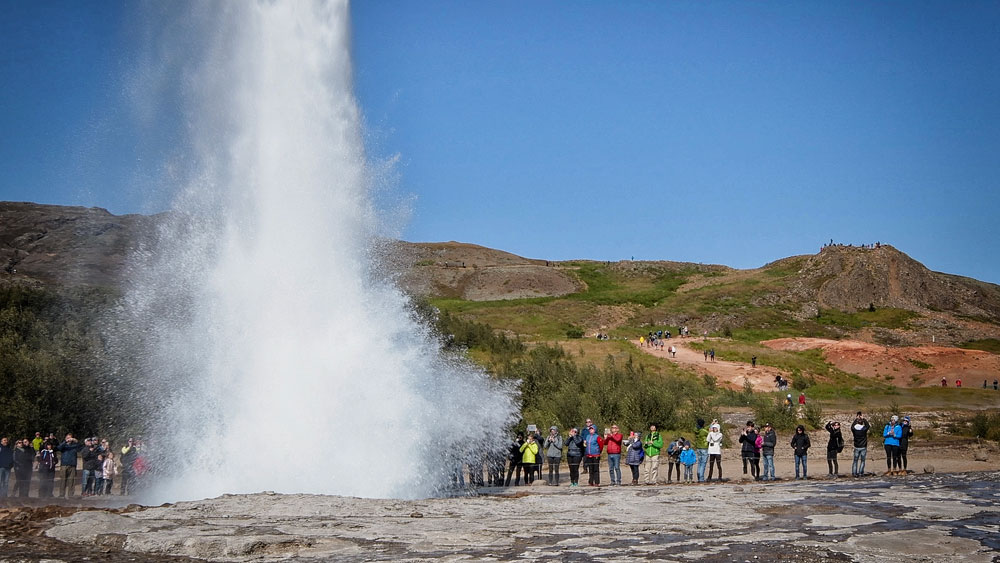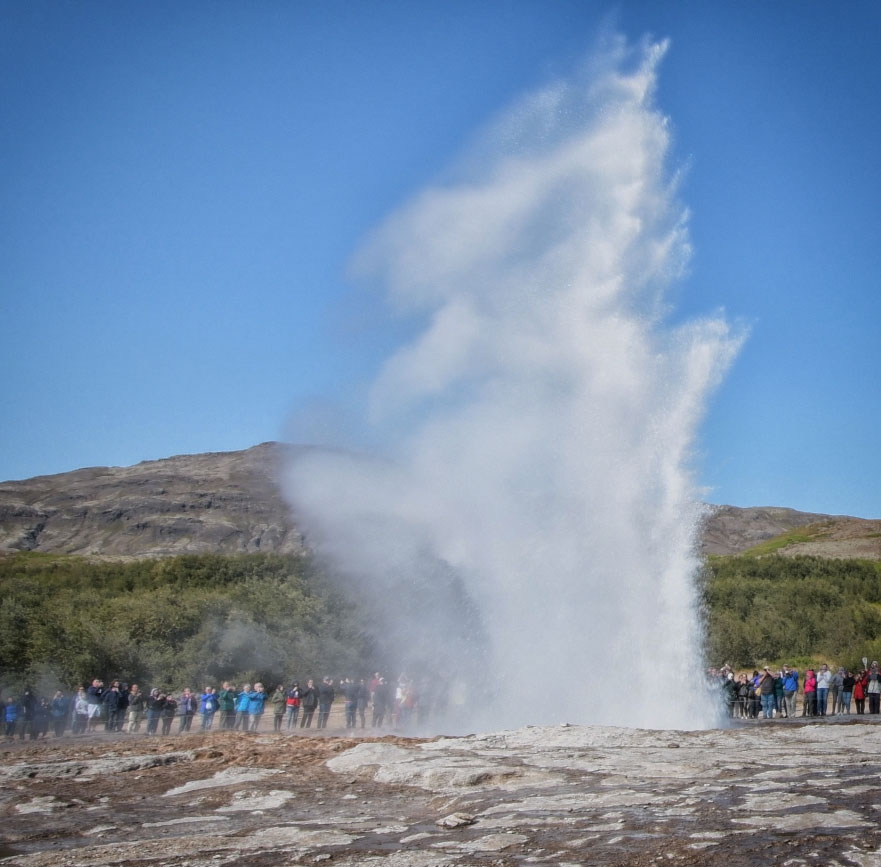


Strokkur is the most visited active geyser in Iceland and one of the three main attractions, along with Gullfoss Waterfall and Þingvellir National Park on the famed Golden Circle route.
The main attraction of the Geysir Geothermal Area
Strokkur lies within the small Geysir Geothermal Area. The place takes its name from a neighboring geyser – Geysir – which is where the name “geyser” comes from. However, Geysir itself erupts very rarely and irregularly, so although its eruptions are much larger, it is Strokkur that “steals the show.” Strokkur also erupts quite high, and in return it does so very regularly and often. Usually every five to ten minutes, although the geyser keeps no timetable: its eruptions differ in height, in length and in the gaps between them. So during a short visit here you can see several of them…
Video: See how Strokkur explodes.
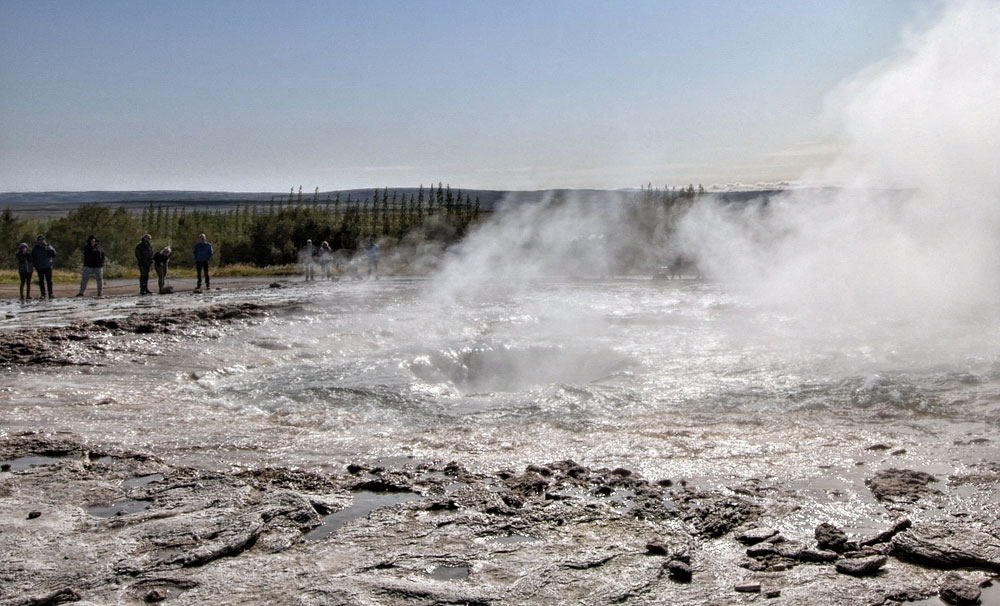
The surroundings of Strokkur are naturally beautiful and shaped by the forces of the earth: full of fumaroles, hot springs, mud pots and small geysers. Thanks to its mineral content, the ground here takes on picturesque colors of yellow (sulfur), green (copper) and red (iron). Here you will of course find Geysir itself, but also Blesi and other smaller springs.
How geysers work
Active geysers such as Strokkur are a rarity in the world. Several conditions have to come together before one can exist. The first is an intense source of heat – the magma must lie close enough to the surface for the rock to boil water. The second is a supply of underground water. In the case of Strokkur it comes from the country’s second-largest glacier, Langjökull. Meltwater from the glacier seeps into the surrounding porous lava rock and flows underground in all directions. And for a geyser to erupt, an intricate “hydraulic” system is needed as well, one that stops the heated water from escaping gradually and calmly (then it would simply form a hot spring, like many in Iceland).
You can read more about how geysers form and work thanks to volcanoes in the article Stunning effects of Iceland’s volcanism.
Strokkur – tips and practical information
- Strokkur erupts regularly, throwing water 15 to 20 m (50 to 65 ft) into the air every five to ten minutes.
- If you plan to visit Strokkur, take a hat with you to protect your head from the sun (there is no shade in the area). In winter, take gloves with you to protect your hands from the wind and low temperatures (especially if you want to take photos).
- The temperature at the surface of the geyser varies a great deal, which affects the conditions in its immediate vicinity.
- At a depth of 1 m (3 ft) the water is close to boiling, 90-95 °C (194-203°F); at 10 m (33 ft) it is 112 °C (234°F), and at the bottom, 23 m (75 ft) down, about 130 °C (266°F) – measurements: Vísindavefur. This is no mistake; the record hot spring in Iceland at depth, and so under immense pressure, sometimes heats up to 150 °C (302°F)!
- Across from the main geothermal area in the Haukadalur valley there is a restaurant, a café, a hotel, a gift shop and an N1 gas station.
How to get to Strokkur
Strokkur, along with several other geysers, is located in the Geysir Geothermal Area, in the Haukadalur Valley. It’s just off Road 35, in the northern part of the so-called Golden Circle, east of Reykjavik and north of the village of Fludir.
There is a convenient, large parking lot for coaches on Road 35, but if you’re traveling in a smaller vehicle, you can turn onto the smaller F333 road to the north and drive up to the parking lot located almost next to the geysers themselves.
Parking at Geysir is paid: 1,080 ISK (about $9) for a car with up to 7 seats, 400 ISK (about $3) for a motorcycle and from 2,500 ISK ($21) to 8,700 ISK ($70) for buses, for a stay of up to eight hours, plus an 89 ISK (about $0.75) transaction fee; restrooms are included in the price. The fee is charged by license plate and can be paid up to 24 hours after you leave – if you do not pay, an extra 1,490 ISK (about $12) is added. The lot is open around the clock, but spending the night there is strictly forbidden (prices September 2026, Parka).