


Hjörleifshöfði (Hjorleifshofdi, literally “Hjörleifur’s Headland”) is a 221-meter (725 ft) hill on the edge of the Mýrdalssandur sand plain, east of Vík. Inside it lies a cave known today as Yoda’s Cave.
Yoda’s Cave
Hjorleifshofdi is a small hill, but the cave inside it is quite spacious. Its Icelandic name is Gígjagjá, from a legend about a sea monster – a woman under a spell – that lived in the cave (source: Viking Park). The echo inside is strong, but the most distinctive feature is the entrance, which looks truly out of this world.
Many people say that the entrance, seen from inside, faithfully traces the outline of Yoda from Star Wars. Which, as you can easily guess, gave the cave its modern tourist name.
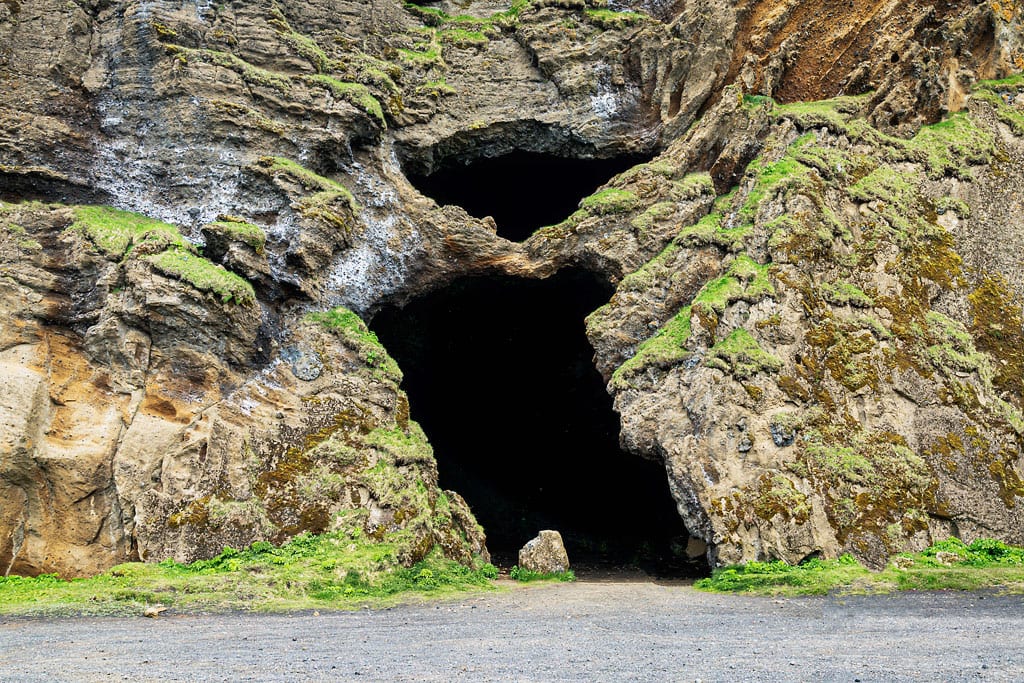
The entrance to Yoda’s Cave seen from outside
Hjorleifshofdi Mountain
The hill is a tuya – a steep-sided, flat-topped volcano made of tuff, formed by an eruption under the glacier in the latter part of the last ice age (source: Katla Geopark). Interestingly, it was probably an island for many years. It was only joined to the mainland around the time the first settlers arrived, when a fjord called Kerlingarfjörður still reached its foot (source: Visit South Iceland).
The hill is named after the settler Hjörleifur Hróðmarsson, foster brother of Ingólfur Arnarson, the first settler of Iceland. The two sailed from Norway in 874: Ingólfur settled where Reykjavik stands today, and Hjörleifur here, by the fjord at the foot of the headland. The very next spring, Hjörleifur and his men were killed by the Irish slaves he had brought with him. His burial mound is said to lie on top of the hill (source: Viking Park).
A farm stood on the southern side of the hill until 1936 – it had been moved there after the Katla eruption of 1721 (source: Visit South Iceland).
The picturesque, though harsh surroundings of the Hjorleifshofdi rock are great for hiking. Those looking for a bit more adventure can also try climbing to the top, where the burial mound is and the views open up in every direction.
Hjorleifshofdi Cave – tips and practical information
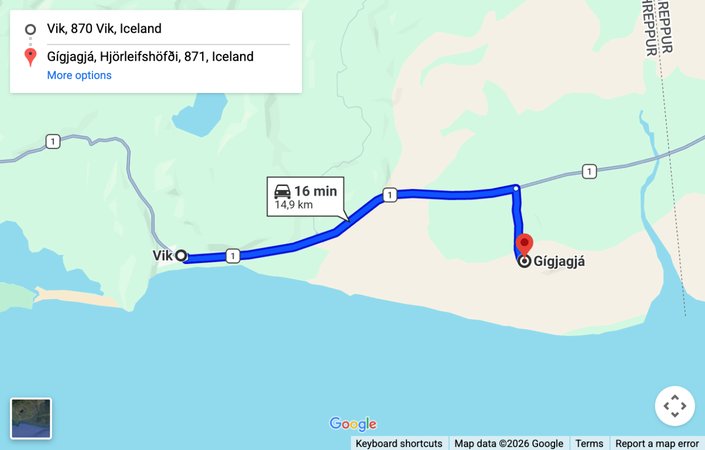
Map: driving route from Vik to the Hjorleifshofdi cave — click to open the interactive map
- The cave is in the western part of Mýrdalssandur, a vast sand plain east of Vík.
- The access road to the cave branches off Road 1 about 12 km (7.5 miles) east of the town. It takes you (about 2 km, 1.2 miles) right up to the cave. The road is gravel, but a car without 4×4 can handle it too.
- Parking is paid. The land is privately owned and run as Viking Park: a regular car costs 1,400 ISK (about $12) for the day (valid until midnight), larger vehicles 2,500 or 6,400 ISK (about $21 or $55). The easiest way to pay is the EasyPark app (zone 870, Viking Park – Sannir Landvættir), which adds a 210 ISK (about $2) service fee; you can also use the AutoPay app or the QR code on the signs. If you don’t pay on the same day, a 4,500 ISK (about $40) surcharge is added (source: Sannir, prices September 2026).
- The cave is accessible all year round. In winter, icicles often form inside and puddles freeze. Such conditions give the place a unique atmosphere and… look great in photos.
- A visit to Yoda’s Cave is a treat for Star Wars fans. Not only because of the distinctive shape of its entrance, but also because the opening scenes of Rogue One were filmed on the sands in front of the cave.