


On September 19, a polar bear was spotted on Iceland’s West Fjords peninsula. In all likelihood, it had arrived on an iceberg from nearby Greenland. Unfortunately, in line with Icelandic procedures, the animal was shot.
Polar bear spotted in the West Fjords
Information about the sighting of a bear roaming among buildings on the coast of the Jökulfirðir fjord in the northern part of the West Fjords was given to police and the Coast Guard by the owner of a nearby vacation home. Jökulfirðir lies north of the town of Ísafjörður and south of the coast of the Hornstrandir Nature Reserve.
These are some of the most sparsely inhabited areas of Iceland, so it is not out of the question that the animal has been in the area for a bit longer. In recent days, an increased number of icebergs have been observed in the waters surrounding the West Fjords, some of which were unusually large. According to eyewitness accounts, they could reach up to 30 meters in height. It is on such icebergs that polar bears reach Iceland.
Where I book my own Iceland trips
Best Iceland deals
Selected partner sites, best prices
Icelandic police shoot polar bear
Unfortunately, polar bears that drift all the way to Iceland have no happy ending ahead of them. In 2008, after another polar bear visit, the Icelandic Minister for the Environment set up a special working group to develop rules for the treatment of polar bears reaching Iceland. The group was made up of specialists and representatives of the Ministry for the Environment, the Environment Agency of Iceland, the Icelandic Institute of Natural History, the Icelandic Food and Veterinary Authority, and the Icelandic Police and Coast Guard.
According to the group’s recommendations, polar bears that reach Iceland should be shot. This is what happened on September 20, 2024 with the aforementioned bear spotted on the coast of Jökulfirðir. The reasons why Iceland has adopted such a ruthless policy towards polar bears are several. First of all, the Icelandic environment does not provide polar bears with natural conditions for survival [source: ni.is]. There is neither enough ice and seals for them to hunt (on average, a polar bear needs more than 40 seals to survive a year [source: Gdansk Zoo]), nor good conditions for reproduction. So it is also impossible to create a convenient natural reserve for them. Left to its own devices, the bear would be doomed to a slow death by starvation, or it would have to find and plunder human garbage cans. In the autumn it could try to hunt sheep, but it would probably not survive the winter. Trapping and taking the animal back to Greenland would not only be very expensive, it is also forbidden by Greenlandic (and Danish) law. On the one hand, the aim is to protect the local population from diseases that could be brought in from elsewhere; on the other, according to a study by Greenlandic scientists, the polar bear population in eastern Greenland is doing so well that the loss of individual bears poses no threat to it.
Taking all these considerations into account, a rule was adopted in 2008 to cull bears that reach Iceland.
And this is what happened to the bear that arrived in Iceland in the last days, in September 2024. After consulting the Ministry for the Environment, police marksmen shot the animal, and the Coast Guard took its body to the Icelandic Institute of Natural History.
Iceland’s first polar bear in 10 years
Polar bears are not natural inhabitants of Iceland. They do not have good conditions here either for hunting or breeding. However, favorable conditions for them are found in Greenland. And although the two countries are separated by 300 km (190 mi) of the Denmark Strait, a stray polar bear sometimes makes its way from one to the other on ice floes and icebergs. Polar bears naturally travel long distances in search of food. They often hunt seals on the edge of the Greenland ice sheet. When they “miss” a good time to return to the mainland, they drift with the ice floe or iceberg to the open ocean and, with a bit of “luck,” can end up in Iceland, for example. According to the Icelandic Institute of Natural History, a total of as many as 600 cases of such “visits” to Iceland by polar bears have been recorded in historical times. As recently as the second half of the 20th century, this happened at least once every 2 years, in the first half of the 20th century at least once a year, and by the end of the 19th century an average more than 4 times a year!
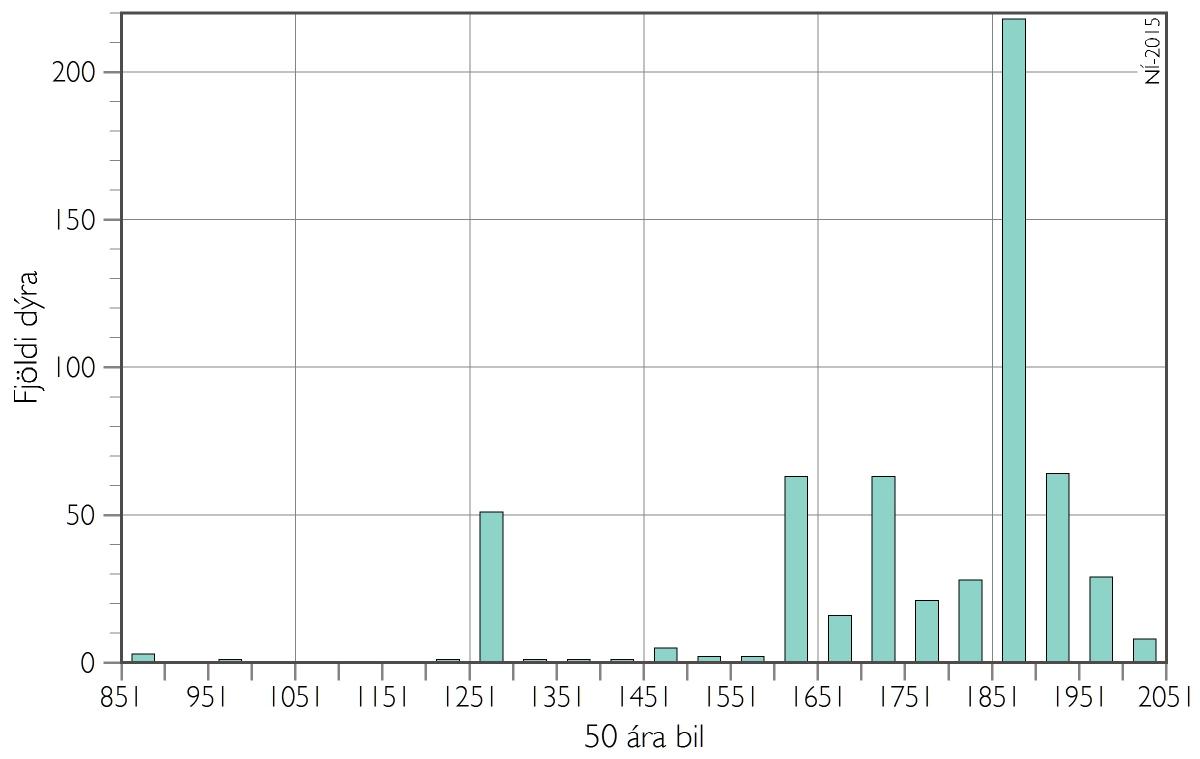
Chart: How many polar bears visit Iceland
source: Icelandic Institute of Natural History
In the current century, Iceland has been “visited” by only 6 bears: in 2008 (two animals), 2010, 2011, 2016 and the latest one in 2024. So the number of animals reaching Iceland is clearly declining, even though in the old days a bear was more likely to arrive unnoticed, or to be seen but never recorded [photo in article header: Gdansk Zoo;
photos in article: West Fjords Police (Lögreglan á Vestfjörðum)]